Wayground logo

Free Printable Worksheets

Font size

S
M
L
XL
Worksheets

APES Air Pollution

Total questions: 61

Worksheet time: 53mins

Name
Class
Date
1.

Which below can be considered an air pollutant?

a)

chemicals

b)

particulates

c)

microbes

d)

odorless gases

e)

all of these

2.

Which is NOT a source of SO2?

a)

combustion of fossil fuels

b)

volcanic eruptions

c)

forest fires

d)

lightning

e)

none of these are sources of SO2

3.

78% of the Earth's atmosphere is made up of

a)

H2O

b)

SO2

c)

N2

d)

CO2

e)

Ar

4.

Which below is considered an air pollutant?

a)

stratospheric ozone

b)

tropospheric ozone

c)

exospheric ozone

d)

mesospheric ozone

e)

thermospheric ozone

5.

What is TRUE of carbon monoxide?

a)

It is CO2

b)

It is an odorless gas

c)

It has a purple color

d)

It is the product of complete combustion

e)

None of these are true

6.

Which is false of carbon dioxide?

a)

It is CO2

b)

It is colorless

c)

It is odorless

d)

It is a greenhouse gas

e)

It is the product of photosynthesis

7.

Which below is a source of particulate matter?

a)

burning wood

b)

dust from gravel roads

c)

volcanoes

d)

forest fires

e)

all of these are sources of particulate matter

8.

Which below is NOT a result of particulate matter in the air?

a)

lung damage

b)

reduced air temperature

c)

reduced photosynthesis

d)

haze

e)

all of these are the result of airborne particulates

9.

Photochemical smog results from a reaction between

a)

nitrogen, oxygen and sunlight

b)

nitrogen, carbon and sunlight

c)

oxygen, water and lead

d)

sunlight, sulfur and carbon

e)

carbon, hydrogen, and methane

10.

Wind turbines are a source of air pollution

a)

True

b)

False

11.

Volcanic eruptions can be sources of air pollution

a)

True

b)

False

12.
What are the pollutants known to cause acid rain?
a)
nitrogen oxides and sulfur dioxide (sulfur compounds)
b)
Low pH and Acid
c)
Lemon Juice and Battery Acid
d)
Particulate Matter and Carbon Dioxide
13.

Smog or ground ozone forms in the troposphere. Which pollutants are most responsible for smog or ground ozone?

a)

sulfur and particulate matter

b)

volatile organic compounds and nitrogen oxides

c)

carbon monoxide and carbon dioxide

d)

none of these answers are correct

14.
CFC's cause harm to our 
a)
Troposphere
b)
Inversion Layer
c)
Ozone Layer
d)
Carbon Dioxide
15.
Which of these problems can be caused by air pollution?
a)
Respiratory problems
b)
Reduced food sources for humans
c)
Increased disease for humans
d)
Decrease in global temperatures
16.
Acid rain can damage
a)
Drinking water sources
b)
Aquatic life
c)
Architecture/buildings
d)
All options are correct
17.
A colorless, odorless gas
a)
Nitrogen oxides
b)
Ground-level ozone
c)
Carbon monoxide
d)
Sulfur dioxide
18.
A metallic element that can cause brain damage
a)
Lead
b)
Particulate matter
c)
Ground-level ozone
d)
Nitrogen oxides
19.
Dust, ash and pollen are examples of this air pollutant
a)
Lead
b)
Ground-level ozone
c)
Particulate matter
d)
Nitrogen oxides
20.

The Clean Air Act- regulates vehicle emissions.

a)

true

b)

false

21.
Used on factory stacks to remove gases and particulate.
a)
Filters
b)
Emission reducers
c)
Scrubbers
d)
Filter Strips
22.

Source of carbon monoxide

a)

Incomplete combustion of fossil fuels

b)

Combustion of fossil fuels

c)

Decomposition of plant and animal matters

d)

Photochemical reaction of CO2

23.
An air pollution prevention mechanism found in vehicles. 
a)
combustion chamber
b)
electrostatic precipitator
c)
scrubber
d)
catalytic converter
24.
What is a primary pollutant? 
a)
pollutant that is put directly into air by human activities
b)
pollutants that react with other primary pollutants
25.

Which of the following are examples of VOC's ? (Select 3)

a)

paint and paint thinners

b)

gasoline

c)

water vapor

d)

formaldehyde

e)

smog

26.

Electrostatic precipitators can be used to remove this type of air pollutant.

a)

volatile organic compounds

b)

sulfur dioxide

c)

particulate matter

d)

ground level ozone

27.

Which of the following is NOT a primary pollutant?

a)

nitric oxides

b)

smog

c)

sulfur dioxide

d)

volatile organic compounds

28.
What is a secondary pollutant? 
a)
pollutant that is put directly into air by human activities
b)
pollutants that react with other primary pollutants
29.

Which of the following pH measurements of rainwater would indicate acid precipitation/rain?

a)

pH 6.0

b)

pH 4.1

c)

pH 7.3

d)

pH 9.6

30.

What areas are more likely to experience temperature inversions?

a)

small cities in the mountains

b)

large cities in valleys

c)

large cities near oceans

d)

small cities near a river

31.
Emitted from most manufactured building materials and furniture
a)
Asbestos
b)
Radon
c)
Lead
d)
Formaldehyde
32.
Composed of fibers known to cause lung disease
a)
Asbestos
b)
Radon
c)
Lead
d)
Formaldehyde
33.
The 3 main anthropogenic sources of gaseous air pollutants in the US are
a)
soil erosion, volcanoes, and forest fires
b)
soil erosion, volcanoes, and energy production
c)
industry, transportation, and energy production
d)
industry, transportation and agriculture
34.

Exposure to too much radon gas can cause

a)

lung cancer

b)

sun burn

c)

blindness

d)

acne

35.
Soils with ____________ are buffered from the effects of acid rain.
a)
limestone
b)
granite
c)
SOx
d)
rocks
36.
The majority of atmospheric mercury is produced by:
a)
Municipal Waste Incinerators
b)
Coal burning power plants
c)
Medical waste
d)
Runoff from thermometer factories
37.
What three components have to be present to create photochemical smog?
a)
VOCS, PANS, Carbon Dioxide
b)
VOCS, Ozone, Nitrogen Monoxide
c)
Nitrogen Dioxide, Sunlight, and VOCS
d)
Sulfur Dioxide, Nitrogen Dioxide, and Ozone
38.
Mitigated by electrostatic precipitators
a)
Sulfur Dioxide
b)
Nitrogen Dioxide
c)
Acid Deposition
d)
PM2.5
39.
A neurotoxin that accumulates in food chains through biomagnification
a)
Pb
b)
Hg
c)
As
d)
CO
40.

Which of the following government agencies is responsible for the Clean Air Act?

a)

the USGS

b)

the USDA

c)

the EPA

d)

the USDOJ

41.

Which of the following is an example of a primary pollutant?

a)

Acid rain

b)

Ozone

c)

Carbon monoxide

d)

Asbestos

42.
Any compound containing carbon that participates in photochemical reactions in the atmosphere.
a)
Photochemical Oxidants
b)
Sulfur Trioxide
c)
Carbon Dioxide
d)
Volatile Organic Compound
43.
Which of the following correctly lists the 6 “criteria” air pollutants as specified under the Clean Air Act?
a)
Pb, SO2, NOX, CO, PM, and tropospheric O3
b)
Tropospheric O3, SO2, NOX, PM, Pb, and CO2
c)
SO4, NOX, CO, PM, Pb, and tropospheric O3
d)
SO2, NOX, CO, Hg, PM, and tropospheric O3
44.
The chemical formula for ozone?
a)
0
b)
02
c)
03
d)
OZn
45.
Uranium 238 decays to make this carcinogenic gas found in the bedrock
a)
Asbestos
b)
Radon
c)
Lead
d)
Thalidomide
46.
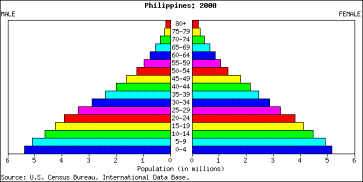
According to the population pyramid of this country, its population is most likely...
a)
growing slowly.
b)
growing rapidly.
c)
decreasing.
d)
not changing.
47.
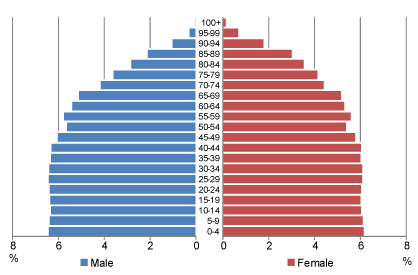
A country with an age structure diagram like this one is most likely experiencing
a)
a high life expectancy.
b)
slow population growth.
c)
a short doubling time.
d)
a low infant mortality rate.
48.

Which of the graphs below shows exponential growth?

a)
b)
c)
d)
e)
49.
Refer to the diagram of the survivorship curve.
Which curve best describes an organism that invests a lot of energy in parenting?
a)
A
b)
B
c)
C
d)
this is not a survivorship curve
50.
What kind of growth is this country experiencing?
a)
Exponential Growth
b)
Stable Growth
c)
Declining Growth
51.

Even if a country reduces its birth rate and maintains replacement-level fertility, its population will still continue to grow for several decades because of

a)

lower death rates

b)

increased income.

c)

population momentum

d)

better health care.

e)

increased life expectancy.

52.

Populations whose age structure diagrams are narrower at the bottom than at the top have

a)

high death rates

b)

the same proportion of individuals in each age group

c)

a declining population

d)

a high growth rate

e)

all of the above

53.
The largest number of individuals that an area can support is called its _______.
a)
limiting factor
b)
abiotic factor
c)
resource availability
d)
carrying capacity
54.
What is the definition Noise Pollution?
a)
Unwanted noise
b)
Excess noise produced by humans
c)
Unwanted noise that distrubs all life 
55.
Which answer is a MAJOR health effect caused by Noise Pollution?
a)
Hearing lose
b)
High levels of blood pressure
c)
Hypertension 
d)
Fatigue 
56.

................should be created around hospitals

a)

schools

b)

silent zone

c)

ground

57.
The majority of atmospheric mercury is produced by:
a)
Municipal Waste Incinerators
b)
Coal burning power plants
c)
Medical waste
d)
Runoff from thermometer factories
58.
What three components have to be present to create photochemical smog?
a)
VOCS, PANS, Carbon Dioxide
b)
VOCS, Ozone, Nitrogen Monoxide
c)
Nitrogen Dioxide, Sunlight, and VOCS
d)
Sulfur Dioxide, Nitrogen Dioxide, and Ozone
59.

Thermal inversions

a)

increase the rate of smog formation

b)

trap high concentrations of pollution at ground level

c)

result in increased levels of acid deposition

d)

reduce the negative effects of VOC's

60.

CO2 and other pollutants are usually measured in units of

a)

pH

b)

percent

c)

decibels

d)

parts per million

61.

During thermal inversion, ______________ air is surrounded by _____________ air.

a)

warm; cooler

b)

cool; warmer

c)

warm; denser

d)

cool; denser