wayground logo

Free Printable Worksheets

Font size

S
M
L
XL
Worksheets

Unit 3 Exam

Total questions: 46

Worksheet time: 32mins

Name
Class
Date
1.

What are the 3 states of matter?

a)

Solid

b)

Gas

c)

Liquid

d)

All of the above

2.

Which of the following is a chemical property?

a)

Crystal formation

b)

Ductility

c)

Colour

d)

Reaction to heat

3.

Which of the following is a physical property?

a)

Ability to burn

b)

Reaction with acids

c)

Flash point

d)

Solubility

4.

Classify the following example of matter:

Oxygen gas ( O2O_2 

a)

Element

b)

Compound

c)

Homogeneous mixture

d)

Heterogeneous mixture

5.
Which of the following can only be observed when it is changing composition?
a)
chemical property
b)
physical property
6.

1.Particles cannot change position in a ________

a)

solid

b)

liquid

c)

gas

7.
A mixture in which different materials can be identified easily
a)
element
b)
heterogeneous mixture
c)
homogeneous mixture
d)
solution
8.
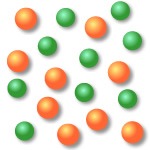
This picture represents which of the following?
a)
element
b)
compound
c)
mixture
9.

This state of matter has a constant volume, but fits the space of the container holding it.

a)

Solid

b)

Liquid

c)

Gas

d)

Plasma

10.

This state of matter expands to fill its container.

a)

Solid

b)

Liquid

c)

Gas

d)

Plasma

11.

This state of matter has a firm, unchanging physical structure.

a)

Solid

b)

Liquid

c)

Gas

d)

Plasma

12.

Atoms or molecules in this state of matter have the lowest energy.

a)

Solid

b)

Liquid

c)

Gas

d)

Plasma

13.

Heating a solid to a high temperature will usually result in this phase change.

a)

Condensation

b)

Melting

c)

Sublimation

d)

Evaporation

14.

Shares electrons

a)

covalent bonds

b)

ionic bonds

c)

hydrogen bonds

15.

What is the basis of hydrogen bond?

a)

Attraction forces between hydrogen atom bonded with another hydrogen atom

b)

Attraction forces between hydrogen atom bonded with a high electronegativity atom (F, O, N)

c)

Attraction forces between hydrogen atom bonded with a high electronegativity atom (F, O, N) with atom (F, O, N) of another molecule

d)

Attraction forces between hydrogen atom with another hydrogen atom of another molecule

16.

Can ammonia, NH3 form hydrogen bonds?

a)

Yes

b)

No

17.

Can chlorine, Cl2 form hydrogen bonds?

a)

Yes

b)

No

18.
What information do we look for on the periodic table if we  want to examine intermolecular forces?
a)
atomic mass
b)
atomic number
c)
electronegativity
d)
ionization 
19.
If fluorine is stronger then carbon, what charge will the fluorine receive?
a)
negative
b)
slight negative
c)
positive
d)
slight positive
20.
Type of intermolecular force present in HF.
a)
dipole dipole
b)
dispersion
c)
H-bond
d)
ionic
21.
Type of intermolecular force present in I2, Br2, and Cl2.
a)
dipole dipole
b)
H-bond
c)
dispersion
d)
metallic
22.
H2S has what kind of intermolecular force?
a)
dipole dipole
b)
dispersion
c)
H-bond
d)
ionic
23.
Intermolecular forces are the forces
a)
within molecules
b)
between molecules
24.
Which of the following would best remove Sharpie marker from your wall if this marker is known to be non-water soluble. 
a)
salt water
b)
ammonia (nitrogen trihydride)
c)
acetone (finger nail polish remover)
d)
distilled water
25.

Ethanol and water have different boiling point. What would be the suitable separation technique for a mixture of both substances?

a)

Distillation

b)

Chromatography paper

c)

Sieving

26.

The pigment responsible for the colour of spinach leaves are several substances. How can you separate them?

a)

sieving

b)

decanting

c)

paper chromatography

27.

Dirt

a)

Heterogeneous

b)

Homogeneous

28.
Air
a)
Heterogeneous
b)
Homogeneous
29.

Are made from a combination of 2 or more elements in a constant ratio...

a)

Atom

b)

Mixture

c)

Compounds

d)

Elements

30.
A combination that can be separated by physical processes is a .....
a)
Atom
b)
Compound
c)
Element
d)
Mixture
31.
Carbon
a)
Element
b)
Compound
c)
Homogeneous Mixture
d)
Heterogeneous Mixture
32.
Aluminum
a)
Element
b)
Compound
c)
Homogeneous Mixture
d)
Heterogeneous Mixture
33.
Which substance is MOST soluble at 0 ºC?
a)
KI
b)
NaNO3
c)
NaCl
d)
Ce2(SO4)3
34.
What is unsaturated?
a)
A solution with more solute than solvent
b)
A solution with less than the maximum amount of solutes 
c)
A solution with the  perfect balance of solutes and solvents
d)
A solution with solids at the bottom
35.
When 50 grams of KCl is dissolved in 100 grams of water at 50 ºC, the solution can be correctly described as:
a)
supersaturated
b)
unsaturated
c)
saturated
36.
Graph that shows the amount of solute that can be dissolved in 100 g of water at a certain temperature.
a)
Solubility curve
b)
Saturation curve
c)
Concentration curve
d)
Molarity curve
37.
Solubility refers to the ____ of solute that can dissolve in a certain volume or mass of solvent, at a certain temperature.
a)
Volume
b)
Proportion
c)
Mass
d)
Particles
38.
Describe a solute.
a)
part of solution present in largest amount
b)
the substance that gets dissolved
c)
the substance that does the dissolving
d)
surrounds and breaks apart
39.
Another name for a homogeneous mixture is 
a)
an element.
b)
a solution.
c)
a compound.
40.
When a certain amount of solvent cannot hold any more solute it is called a ________ solution.
a)
Diluted
b)
Saturated
41.

Type of mixture that DOESN'T HAVE the same composition in every part.

a)

Homogeneous

b)

Heterogeneous

42.

Type of mixture that has the SAME COMPOSITION in every part.

a)

Homogenous

b)

Heterogeneous

43.
Kool-Aid - Powder, sugar, and water
Identify the solvent 
a)
water
b)
powder
c)
sugar
d)
powder and sugar
44.
Lemonade - Water, lemon juice, and sugar
Identify the solute
a)
water
b)
lemon juice
c)
sugar and lemon juice 
45.
The separation technique that involves heating a solution until the liquid changes into a gaseous state, leaving behind a solid is known as
a)
decanting
b)
 evaporation
c)
loading
d)
chromatography
46.
Combination of two or more pure substances that are not chemically combined
a)
compound          
b)
atom
c)
mixture 
d)
element