
 Worksheets
Plate tectonics #1
Total questions: 216
Worksheet time: 7hrs 12mins
Earth's plates meet at ____________.
plate tectonics
plate boundaries
continental drift
oceans
Plates slide past each other at _________________ boundaries.
divergent
convergent
transform
universal
Plates slide apart along _____________ boundaries.
convergent
divergent
transform
universal
Which feature forms at convergent boundaries?
trench
rift valley
mountain range
mid-ocean ridge
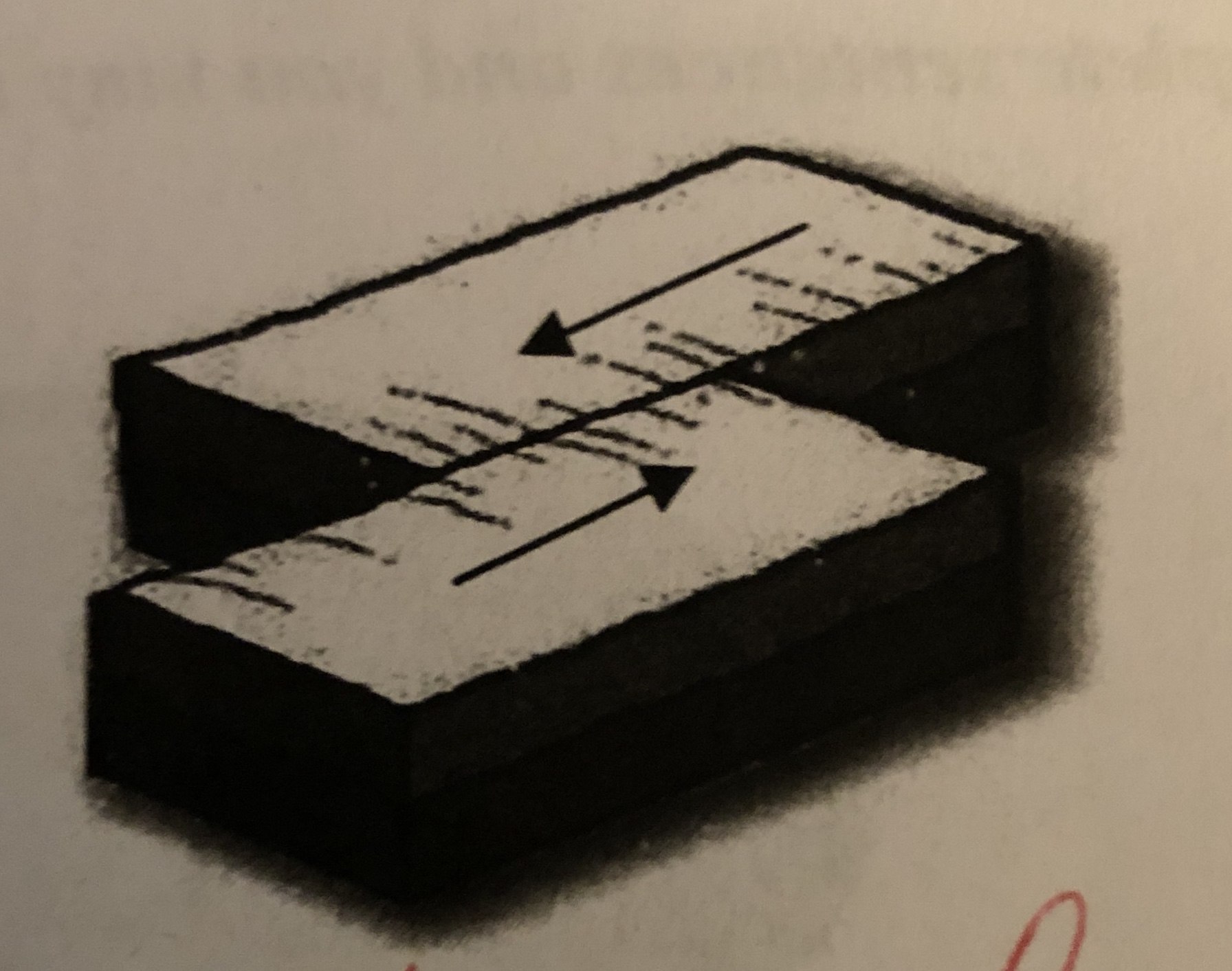
What type of boundary is this?
convergent
divergent
transform
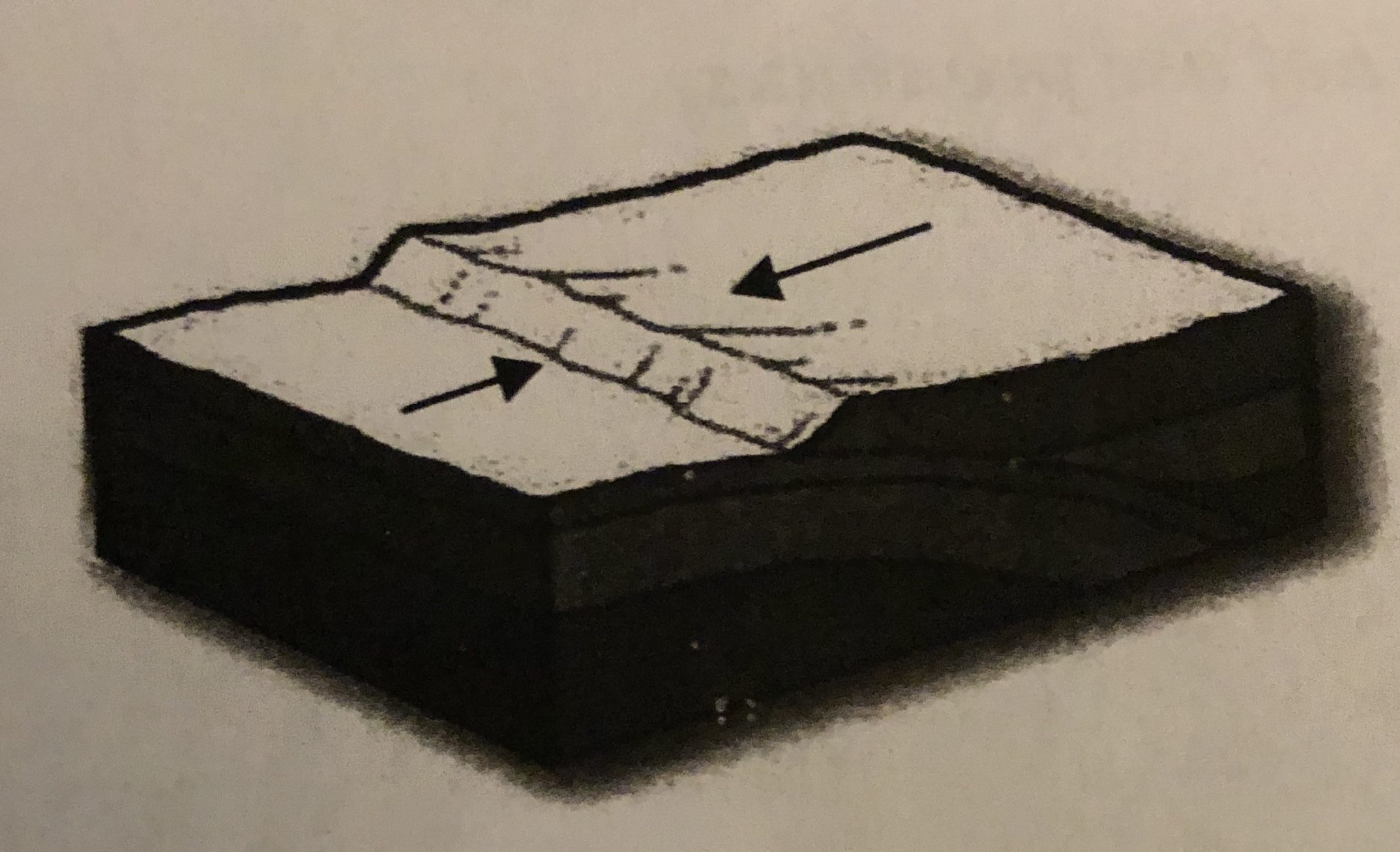
What type of boundary is this?
convergent
transform
divergent
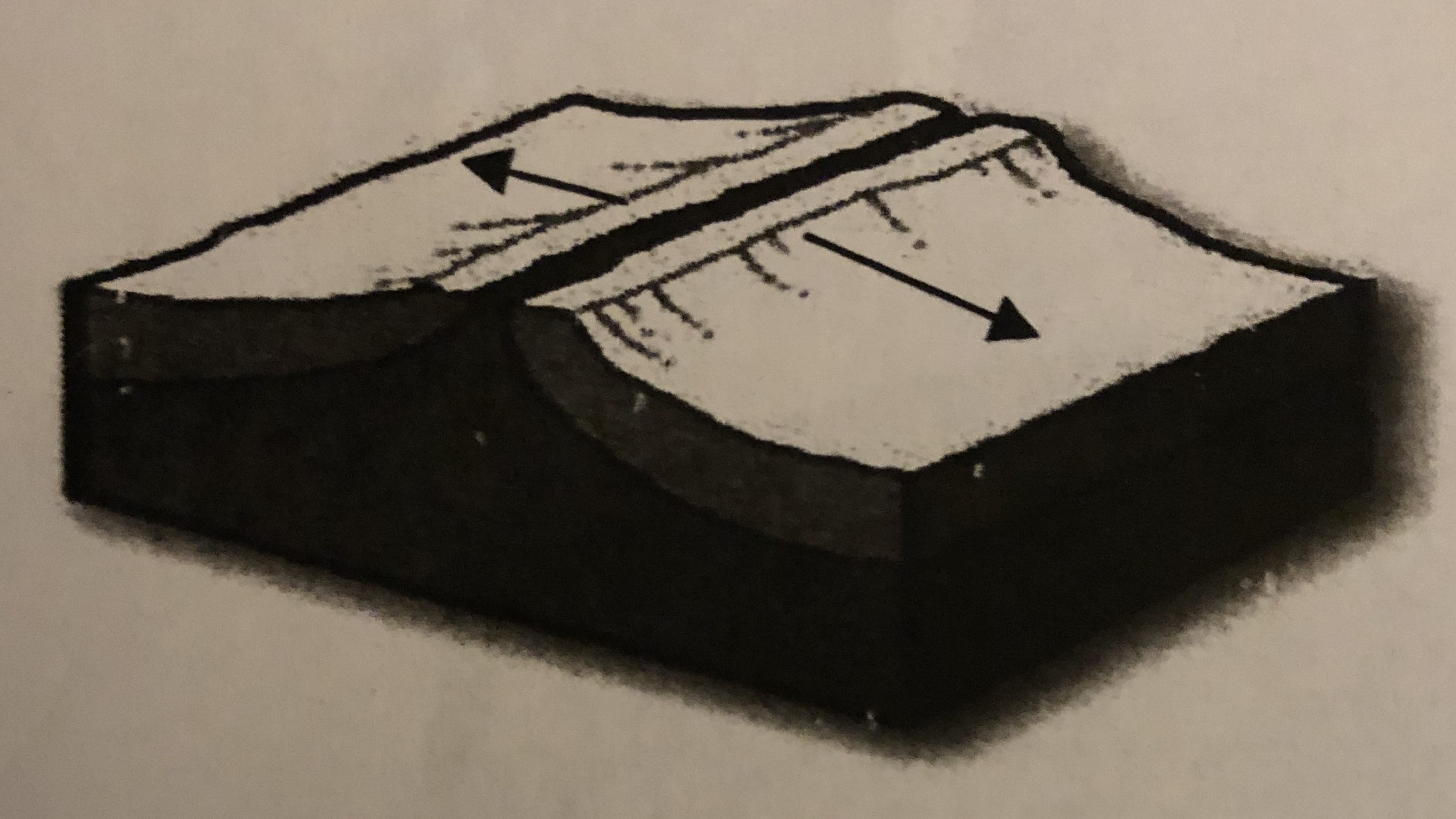
What type of boundary is this?
convergent
divergent
transform
What is a plate boundary where both plates move away from each other?
divergent
plate
convergent
transform
What is the process that continually adds new crust to the ocean floor along both sides of the mid-ocean ridge?
subduction
continental drift
convergent
sea floor spreading
What is a plate boundary where two plates move toward each other?
transform
convergent
divergent
What is a plate boundary where two plates slip past each other moving in opposite directions?
transform
convergent
divergent
Most geologists think that the movement of Earth's plates is caused by
conduction
earthquakes
convection currents in the mantle
Earth's magnetic field


The place where two plates come together is known as a _______
transform boundary.
divergent boundary.
convergent boundary.
rift valley.
What type of geological event would most likely happen along a transform boundary?
volcanoe
sea floor spreading
earthquake
mountain building


The map shows locations of the tectonic plates. What is the name of Plate E?
Eurasian
African
Australian
Pacific
When the edges of tectonic plates shift and energy is released, what is the most likely result?
Earthquakes
Volcanoes
Mountain formation
Island formation

The map shows locations of the tectonic plates. Which plate is aligned with the west coast of North America?
Pacific
Australian
African
Eurasian
Which type of plate movement causes mountain ranges to form?
Divergent
Oceanic
Convergent
Transform
Which statement best describes the movement of Earth's plates?
The plates moved for millions of years but have now stopped
There is no evidence that plates ever moved
The plates stayed in one place for millions of year but are moving now
The plates are constantly moving

Based on the image, one of the boundaries between which plates is classified as transform?
North American and Pacific
South American and African
Australian and Pacific
Eurasian and North American
According to the theory of plate tectonics, where do most active volcanoes occur?
On continental plates
Along plate boundaries
On oceanic plates
Underwater

The map shows locations of the tectonic plates. The border marked with a bold dashed line is between which two plates?
Eurasian and African
Australian and Pacific
North American and South American
Eurasian and North American
Which type of geologic event is most likely to occur along a transform boundary?
Volcano
Seafloor spreading
Mountain building
Earthquake
Ocean basins form at which type of plate boundary?
Transform
Divergent
Convergent
Oceanic
Mountain ranges form where crustal plates meet. The natural elevation of Earth's surface is much higher on mountain ranges. What type of plate tectonic boundary causes this geological event?
Strike-slip boundary
Divergent boundary
Transform boundary
Convergent boundary
Which of the following methods would best model how the mountains formed?
Drop pennies into a pile
Shake a soda bottle until the soda shoots up
Drip water on the sides of a sugar cube
Push two towels together
What causes tectonic plates to move?
Temperature of oceanic crust
Thickness of Earth's layers
Density of continental crust
Convection currents in the asthenosphere
What causes mountains to form and grow?
convergent boundary
divergent boundary
transform boundary
fault boundary

The map shows locations of the tectonic plates. The South American Plate is?
Plate A
Plate B
Plate C
Plate D
The Earth is made of many layers. Which layer is made up of part crust and part mantle material?
Inner core
Outer core
Lithosphere
Asthenosphere

The major tectonic plates are shown on the map. Which plates border the Pacific Ocean?
Eurasian, North American, and South American
North American, African, and Australian
North American, South American, and African
Australian, South American, and African

Which direction of plate movement will most likely result in the formation of an ocean basin?
A
B
C
D
True or false- Convergent boundaries slide past each other.
True
False
What is it called when one plate is denser than another and is forced below as they converge?
ocean basins
subduction
geologic event
spreading ridges
When two continental plates converge what is expected to form?
rift valley
ocean basin
mountains
Transform boundaries cause what?
volcanoes
earthquakes
sea floor spreading
ocean basins
Large plates move across the surface of the Earth by what process?
Conduction
Convection
Radiation
Condensation
True or false- Transform boundaries come together and collide.
True
False
True or false- Divergent boundaries move away from each other.
True
False
True or false- tectonic plates are constantly moving
True
False
Which boundary is responsible for the formation and growth of mountains?
convergent
divergent
transform
Where do most volcanoes occur?
underwater
on continental plates
along plate boundaries
on oceanic plates


The movement of the tectonic plates is caused by
the rotation of the Earth.
convection currents in the Asthenosphere
the gravity of the iron-nickel core.
the Moho discontinuity.
In some areas of the world, like California and Japan, earthquakes are a common occurrence. How can this best be explained?
The strong ocean currents are undermining both areas causing earthquakes.
Both areas are located near the edge of the Pacific Ocean, the unstable sand causes earthquakes.
Both areas are subjected to strong ocean wind and waves that causes earthquakes.
Both areas are on the boundary of active plates, the motion of the plates causes earthquakes.
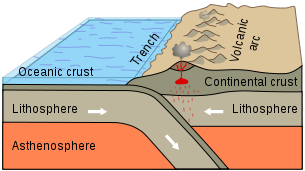
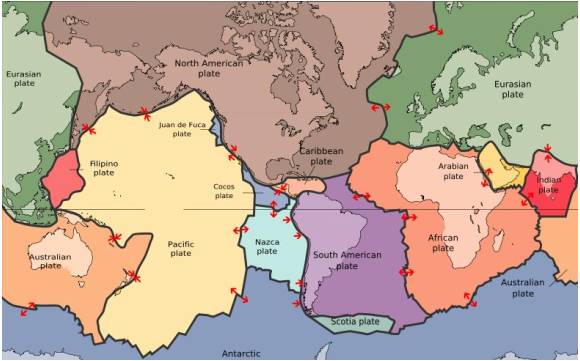
The map in the picture shows tectonic plate boundaries. This map would be useful in predicting the location of future
droughts
hurricanes
earthquakes
tornadoes
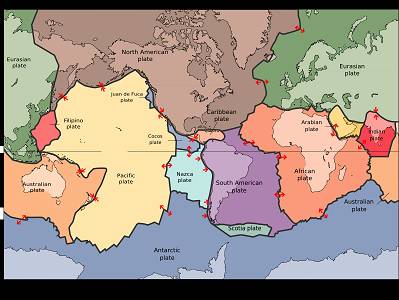
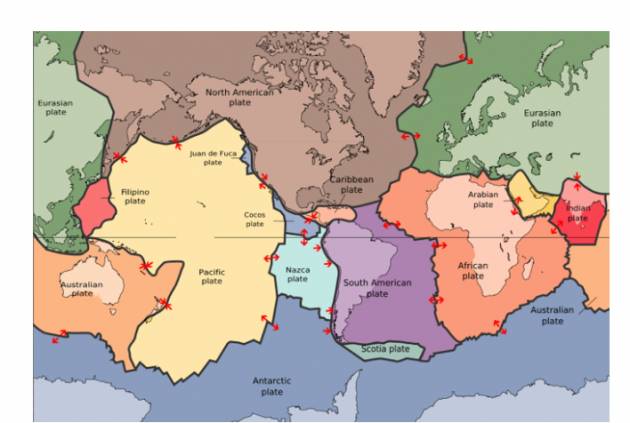
Where are earthquakes MOST LIKELY to occur?
close to the equator
close to the center of tectonic plates
at divergent or convergent plate boundaries
at transform plate boundaries
The 2004 Indian Ocean tsunami was caused by a shift in two plates that pushed one section of the sea floor under another section of the sea floor by 5 meters. What type of boundary is this?
divergent
convergent
transform
metamorphic
___________ currents in the Earth's asthenosphere cause plate to shift at their boundaries. This movement also causes earthquakes and volcanic activity.
conduction
convection
radiation
ocean
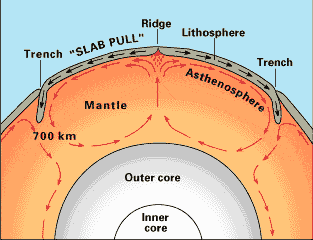
What is the source of energy that drives plate movement?
the subducton of the sea floor
the different densities of the oceanic and crustal plates
convection currents in the asthenosphere
the friction force between the plates that move past each other
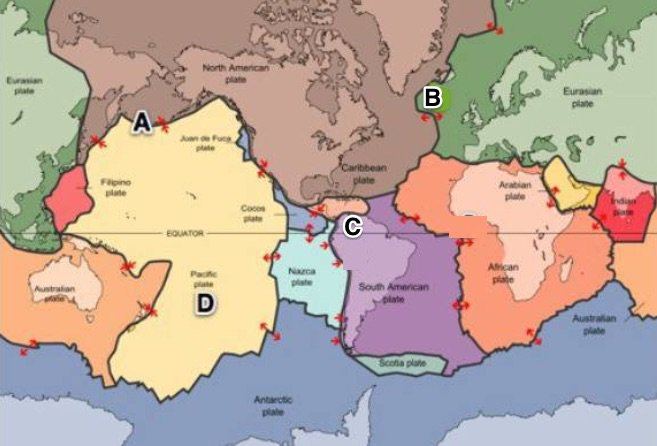
Where would sea floor spreading most likely occur?
At convergent boundaries (oceanic vs. oceanic)
At convergent boundaries (oceanic vs. continental)
At divergent plate boundaries (oceanic vs. oceanic)
At transform plate boundaries
Plates slide apart along _____________ boundaries.
convergent
divergent
transform
universal
Which feature forms at convergent boundaries?
trench
rift valley
mountain range
mid-ocean ridge

divergent boundary
convergent boundary
transform boundary

divergent boundary
convergent boundary
transform boundary
New crust is formed at this type of boundary
divergent
convergent
transform
Subduction means.....
one plate goes under another plate
two plates slide past each other
two plate collide and form folded mountains
Sea-floor spreading explains how.....
new crust is created at a divergent boundary
volcanoes are formed on continents
deep sea trenches are formed

This area is called the....
Arc of Volcanoes
Ring of Fire
Horseshoe of Magma


Why does oceanic crust subduct under continental crust?
Oceanic crust is thin
Oceanic crust is dense
Continental crust is thin
Continental crust is dense
What is the process of convection?
The process of hot material rising and cooler material sinking in circular patterns
The process of hot rock solidifying and forming new crust
The process of explaining what goes up must come down
Strong ocean currents moving tremendous amounts of material
Earthquakes can happen along
All boundaries
Divergent and transform boundaries
Convergent and divergent boundaries
Transform and Convergent boundaries

Which best describes this diagram?
divergent boundary
subduction zone
transform boundary
volcanic islands forming

The diagram illustrates that
seafloor spreading occurs at a convergent boundary
the oldest oceanic crust is located far from where the plates are separating
the continents are slowly moving toward each other
the youngest oceanic crust is located far from where it is separating

Looking at the diagram, where do think most earthquakes would most likely occur?
in the center of tectonic plates
along the boundaries of tectonic plates

The Appalachian Mountains were formed when
volcanoes erupted
landmasses split
landmasses came together
earthquakes happened

Early scientist studies the continents an dobserved that South America and Africa fit together like puzzle pieces. Which of the following ideas does this observation support?
The continental shelves of these two continents are made of the same type of rock.
The material that makes up the continental shelves is eroded from the continents.
These continents were joined in the past and have moved apart since that time.
The tectonic plates beneath these continents are roughly the same age.

Divergent plates move away from each other. What feature is most likely found at a divergent plate boundary?
Mountain range
Mid-Ocean Ridge
Plateau
sand bars
Examining rocks that form on either side of the Mid-Atlantic Ridge provides evidence that supports the theory of plate tectonics. These rocks provide evidence of plate movement. What is happening to the rocks as they get farther and farther from the ridge?
They are made up of smaller particles.
They have higher iron content.
They become increasingly older.
They become thinner and thinner.

The map below shows dark bands that indicate long mountain ranges on the west coasts of North America and South America. What caused the formation of these mountain ranges?
deposition of river sediments entering the ocean
collision of lithospheric tectonic plates
erosion of continental coastlines by ocean waves
uneven heating of Earth’s surface

The Ring of Fire is an area along the edge of the Pacific Ocean with many volcanoes. Which of these geologic areas is where rock is recycled by one tectonic plate sliding underneath another tectonic plate?
a strike-slip fault
a subduction zone
a rift valley
a divergent boundary
Earthquakes are experienced in many areas on the planet. What is occurring that results in earthquakes
two tectonic plates sliding past each other
two tectonic plates pulling away from each other
tectonic plates being weathered over time
tectonic plates melting as they slide into the mantle
Currently, there are 44 active volcanoes in the Andes Mountains in South America. Why are volcanoes so common in mountain ranges such as the Andes?
The Andes absorb more solar radiation and create the heat necessary to form lava
The Andes are located largely in rainforests where the hot climate supports volcano formation
The Andes are at a high elevation, which is necessary for volcano cone formation.
The Andes are in a region where a crustal plate is moving under another plate, which causes volcano formation.
Which of the following statements best explains why earthquakes occur more frequently in California than in Florida?
California is located on the boundary of two crustal plates, but Florida is not.
The rock under California is soft, but the rock under Florida is hard.
Rock found in California is sedimentary, but rock found in Florida is igneous.
California is located on a continental plate, but Florida is not.
Alfred Wegner hypothesized that when the edges of separate continents are very similar; it suggests that these rocks were formed in the same way, implying that they were joined initially. To prove his hypothesis, Wegner collected fossil evidence from the east coast of South America and the west coast of Africa. Analysis of the fossils showed that they are similar, not only in structure, but in age. His conclusion was that these two continents were once joined. How would you best describe the results of Wegner’s experiment?
No conclusion can be drawn from the results
The results fail to support the hypothesis
The results are inaccurate
The results support the hypothesis
Which best describes this diagram?
divergent boundary
subduction zone
transform boundary
volcanic islands forming
The diagram illustrates that
seafloor spreading occurs at a convergent boundary
the oldest oceanic crust is located far from where the plates are separating
the continents are slowly moving toward each other
the youngest oceanic crust is located far from where it is separating
The Earth's surface is divided into
several oceanic plates
oceanic and continental plates
continental and crustal plates
seven continental plates
Why does the continental crust rise over the oceanic crust?
The continental crust is less dense.
The oceanic crust is thinner.
The continental crust is not made of granite.
The oceanic crust is younger.
Looking at the diagram, where do think most earthquakes would most likely occur?
in the center of tectonic plates
along the boundaries of tectonic plates
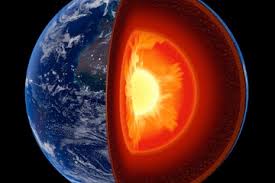
In 1912, Alfred Wegener proposed the theory of continental drift, stating that all the continents were once joined together and slowly moved apart. However, his theory was not widely accepted in his time. In 1962, the discovery of sea floor spreading (sea floor being forced apart by the formation of new crust) eventually led to a more modern and widely accepted theory of plate tectonics.
Why did the theory of plate tectonics improve upon Wegener’s theory of continental drift?
The theory of plate tectonics was a less complete theory because it failed to provide complete reasons and mechanisms for why the plates and continents moved.
The theory of plate tectonics was a more complete theory because it provided a reason and mechanism for why the plates and continents moved.
The theory of plate tectonics was a more complete theory because it failed to provide reasons and mechanisms for why the plates and continents moved.
The theory of plate tectonics was a less complete theory because it provided a reason and mechanism for why the plates and continents moved.
The San Andreas Fault in California is caused by the Pacific Plate sliding horizontally along the North American Plate. Many earthquakes occur along this fault. What type of fault results from this type of plate boundary movement?
convergent
divergent
subduction
transform
The vast majority of earthquakes and volcanic eruptions occur near plate boundaries, but there are some exceptions. The Hawaiian Islands, which are entirely of volcanic origin, have formed in the middle of the Pacific Ocean in the middle of the Pacific Plate.
Regions exist below the plates which provide localized sources of high heat energy to sustain volcanism. What are these regions called?
subduction zones
hot spots
convection centers
asthenosphere thermals
The North American plate and Pacific plates meet at the San Andres Fault in California causing frequent earthquakes. This fault is located at a _____ boundary.
Ridge
Divergent
Convergent
Transform

What geologic process formed the Himalayas?
two continental plates converging
an earthquake in a subduction zone
a tectonic plate moving over a hot spot
movement at a transform fault boundary
The __________________ are chains of undersea mountains.
Mid-Ocean Ridges
Ocean Trench
Divergent boundary
Transform boundary
______________________ continually adds materials to the ocean floor creating ocean floor.
Sea-floor spreading
Ocean trenches
Divergent mid-ocean ridges
Convergent mid-ocean ridges
_____________________ are undersea that are the deepest part of the ocean.
Divergent trenches
Ocean trenches
Transform trenches
Mid-ocean trenches
Which of these is NOT causes by the moving of tectonic plates?
Valleys
Mountains
Earthquakes
Hurricanes

Fossil records indicate that the continents were once connected. How do fossil records support this claim?
We have been able to transport the same types of fossils from one continent to another.
Fossils of the same organism have been found on continents that are now separated by oceans.
Some continents contain fossils of many different types of organisms.

One piece of evidence for Plate Tectonics is that--
some continents appear to fit together like a puzzle.
we have video footage of the plates actually moving.
all continents have formed from volcanic eruptions.
the continents are no longer moving.

Younger crust being found near mid-ocean ridges supports the idea of Plate Tectonics because---
this indicates that new crust is being formed over time, pushing old crust outward.
this indicates that volcanoes are able to take place in different places on the Earth.
this indicates that new crust is never formed.
this indicates that the continents are stationary.
When two plates collide, and one is pulled underneath the other at a subduction zone, the plate that is pulled under melts creating magma that rises to the surface. What is going to form at this boundary?
Mountains form because of the uplift of material
Volcanoes form along edges of plate boundaries
Ocean ridges form
Faults, like San Andreas, form
What is the motion of Earth's plates like?
fast and in stages
slow and in stages
fast and constant
slow and constant
What image best represents mantle convection?


Which image best represents a transform boundary?


Which image best illustrates a subduction zone?


Which image best illustrates a continental collision plate boundary?


The youngest rocks on the seafloor are most likely found...
closest to a mid-ocean ridge
farthest from a mid-ocean ridge
near the coastlines
closest to a deep sea trench
The 2004 Indian Ocean tsunami was caused by a shift in two plates that pushed one section of the sea floor under another section of the sea floor by 5 meters. What type of boundary is this?
divergent
convergent
transform
metamorphic
Which type of crust is more dense?
oceanic
continental

Which letter corresponds with the oldest rock?
L
M
N
O
Which letter corresponds with the newest rock?
L
M
N
O
During sea floor spreading, molten material rises up from the mantle...
along the continents
deep ocean trenches
at the mid ocean ridges
at north and south poles
Earth's plates are...
constantly moving and changing the face of the earth
Moves seldom and very fast
Never moves
Moves when it feels like it

A map is provided that presents information on a certain region of the Earth. Based on the information on the map, at which location are mountains most likely to form?
A
B
C
D
What is an example of a convection current?
Movement of gas in a hot air balloon.
Feeling the sun’s rays on a nice summer day.
Touching a hot spoon that was in a soup bowl.
Touching an iron skillet after cooking and feeling the heat
NAME THE PLATE:
This plate includes the continental crust of Greenland, North America, Siberia, and the surrounding oceanic crust.
North American
South American
Eurasian
African
NAME THE PLATE:
This plate includes most of the landmasses of Europe and Asia.
African
Indo-Australian
Eurasian
Pacific

Name the plate that is on both sides of the map-marked with the red boxes
Nazca
Indo-Australian
Antarctic
Pacific
Name the plate that is composed entirely of oceanic crust and lies beneath an ocean.
Atlantic
Pacific
Indian
Antarctic
Name the plate that we live on
Eurasian
North American
South American
African
A map of global earthquakes and volcanoes tells you:_______.
Where the edges of the continents are
Where the earth is the hottest
Where the plate boundaries are
None of the above

Which of the following plate boundaries would you find a Subduction Zone?
Convergent Plate Boundaries
Divergent Plate Boundaries
Transform Plate Boundaries
Convection Plate Boundaries
Which of the following images show a Convergent Plate boundary?


Which of the following images show a Divergent Plate boundary?
Which of the following images show a Transform Plate boundary?
The place where two tectonic plates meet is called a plate..
boundary
transformation
border
collision


What is the name of the tectonic plate labelled "D"
Eurasian plate
North America plate
Antarctica plate
Cocos plate

Name the plate labelled "C"
north american plate
nazca plate
indian plate
african plate

Plate B is also known as ?
Antarctica plate
African plate
South American plate
Eurasian plate

Plate labelled "H" is the ____________ plate?
South American plate
Cocos plate
North American plate
African plate

"N" is the __________________ plate
Pacific plate
Antarctica plate
Eurasian plate
Indo-Australian plate

"G" is the ____________________ plate
North American
Cocos
Nazca
Juan de Fuca
South American


When molten rock spews out from the mantle to the surface of Earth as ash, lava, and gases; major geological events that occur when a dense plate subducts below a less dense plate. This is called a _____.
Earthquake
Tsunami
Volcanic Eruption
Mountain
Convection currents are powered by
Density
Heat
Pressure
Water
The process that continually adds new crust onto the ocean floor is:
Earthquake
Subduction
Sea-Floor Spreading
Convection Current
Earthquakes and volcanoes are most likely to be found in ____.
In oceans
In the middle of continents
In the middle of nowhere
At plate boundaries
Which of the following plate interactions is most likely to form a mountain range?
A transform boundary between ocean plates
A transform boundary between continental plates
A convergent boundary between continental plates
A subduction zone between a continental plate and an ocean plate
Which layer of the earth do we live on?
crust
mantle
core
outside
What is the name for a vast underwater mountain chain?
mountain chain
mid-ocean ridge
sea floor spreading
continental crust
Tropical fern fossils have been found on Antarctica, which has a very cold climate. Which of these explanations is correct?
The fossils floated across the ocean to Antarctica.
Tropical plants can grow in cold climates.
Antarctica must have been located near the equator at one time.
The equator floated away from Antarctica.
Which of the following statements are true?
Magma is what comes out of a volcano.
Magma is solid lava.
Magma is found under the crust, while lava is found on Earth's surface.
Lava is found under the crust, while magma is found on Earth's surface.
When melted rock and hot gases erupt through a crack in the crust, this may occur.
earthquake
volcano
subduction
continental drift


Study this diagram carefully, noticing the direction of the arrows.The green bars are tectonic plates.What will happen at the place where the star is drawn on this diagram?
The plates will slide past each other (causing a major earthquake)
The plates will hit each other (one will subduct)
The plates will diverge (spread apart)

What type of plate boundary occurs between the Antarctic Plate and Indo-Australian Plate?
Convergent
Divergent
Transform
None of these

What type of plate boundary occurs between the Nazca Plate and South American Plate?
Convergent
Divergent
Transform
None of these
Tectonic plates:
move slowly
sometimes press against or pull away from each other
sometimes scrape against each other
all of the choices above

The fossil plant Glossopteris has been found in Africa, Australia, India, South America, and Antarctica. This evidence helps support the idea that ____________.
the continents have always been at the same locations they are now
the continents have moved
the continents were all once covered by ice

Molten rock below the surface of the Earth
magma
mantle
lava
crust

Even the fastest tectonic plates only move tens of ____ every year! Wow! That's a very short distance!
meters
miles
centimeters

What happens at this boundary?
New crust is formed via earthquakes
New crust is formed via sea floor spreading
Crust is destroyed via volcanoes
None of these choices

Which plate is located at number 5?
North American
South American
African
Eurasian
Scientists theorized that the continents were once joined together even before they had modern evidence from rocks and fossils. Using only maps, they observed that -
continents with the most temperate climates were found near the Equator.
the oceans have become smaller throughout the history of Earth.
the shapes of continents appeared to allow them to fit together.
most of the larger land masses are in the Northern Hemisphere.
The earthquakes experienced in California are related to tectonic plates because these catastrophic events are the result of -
two tectonic plates sliding past each other.
tectonic plates melting as they slide into the mantle.
tectonic plates being weathered over time.
two tectonic plates pulling away from each other.
Where is the highest risk of earthquakes in the U.S.?
California
Washington D.C.
Arkansas
Utah


Holes drilled several kilometers into Earth’s crust provide direct evidence about Earth’s interior in the form of _______
seismic waves
rock samples
liquid iron
volcanic eruption

