wayground logo

Free Printable Worksheets

NEW

Font size

S
M
L
XL
Worksheets

Test 2 Practice

Total questions: 70

Worksheet time: 1hrs 4mins

Name
Class
Date
1.
What is the name of Ag?
a)
Gold
b)
Silver
c)
Platinum
d)
Lead
2.
The chemical symbol for Silicon is
a)
S
b)
Sn
c)
Sc
d)
Si
3.
What is the symbol for Chlorine?
a)
Ce
b)
Cl
c)
Ch
d)
C
4.
What is the symbol for Copper
a)
C
b)
Co
c)
c
d)
Cu
5.
What is the symbol for Lithium
a)
L
b)
Lm
c)
Li
d)
LM
6.
What element is Pb?
a)
Polonium
b)
Lead
c)
Arsenic
d)
Mercury
7.
What is the symbol for Sodium
a)
So
b)
Na
c)
S
d)
Sm
8.
What is the symbol for Arsenic?
a)
As
b)
A
c)
An
d)
Ar
9.
What is the name of Mg
a)
Magnesium
b)
Manganesse
c)
Iron
d)
Germanium
10.
The period for Bromine is ___________.
a)
3
b)
2
c)
4
11.
Beryllium is in group number______.
a)
Group 2
b)
Group 3
c)
Group 4
d)
Group 7
12.
Elements in the same ________ are more chemically similar.
a)
group
b)
period
c)
club
d)
table
13.
Which elements have the most similar chemical properties?
a)
K and Na
b)
K and Ca
c)
K and Cl
d)
K and S
14.
Name group 1A on the periodic table.
a)
alkali metals
b)
alkaline earth metals
c)
noble gases
noble gases
d)
halogens
15.
Name group 2A on the periodic table.
a)
alkali metals
b)
alkaline earth metals
c)
noble gases
d)
transition metals
16.
Name group 8A on the periodic table.
a)
alkali metals
b)
alkaline earth metals
c)
transition metals
d)
noble gases
17.
Name groups 3B - 12B on the periodic table.
a)
noble gases
b)
halogens
c)
metalloids
d)
transition metals
18.
Name group 7A on the periodic table.
a)
transition metals
b)
metalloids
c)
halogens
d)
alkali metals
19.
The atoms along the staircase are called 
a)
metals
b)
nonmetals
c)
metalloids
d)
noble gases
20.
Which statement is true about the carbon family?
a)
They are all non-metals.
b)
They all have four valence electrons.
c)
They are all metals.
d)
They do not react with other elements.
21.
Which statement is true about the alkaline earth metal family?
a)
They have 2 valence electrons.
b)
They are found on the right side of the periodic table.
c)
They form -2 charges.
d)
They tend to gain valence electrons.
22.

The nucleus of an atom contains which subatomic particles?

a)

protons and electrons

b)

protons and neutrons

c)

electrons and neutrons

d)

protons, electrons, and neutrons

23.

Typically in an atom, which two subatomic particles are equal in number?

a)

protons and neutrons

b)

all subatomic particles are equal in number

c)

neutrons and electrons

d)

protons and electrons

24.
Particles in an atom that are neutral and have no charge are 
a)
negatrons 
b)
electrons 
c)
neutrons 
d)
protons 
25.
The atomic number is equal to _.
a)
the number of protons and electrons
b)
the number of neutrons only
c)
the total number of protons and neutrons
d)
the number of protons neutrons and electrons
26.
The atomic mass is equal to _.
a)
the number of protons only
b)
the number of neutrons only
c)
the total number of protons and neutrons
d)
the number of protons, neutrons, and electrons.
27.
An atom that has gained or lost electrons is called ...
a)
a winner
b)
an isotope
c)
an ion
d)
a loser
28.

When an atom loses an electron, it becomes a

a)

positive ion

b)

negative ion

c)

neutral ion

d)

neutral atom

29.
24.1% of all the isotopes of a an element have a mass of 75.23 amu, 48.7% have a mass of 74.61 amu, and 27.2% have a mass of 75.20 amu.
What is the average mass of this element?
a)
74.92 amu
b)
24.97 amu
c)
75.01 amu
d)
74.51 amu
30.

The atomic mass of an element is the ___.

a)

average of the mass number and the atomic number for the element

b)

weighted average of the masses of the isotopes of the element

c)

total mass of the isotopes of the element

d)

total number of subatomic particles in the nucleus

31.

Calculate the average atomic mass of the element iron (Fe) using the following data:

[Isotope / % abundance]

[Iron 54 / 6% ] [Iron 56 / 92% ] [ Iron 57 / 2% ]

a)

53.7 amu

b)

54.9 amu

c)

5592.0 amu

d)

55.9 amu

32.
An isotope has three forms.  30% have a mass of 4 amu, 20% have a mass of 5 amu and 50% have a mass of 3 amu.  Average atomic mass will be closest to
a)
2 amu
b)
3 amu
c)
4 amu
d)
5 amu
33.
4.35% of all X atoms have a mass of 39.946 amu. 83.79% have a mass of 41.941 amu, 9.50% have a mass of 42.941 amu, and 2.36% have a mass of 43.939 amu. What is the average atomic mass of atom X?
a)
41.97 amu
b)
42.19 amu
c)
10.43 amu
d)
40.04 amu
34.
How many neutrons does the isotope of lithium have?
a)
8
b)
3
c)
4
d)
5
35.
How many electrons are in an atom that has an atomic number of 34, an atomic mass of 74 and a charge of -2?
a)
34
b)
36
c)
2
d)
40
36.
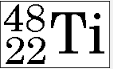
How many protons does this isotope of titanium have?
a)
48
b)
22
c)
26
d)
70
37.
What atom matches this electron configuration?
1s22s22p63s23p64s23d10
a)
Zinc
b)
Copper
c)
Nickel
d)
Germanium
38.
What electron configuration matches an oxygen atom?
a)
1s22s22p63s2, 3p64s23d104p5
b)
1s22s22p4
c)
1s22s22p6
d)
1s22s22p63s23p64s23d1
39.
The electron configuration of an atom is 1s22s22p6.  The number of electrons in the atom is 
a)
3
b)
6
c)
8
d)
10
40.
Which electron configuration belongs to Chlorine (Cl)?
a)
1s2s2p3s3p5
b)
1s2s2p3s3p6
c)
1s2s2p3s3p7
41.
How many electrons can the d sublevel hold?
a)
14
b)
10
c)
2
d)
6
42.
What atom matches this electron configuration?
1s22s22p63s2
a)
Neon
b)
Magnesium
c)
Aluminum
d)
Potassium
43.

Choose the correct shortcut configuration for iodine.

a)

[Ar]4s24d104p5

b)

[Kr]5s24d105p5

c)

[Xe]5s25d105p5

d)

none of the above

44.
How many electrons can the s sublevel hold?
a)
14
b)
10
c)
2
d)
6
45.
Metals tend to 
a)
gain electrons
b)
lose electrons
46.
Nonmetals tend to 
a)
gain electrons
b)
lose electrons
47.
How do the following two elements bond together?
Cr3+  O2-         
a)
CrO
b)
Cr3O2
c)
Cr2O3
d)
CrO3
48.
PbS2
a)
lead sulfide
b)
lead sulfur
c)
lead II sulfide
d)
lead IV sulfide
49.
The proper formula for magnesium hydroxide:
a)
MgOH
b)
Mg2OH
c)
Mg(OH)2
d)
Mg2OH2
50.
Name the following ionic compound: Cr(NO2)3
a)
chromium nitrite
b)
chromium nitride
c)
chromium III nitride
d)
chromium III nitrite
51.
How do the following two elements bond together?
Al3+  O2-         
a)
AlO
b)
Al2O3
c)
Al3O6
d)
Al3O2
52.
What is the correct formula for the compound, lithium oxide?
a)
LiO
b)
Li2O
c)
LiO2
d)
Li2O2
53.
The name for CrN:
a)
Chromium nitride
b)
Chromium (I) nitride
c)
Chromium (III) nitride
d)
Chromium nitride (III)
54.
The name of Cu₃N₂ is
a)
copper (III) nitride
b)
copper (II) nitride
c)
copper nitride
d)
tricopper dinitride
55.

How do you know the charge for a transition metal?

a)

look at the anion

b)

look at the Roman Numeral in the name

c)

look at the subscript for the anion

d)

all of the above

56.
phosphorus trichloride
a)
KCl3
b)
PCl3
c)
K3Cl
d)
P3Cl
57.
silicon dioxide
a)
SO2
b)
NaO2
c)
SiO2
d)
SiO
58.
diphosphorus pentoxide
a)
P2O5
b)
PO5
c)
P5O2
d)
P2O6
59.
The chemical formula of sulfur hexabromide is
a)
SBr₆
b)
S₆Br
c)
S(VI)Br
d)
S6Br
60.
The chemical formula of carbon tetrachloride is
a)
CCl
b)
C₄Cl
c)
CCl₄
d)
C(IV)Cl
61.
The chemical formula of tetraphosphorus heptaoxide is
a)
F₄O₁₀
b)
P₄O7
c)
PO
d)
P₁₀O₄
62.
The name of SO₃ compound is
a)
sulfate
b)
sulfur oxide
c)
sulfur trioxide
d)
monosulfur trioxide
63.
BrO3
a)
bromine oxide
b)
monobromine trioxide
c)
bromine trioxide
d)
bromine (III) oxide
64.
Ionic compounds are bonds between
a)
Metals and Metals
b)
Metals and Nonmetals
c)
Nonmetals and Nonmetals
d)
None of the above
65.
Formed when a non-metal shares electrons with another non-metal.
a)
ionic compound
b)
molecular compound
66.
NaCl is a(n) 
a)
ionic compound
b)
molecular compound
67.
CH3OH is a(n)
a)
ionic compound
b)
molecular compound
68.

What is the correct name for this polyatomic ion: NO3

a)

carbonate

b)

hydroxide

c)

nitrite

d)

nitrate

69.

What is the correct name for this polyatomic ion: PO43–

a)

phosphorus tetroxide

b)

phosphate

c)

sulphate

d)

hydroxide

70.

What is the correct formula for the polyatomic ion called ammonium?

a)

NH3+

b)

NH3

c)

CN+

d)

NH4+