
 Worksheets
Ch. 16 - Atoms and The Periodic Table
Total questions: 69
Worksheet time: 54mins
Name
Class
Date
1.

What is in the nucleus of an atom?
a)
Neutrons and protons
b)
Protons
c)
Protons and Electrons
d)
Electrons and Nuetrons
2.
Which of the following is a positively charged subatomic particle found in the nucleus of an atom?
a)
Electron
b)
Proton
c)
Neutron
d)
Quark
3.
An atom has an atomic number of 15 and a mass number of 31. How many protons are there in the atom?
a)
15
b)
31
c)
16
d)
47
4.
An atom has an atomic number of 19 and a mass number of 29. How many neutrons are in the atom?
a)
30
b)
19
c)
10
d)
38
5.
An atom has 5 protons and 7 neutrons. What is the mass number of the atom?
a)
5
b)
7
c)
2
d)
12
6.
What carries no charge
a)
Neutrons
b)
Electrons
c)
Protons
7.
Where are electrons of an atom found?
a)
Nucleus
b)
Electron Cloud
c)
Some are in the nucleus and some in the electron cloud.
d)
They are moving everywhere.
8.

How many Protons are in one atom of Lithium?
a)
3
b)
6
c)
7
d)
6.941
9.

What is the Atomic Mass?
a)
6.941
b)
7
c)
3
d)
6
10.
Which is the smallest?
a)
electron
b)
proton
c)
atom
d)
neutron
11.

For a given element, the atomic number indicates the number of _____
a)
protons in the nucleus
b)
neutron in the nucleus
c)
electrons in the atom
d)
nucleons in the atom
12.

The number in the upper corner of an element tile (7 for nitrogen) is called _____
a)
the proton number
b)
the atomic number
c)
the electron number
d)
the mass number
13.

If you want to know which atom an element is, then count the _____
a)
protons
b)
neutrons
c)
electrons
d)
nucleons
14.

For an atom to be electrically neutral, it must contain the same number of _____
a)
protons and neutrons
b)
neutrons and electrons
c)
protons and electrons
d)
nucleons and electrons
15.

For an atom, the number of electrons is equal to the number of _____
a)
protons
b)
protons plus neutrons
c)
neutrons
d)
nucleons
16.

Different versions of an element, with differing numbers of neutrons, are called _____
a)
isosceles
b)
isomers
c)
isotopes
d)
isicless
17.

The mass number identifies the specific _____
a)
state of an element
b)
element
c)
isotope of an element
d)
weight of an element
18.

The sum of the number of protons and the number of neutrons is called the _____
a)
atomic number
b)
mass number
c)
isotope number
d)
average weight
19.

number of neutrons = _____
a)
atomic number - mass number
b)
isotope number - atomic weight
c)
mass number - atomic weight
d)
mass number - atomic number
20.

The middle of the atom, which contains protons and neutrons, is called _____
a)
the shell
b)
the nucleus
c)
the cell
d)
the control center
21.

The nucleus contains _____
a)
only protons
b)
protons and neutrons
c)
protons and electrons
d)
electrons and neutrons
22.

Everything is made up of little tiny things called _____
a)
compounds
b)
molecules
c)
atoms
d)
solids
23.

From the diagram, which particles are indicated with the arrow?
a)
electrons and protons
b)
protons and neutrons
c)
electrons and neutrons
d)
photons and nucleons
24.

These particles orbit around the nucleus of an atom. What are they called?
a)
electrons
b)
protons
c)
neutrons
d)
photons
25.

If a grapefruit's atoms were the size of blueberries, then the grapefruit would be the size of _____
a)
the Earth
b)
a house
c)
a city
d)
the solar system
26.

If you filled the Earth with blueberries, that same number would represent the atoms in _____
a)
a grapefruit
b)
the sun
c)
a basketball
d)
a grain of sand
27.

In the center of the atom is something called _____
a)
the kernel
b)
the cell
c)
the nucleus
d)
the focal point
28.

What are the names of the particles in the nucleus?
a)
protons and neutrons
b)
protons and electrons
c)
photons and neutrons
d)
nucleons and protons
29.

Near the outside of an atom, you'd find _____
a)
electrons
b)
protons
c)
neutrons
d)
photons
30.

Old pictures of the atom from science textbooks are wrong because _____
a)
they show the nucleus at the center
b)
they're not drawn to scale
c)
the nucleus is drawn too small
d)
the electrons are on the outside
31.

If you opened up a blueberry, which represented an atom, the nucleus would be _____
a)
too small to see
b)
barely visible
c)
the size of a seed
d)
almost the size of the blueberry
32.

If a blueberry, which represents an atom, was the size of a house then the nucleus would be _____
a)
too small to see
b)
barely visible
c)
the size of a seed
d)
almost the size of the blueberry
33.

If an atom was the size of a football stadium, the nucleus would be _____
a)
too small to see
b)
barely visible
c)
the size of a marble
d)
the size of a house
34.

The protons and neutrons are inside of the nucleus, and contain almost all of _____
a)
the charge of the atom
b)
the volume of the atom
c)
the mass of the atom
d)
the kinetic energy of the atom
35.

In terms of matter, the atom is almost entirely filled with _____
a)
orbiting electrons
b)
charged protons
c)
heavy neutrons
d)
empty space
36.

Technically, in the vast regions of the empty space of the atom there are _____
a)
fields of study
b)
wheat fields
c)
gravitational fields
d)
electromagnetic fields
37.

To have the same density as a nucleus, how many cars must be crammed into a one-cubic-foot box?
a)
one car
b)
one hundred cars
c)
about 6 million cars
d)
about 6 billion cars
38.
What is the unit used to measure weighted average atomic mass?
a)
amu
b)
gram
c)
angstrom
d)
nanogrm
39.
What are the horizontal rows on the periodic table called?
a)
Groups
b)
Periods
c)
Rows
d)
Classifications
40.
An element has an atomic number of 76. The number of protons and electrons in a neutral atom of the element are
a)
152 p+, 76 e-
b)
76 p+, 0 e-
c)
38 p+, 38 e-
d)
76 p+, 76 e-
41.
An atom has 5 protons, 7 neutrons and 5 electrons. What is the mass number of the atom?
a)
5
b)
7
c)
2
d)
12
42.
Hydrogen has 1 proton. It's atomic number is:
a)
0
b)
1
c)
2
d)
cannot be determined
43.
An atom has 10 protons and a mass of 18. It has __ neutrons
a)
10
b)
18
c)
28
d)
8
44.
The element symbol for potassium:
a)
P
b)
Po
c)
Pt
d)
K
45.
I'll make up the word atom.
a)
Von Hohenheim
b)
Dalton
c)
Democritus
d)
Tom
46.
An aluminum isotope consists of 13 protons, 13 electrons, and 14 neutrons. Its mass number is
a)
13
b)
14
c)
27
d)
40
47.

What is the
atomic number
and mass number
of this atom?
atomic number
and mass number
of this atom?
a)
atomic number 7 mass number is 14
b)
atomic number 14 mass number 7
c)
none of the above
48.
In the modern periodic table elements are arranged by:
a)
atomic mass
b)
atomic number
c)
valence electrons
d)
number of isotopes
49.
Each column in the periodic table is called a
a)
period
b)
group
c)
cluster
d)
unit
50.

The atoms along the staircase are called
a)
metals
b)
nonmetals
c)
metalloids
d)
noble gases
51.
All the elements on the right side of the periodic table are called..
a)
Metals
b)
Metalloid
c)
Nonmetals
52.
What happens to the atomic number of elements as you move left to right, up to down on the Periodic Table?
a)
Increases
b)
Decreases
53.
Rows on the period table are called _____ while columns are called _____.
a)
groups, families
b)
groups, periods
c)
periods, groups
d)
families, groups
54.

What's a valence electron?
a)
electrons in the second energy level
b)
electrons in the outermost energy level
c)
the atomic number
d)
electrons in the first level
55.
The positive particles of an atom are
a)
electrons
b)
positrons
c)
neutrons
d)
protons
56.
How many electrons should Lithium have around its Lewis dot model?
a)
1
b)
2
c)
3
d)
4
57.
How many electrons should Beryllium have around its Lewis dot model?
a)
1
b)
2
c)
3
d)
4
58.
How many electrons should Nitrogen have around its Lewis dot model?
a)
1
b)
3
c)
4
d)
5
59.
How many electrons should Carbon have around its Lewis dot model?
a)
1
b)
3
c)
4
d)
5
60.
How many electrons should Sodium have around its Lewis dot model?
a)
1
b)
2
c)
3
d)
4
61.
Calcium is most like which of the following?
a)
Barium
b)
Potassium
c)
Cesium
d)
Nitrogen
62.
Each inner energy level of an atom has a maximum number of ____ it can hold
a)
neutrons
b)
quarks
c)
electrons
d)
protons
63.
Particles of matter that make up protons and neutrons are called____.
a)
isotopes
b)
electrons
c)
ions
d)
quarks
64.
So far, scientists have confirmed the existence of six different quarks.
a)
true
b)
false
65.
How many neutrons in C-14?
a)
6
b)
7
c)
14
d)
8
66.

How many neutrons does the isotope of lithium have?
a)
8
b)
3
c)
4
d)
5
67.

What do these isotopes of carbon all have in common?
a)
neutrons & mass number
b)
atomic number and neutrons
c)
atomic number and electrons
d)
protons, atomic number, and mass number
68.
What quantities vary between isotopes of an element?
a)
protons, electrons, and atomic mass
b)
protons, electrons, and atomic number
c)
neutrons and electrons
d)
neutrons and atomic mass
69.
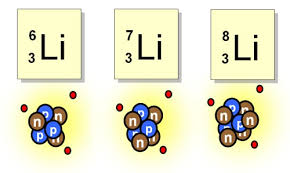
which atom has 4 neutrons?
a)
Li-6
b)
Li-7
c)
Li-8
d)
they have the same # of neutrons
100 %

