wayground logo

Free Printable Worksheets

NEW

Font size

S
M
L
XL
Worksheets

3/5 - TOTD (Flame Test, Electron Configuration, Trends)

Total questions: 25

Worksheet time: 26mins

Name
Class
Date
1.
From the following elements, which has the highest electronegativity?
a)
Na
b)
Mg
c)
Si
d)
Cl
2.
What is the electron configuration for Arsenic?
a)
1s2 2s2 2p6 3s2 3p6 4s2 4p3
b)
1s2 2s2 2p6 3s2 3p6 4s2 3d10 4p6
c)
1s2 2s2 2p6 3s2 3p6 4s2 3d10 4p3
d)
1s2 2s2 2p6 3s2 3p6 4s2 4d10 4p3
3.
Which element has the following electron configuration: [Ar] 4s2 3d10 4p4?
a)
Bromine
b)
Gold
c)
Iodine
d)
Selenium
4.
Which element has the electron configuration, 1s2 2s2 2p6 3s2 3p6 4s23d10?
a)
Phosphorus
b)
Zinc
c)
Potassium
d)
Copper
5.
Which element requires the LEAST amount of energy to remove the most loosely held electron from a gaseous atom in the ground state?
a)
Gold
b)
Bromine
c)
Lithium
d)
Beryllium
6.
Which of the following is a p block element?
a)
Ca
b)
Ar
c)
Re
d)
Au
7.
What is the last orbital filled for an element in period 4, group 4?
a)
4d4
b)
3d2
c)
4d2
d)
3f2
8.
The electron configuration of an atom is 1s22s22p6.  The number of electrons in the atom is 
a)
3
b)
6
c)
8
d)
10
9.
What is the electron configuration for this atom?
a)
1s22s22p6
b)
1s22s22p5
c)
1s22s22p3
d)
2s22p3
10.

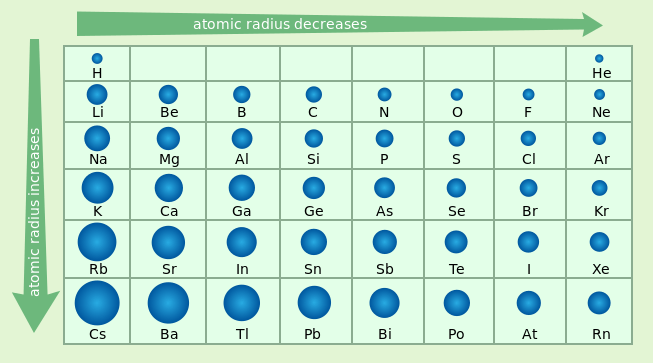
Which element has the bigger atomic radius?

a)

I

b)

F

11.

Which element has higher ionization energy?

a)

Ca

b)

Br

12.

refers to an elements tendency to attract electrons when chemically bonded to other atoms

a)

ionization energy

b)

electronegativity

c)

periodic trends

d)

atomic radius

13.

Which of the following is the condensed or short electron configuration for Iron (Fe)

a)

[Ar] 3d6

b)

[Kr]3d6

c)

[Ar] 4s2 3d6

d)

[Kr] 4s2 3d6

14.

Which of the period 3 elements has the largest electronegativity?

a)

Ar

b)

Cl

c)

Na

d)

F

15.
As you move across the periodic table atoms tend to get smaller because, ______________.
a)
the atoms have more mass.
b)
the atoms have less mass
c)
the atoms have more protons.
d)
the atoms have less electrons.
16.
Which of the following will have a lower ionization energy than Scandium (Sc)?
a)
Helium (He)
b)
Titanium (Ti)
c)
Calcium (Ca)
d)
Magnesium (Mg)
17.
Which of the following will have a higher ionization energy than arsenic (As)?
a)
Gallium (Ga)
b)
Neon (Ne)
c)
Antimony (Sb)
d)
Germanium (Ge)
18.
Which of the following will have a higher electronegativity than arsenic (As)?
a)
Carbon (C)
b)
Neon (Ne)
c)
Antimony (Sb)
d)
Germanium (Ge)
19.
Atoms that have a high electronegativity, _______________.
a)
give up their electrons more easily.
b)
hold on to their electrons more tightly.
c)
have more electron shells.
20.
The Periodic Table of the Elements is useful for revealing patterns and trends in the elements. Which statement accurately describes a pattern in the size of atomic radii in the Periodic Table of the Elements?
a)
Atomic radii decrease from left to right across a period and decrease from top to bottom in a group.
b)
Atomic radii increase from left to right across a period and increase from top to bottom in a group.
c)
Atomic radii decrease from left to right across a period and increase from top to bottom in a group.
d)
Atomic radii increase from left to right across a period and decrease from top to bottom in a group.
21.
Which of these elements has the greatest atomic radius? 
a)
H
b)
N
c)
Cl
d)
Cs
22.

What is the state when electrons move to a higher energy level upon absorption of energy?

a)

active

b)

inactive

c)

excited

d)

ground

23.
Absorption of energy by an electron results in 
a)
it moving from the ground to an excited state
b)
it moving from an excited to the ground state
c)
the emission of a photon
d)
it moving from an excited to the ground state and the emission of a photon
24.

An element has the following configuration: 1s22s22p5


How many valence electrons does this element have?

a)

1

b)

2

c)

5

d)

7

25.

When the element is heated, the electrons jump to higher energy level and this is called the ___ state.

a)

ground

b)

excited