
 Worksheets
Biocatalysis DB024
Total questions: 35
Worksheet time: 30mins
Enzymes are important biological catalysts because they:
supply the energy to initiate a biochemical reaction
increase the free energy of a biochemical reaction
lower the entropy and enthalpy of a biochemical reaction
lower the activation energy of a biochemical reaction
Most enzyme are ___________
carbohydrate
lipid
protein
DNA
Because enzymes affect the speed of chemical reactions without being consumed, they are referred to as:
hydrogen acceptors
activation energy
catalysis
cytochromes

The line on the graph labeled A represents the:
activation energy with an enzyme
activation energy without an enzyme
free energy of the reactants
change in entropy and enthalpy
Parts of the enzyme molecule that interact with a substrate are called:
cofactors
active sites
induced-fit models
reaction sites
Hydrolases are one important class of enzyme that function to catalyze ____________
splitting a molecule using water
conversions between isomers
reactions in which double bonds are formed
oxidation-reduction reactions
1. The substance on which an enzyme acts:
substrate
product
ATP
free energy
The reaction rate of an enzyme catalyzed chemical reaction would likely be affected by:
pH
substrate concentration
temperature
all of these are correct
What is an organic non-protein "helper" of an enzyme molecule called?
accessory enzyme
allosteric group
cofactor
functional group
Which of the following is true of enzymes?
Enzymes may require a non-protein cofactor or ion for catalysis to take place
Enzyme function is influenced by physical and chemical environmental factors such as pH and temperature
Enzymes increase the rate of chemical reaction by lowering activation energy
All of these are correct
Which of these statements regarding enzymes is false?
Enzymes are proteins that function as catalysts
Enzymes display specificity for certain molecules with which they interact
Enzymes increase the activation energy for the reactions they catalyze
The activity of enzymes can be regulated by other molecule
An enzyme catalyses a reaction by ___________
supplying the energy to speed up a reaction
lowering the energy of activation of a reaction
changing the equilibrium of a spontaneous reaction
increasing the amount of free energy of a reaction
The active site of an enzyme is the region that _________
binds allosteric regulators of the enzyme
is involved in the catalytic reaction of the enzyme
binds the product of the catalytic reaction
is inhibited by the presence of a coenzyme or a cofactor
Only a small amount of enzyme is needed for a large amount of substrate because _______
Enzymes do not change at the end of a reaction and as such can be reused
A small amount of enzyme can provide enough energy to continue the reaction
More enzymes are formed while reaction takes place
Enzymes act till completion of a reaction or not at all
Which of these are properties of enzymes?
Reusable
Needed in small quantity
Highly specific
Fibrous protein

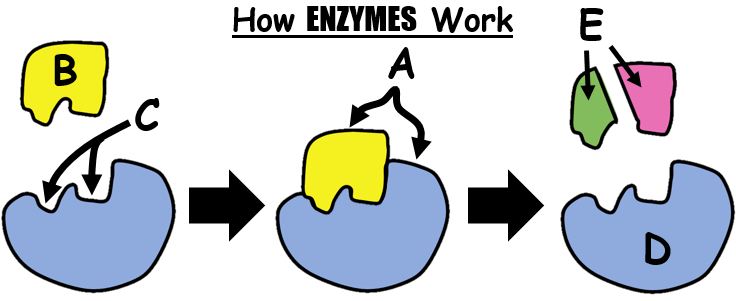
Explain model shown above
The active site is exactly complementary to substrate
The active site is highly specific
The active site is flexible
The active site is rigid

State the function of X
Binding site of substrate
Binding site of cofactor
Binding site of reactant
Binding site of inhibitor
How does enzyme lower the activation energy?
Bring substrate closer to each other
Increase the kinetic energy of substrate
Weakening the bonds inside the substrate
Bring substrate together into correct orientation
What happen when heavy metal ions bind to enzyme?
Substrate is blocked by inhibitor from binding to the active site
Enzyme is permanently denatured
Maximum rate of reaction is still reached at the end
Active site is no longer complementary with substrate
Which best describe an enzyme?
it is globular protein
act as biological catalyst
its monomer is amino acid
speed up a chemical reaction

What is structure C?
Substrate-enzyme complex
Substrate-enzyme complement
Enzyme-substrate complement
Enzyme-substrate complex
Which of the following best describe yourself?
I'm clever
I'm handsome
I'm beautiful
I'm positive
I'm strong

Watch the animation and identify the hypothesis involved
Lock and Key hypothesis
Induced Fit hypothesis
Enzyme-Substrate hypothesis

what reduces the productivity of enzymes by blocking substrates from entering active sites?
non competitive inhibitors
competitive inhibitors
coenzymes
cofactors
Which of the following are the properties of enzyme?
I Enzymes are highly specific.
II All enzymes are denatured at 60°c
III A large number of enzymes is needed to react with large number of substrate.
IV Enzymes lower the activation energy.
I only.
I and IV only.
I, II and III
I, II and IV
The protein part of an enzyme that binds to prosthetic group to form a functional enzyme is called
holoenzyme
apoenzyme
coenzyme
conjugated protein
The rate of reaction of thrombokinase in prothrombin decrease as the concentration of Ca2+ reduced. Which of the following is the role of Ca2+ ?
Competitive inhibitor
Cofactors
Coenzyme
Prosthetic group
Cofactors for enzyme are
The protein substance
The inorganic substance
The protein and non-protein substances
The non-protein substance
Enzymes are also called as...
Bioagents
Biocatalysts
Biocontrollers
Biomanagers
Enzymes are needed in a very small amount.
True
False
Enzymes remain unaffected or unchanged qualitatively and quantitatively at the end of the enzymatic reaction.
True
False

A site for substrate to fit in an enzyme is called as (a)
How do you predict your result?
I am confidence of the result
Might regret it but still excited
I am not looking forward to the result
I wish to re-do it

