wayground logo

Free Printable Worksheets

NEW

Font size

S
M
L
XL
Worksheets

P5 Forces and P1 Energy AQA

Total questions: 50

Worksheet time: 53mins

Name
Class
Date
1.

Gravitational potential energy depends on which two factors?

a)

mass and height above the ground

b)

distance and speed

c)

speed and height above the ground

d)

mass and speed

2.

A stretched rubber band represents what type of potential energy?

a)

gravitational potential energy

b)

elastic potential energy

c)

chemical potential energy

d)

kinetic potential energy

3.

At which position does the child on the swing have the most gravitational potential energy?

a)

W

b)

X

c)

Y

d)

Z

4.

Which object has elastic potential energy?

a)

a hanging leaf

b)

a burning coal

c)

a rolling ball

d)

a stretched bow

5.

When does a yo-yo have the most potential energy?

a)

When it's moving at its top speed.

b)

When it's moving between its highest and lowest points.

c)

When it's at its lowest point.

d)

When it's at its highest point.

6.

The energy of moving matter is called ____________.

a)

gravitational potential energy

b)

elastic potential energy

c)

kinetic energy

d)

potential energy

7.

What unit is used for the Potential Energy of a spring?

a)

Newton

b)

meter

c)

Joule

d)

m/s^2

8.
Which type of potential energy causes the arrow to shoot from the bow?
a)
kinetic
b)
elastic
c)
chemical
d)
gravitational
9.

The diagram shows the same spring being stretched at different lengths using different masses. At which length does the spring have the MOST potential energy?

a)

length A

b)

length B

c)

length C

d)

length D

10.
What does elastic energy depend on?
a)
deformation and rigidity
b)
deformation and mass
c)
rigidity and elasticity
d)
mass and elevation
11.

Elastic Potential Energy is _____________________________________.

a)

the ability of a material to return to its original shape after it has been stretched or deformed.

b)

potential energy that is stored due to the deformation of an elastic object, such as a stretched spring.

c)

energy stored in the bonds of chemical compounds. Chemical energy is released during chemical reactions.

d)

the energy contained within a system that is responsible for its temperature.

e)

the flow of thermal energy.

12.

If F is force, k is spring constant and e is extension, Hooke's Law tells us that:

a)

F=k/e

b)

e=Fk

c)

k=Fe

d)

F=ke

13.
A stiff material has a:
a)
high spring constant
b)
low spring constant
c)
spring constant of any value
d)
spring constant which is difficult to predict
14.
A spring extends 1.5m under load 10N. What is its spring constant?
a)
0.15N/m
b)
10N/m
c)
6.7N/m
d)
15N/m
15.
Which statement most accurately represents Hooke's Law?
a)
a) Extension of a spring is proportional to the force applied.
b)
b) Extension of a spring is proportional to the number of coils.
c)
c) Extension of a spring is inversely proportional to the force applied.
d)
d) Thickness of a spring wire is proportional to the force applied.
16.

Spring constant is measured in

a)

N

b)

N/m

c)

m

17.
What force should be applied to compress a spring by 0.013 m if its spring constant is k = 1900 N/m?
a)
1880 N
b)
24.7 N
c)
1900 N
d)
0.127 N
18.
Hooke's Law fails when a material reaches its:
a)
breakdown
b)
elastic limit
c)
end of tether
d)
fracture stress
19.

At point P, _______.

a)

the force applied to the spring is equal to its elongation

b)

Hooke's Law ceases to be valid

c)

the spring is can be stretched but still springs back into shape reversibly

d)

the spring constant increases

20.
If extension = Stretched length - original length. What is the extension of spring D.
a)
1mm
b)
2mm
c)
3mm
d)
0mm
21.

The formula for calculating elastic potential energy (Ee) is...

a)

2 x spring constant x extension2

b)

1/2 x spring constant2 x extension

c)

1/2 x spring constant x extension2

d)

1/2 x mass x extension2

22.

When you compress a spring, you are storing __________ energy.

a)

sound

b)

elastic

c)

light

d)

chemical

23.
At which point is potential energy greatest?
a)
W
b)
X
c)
Y
d)
Z
24.
What word best describes Kinetic Energy?
a)
Stored
b)
Motion
c)
Elastic
d)
Gravity
25.
Gravitational Potential energy increases as _________ increases.
a)
Speed
b)
Elasticity
c)
Height
d)
Movement
26.

Gravitational potential energy depends on the strength of gravity, ________ and ________ of the object.

a)

height and mass

b)

friction and movement

c)

mass and movement

d)

height and friction

27.
Which object has the most kinetic energy?
a)
a hibernating bear
b)
a sleeping baby
c)
a book on the library shelf
d)
a swimming seal
28.
The faster an object moves, the ________ kinetic energy it has. 
a)
more
b)
less
c)
none of the above
d)
all of the above 
29.
Which is the best example of kinetic energy?
a)
a car parked on a steep hill 
b)
a tennis ball rolling across the court
c)
a picture hanging on the wall 
d)
a piece of coal before it's burned 
30.
As mass increases, KE ...
a)
increases
b)
decreases
c)
stays the same
31.
How much KE does a moving 6 kilogram object have if it moves with a velocity of 3 m/s?
a)
27 J
b)
18 J
c)
9 J
d)
2 J
32.

How much force is needed to accelerate a 3kg skateboard at 5m/s2.

a)

8N

b)

1.6N

c)

0.6N

d)

15N

33.

How much force is needed to accelerate a 25kg bowling ball at 2m/s2.

a)

50N

b)

5N

c)

12.5N

d)

100N

34.

If a 2kg bird is pushed by the wind with a force of 2N, how fast does the bird accelerate?

a)

1 m

b)

2 m/s2

c)

4m/s2

d)

1 m/s2

35.
What is a force?
a)
A force is a push or pull.
b)
A force is anything that acting on another object.
c)
A force can be balanced or unbalanced.
d)
all of the above
36.
What is the magnitude (size) and direction of the net force?
a)
14 N Down
b)
14 N Up
c)
6 N Up
d)
6 N Down
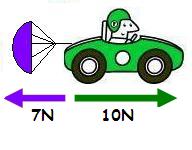
37.
What is the magnitude (size) and direction of the net force?
a)
10 N to the Right
b)
10 N to the Left
c)
0 N
d)
8 N to the Left
38.
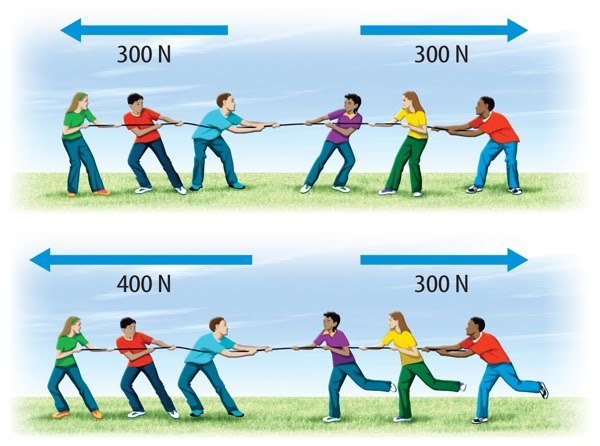
Which one is balanced?
a)
top
b)
bottom
c)
both
39.
What is the unit for FORCE? 
a)
N (Newtons)
b)
lbs (pounds)
c)
g (grams)
d)
m/s (meters per second)
40.
If there are two forces going in the SAME direction, you would ...?
a)
(-) Subtract the forces
b)
(+) Add the forces
c)
Neither
d)
(x) Multiply
41.
Forces that have a force of Zero (0).
a)
Balanced force
b)
Unbalanced force
42.

If the net force is 0 the object will ...

a)

CHANGES motion

b)

STAY the SAME, NOT Move

43.
What is the net force?
a)
17 N Right
b)
3 N Right
c)
3 N Left
d)
17 N Left
44.
Calculate the net force of the object in the image shown.
a)
20N
b)
35N
c)
5N
d)
25N
45.
Which direction will the object move?
a)
Up
b)
Down
c)
Right
d)
Left
46.
Is this a balanced or unbalanced force?
a)
Balanced
b)
Unbalanced
c)
Neither
d)
Both
47.
If a 2kg bird is pushed by the wind with a force of 2N, how fast does the bird accelerate?
a)
1 m
b)
2 m/s2
c)
4m/s2
d)
1 m/s2
48.
For an object to remain at rest, which of the following must be true? 
a)
The forces on it are balanced
b)
There is no friction
c)
Gravity does not act on it
d)
The object has no mass
49.
Newton's law of motion describes the relationship of force, mass, and acceleration. Write the equation.
a)
M=F/A
b)
F=MA
c)
A= F/M
d)
All of the above
50.
If you increase the force on an object, its acceleration? 
a)
decreases
b)
stays the same
c)
also increases
d)
stops