
 Worksheets
Translations in Coordinate Plane ,Vectors
Total questions: 35
Worksheet time: 1hrs 16mins
Level 1: When a figure is translated down what happens?
The x-coordinate gets smaller (subtract from x)
The y-coordinate gets smaller (subtract from y)
The x-coordinate gets larger (add to x)
The y-coordinate gets larger (add to y)
Level 1: When a figure is translated to the right, what happens?
The y-coordinate gets smaller (subtract from y)
The y-coordinate gets larger (add to y)
The x-coordinate gets smaller (subtract from x)
The x-coordinate gets larger (add to x)

Level 2: Where would point J' be if you translated point J 5 units to the left and 2 units up?
(5, 3)
(3, -5)
(-5, 3)
(-3, 5)

Level 2: How is triangle ABC being translated to triangle A'B'C'?
up 3, left 8
up 9, left 4
down 3, right 8
down 9, right 4

Level 2: How would you translate point P to P'?
Translate 2 units to the right and 8 units down
Translate 3 units down and 2 units to the right
Translate 4 units down and 4 units to the left
Translate 8 units to the right and 2 units down

Level 2: How is trapezoid ABCD translated to trapezoid A'B'C'D'?
Translated 5 units down and 5 units to the right
Translated 5 units down and 1 to the right
Translated 8 units down and 5 units to the right
Translated 5 units down and 4 units to the right

Level 3: What rule translates the blue shape to the green shape?
(x, y) --> (x + 5, y + 2)
(x, y) --> (x - 5, y - 2)
(x, y) --> (x + 5, y + 5)
(x, y) --> (x - 5, y - 5)
Level 3: Point K (4, 2) is translated using this rule:
(x, y)----> (x + 3, y - 1)
What are the coordinates of K'?
(6, 3)
(7, 3)
(7, 1)
(5, 3)
Level 3: Write the rule for this translation:
Slide 3 up and 2 right
(x, y)---->(x + 3, y + 2)
(x, y)-----> (x+2, y + 3)
(x, y)----> (x - 2, y + 3)

Level 3: What rule translates the green shape to the blue shape?
(x, y) --> (x - 3, y - 3)
(x, y) --> (x + 3, y + 3)
(x, y) --> (x + 2, y + 3)
(x, y) --> (x - 2, y - 3)
Level 3: Point M (-3, 5) is translated using this rule.
(x, y) ----> (x - 1, y)
What are the coordinates of M'?
(-4, 5)
(-2, 5)
(-4, 4)
None of these

Level 3: What rule describes the translation?
(x - 6, y + 2)
(x - 2, y + 6)
(x + 2, y - 6)
(x + 6, y - 2)
Level 3: What transformation is happening?
(x, y) ----> (x + 2, y - 3)
slide up 2, left 3
slide right 2, up 3
slide right 2, down 3
slide left 3, right 2

Level 4: Write a rule for the translation.
(x -1, y + 2)
(x -2, y + 1)
(x +2, y - 1)
(x +1, y - 2)

Level 4: Find the image of A after a translation of (x - 2, y - 6).
B
E
D
C

Level 4: How was B translated to B' if B' is at (4, -2)?
Translated 6 units down
Translated 2 units to the left and 6 units down
Translated 2 units to the right and 6 units down
Translated 2 units to the right
Level 4: What are the coordinates of B (pre-image) if B' (image) is located at (-9, 3) and was obtained by a translation 4 units down and 3 units right?
(-6, -1)
(-13, 6)
(-5, 6)
(-6, 7)

Level 4: Translate shape C to shape A and then from shape A to shape B?
(x, y) --> (x + 3, y + 5) and
(x, y) --> (x + 2, y - 4)
(x, y) --> (x - 3, y - 5) and
(x, y) --> (x + 3, y + 5)
(x, y) --> (x - 2, y + 4) and
(x, y) --> (x + 2, y - 4)
(x, y) --> (x + 2, y - 4) and
(x, y) --> (x + 3, y + 5)
Vector is a quantity with:
magnitude and direction
magnitude
direction
none of the above

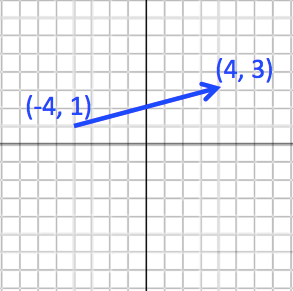
Write in component form.
<-8, -2>
<8, 2>
<2, 8>
<-2, -8>

Component Form
<-3, -7>
<3, -7>
<-3, 7>
<7, 3>
Write in component form.
<0, 4>
<8, 2>
<2, 8>
<0, 2>

Horizontal component
-18
5
18
-5
A vector is a ray with both ____________ and _____________.
Wings and halos
Space and time
Direction and magnitude
Radicals and exponents
True or False: Rigid motions preserve angle measure.
True
False

Identify the transformation:
Rotation
Reflection
Translation
Dilation

