
 Worksheets
Bacteria and Viruses
Total questions: 33
Worksheet time: 41mins
Which of the following is true for both bacteria and viruses?
both contain genetic material
can be killed using antibiotics
have a cell membrane
have a protein coat
Which statement is true about viruses?
Viruses can eat and metabolize food.
Viruses can reproduce only using a host cell.
Viruses can reproduce on their own at any time.
Viruses contain DNA, so they are alive.
The use of what modern technology has cause the rise in resistant bacteria
vaccines
antibiotics
fertilizers
solar panels
One important way to control the spread of viruses in through
the use of vaccines
drinking a lot of tea
the use of other types of bacteria
the use of antibiotics
What type of cells contain a nucleus?
bacterial cells
virus cells
prokaryotic cells
eukaryotic cells
Which of these is characteristic of both viruses and bacteria?
They get their energy from their environment.
They can reproduce on their own.
They can form crystals and become dormant.
They contain proteins and nucleic acids.
A bacterium reproduces asexually by dividing to form two new bacterial cells. What is the name of the process by which bacteria reproduce?
meiosis
mitosis
budding
binary fission
Which of the following is a risk of overusing antibiotics to treat infections>
Bacteria may become resistant to antibiotics.
Antibiotics increase the rate of infection.
Antibiotics cause other diseases to develop.
Antibiotics only work once.
Bacteria come in which of the following shapes?
rod, cone, spiral
rod, sphere, spiral
rod, sphere, cone
sphere, cone, spiral
What do viruses need to reproduce?
Genetic material
A host cell
Bacteria
Insulin

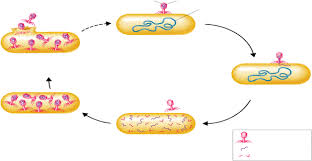
Which viral life cycle kills its host cell by lysing (bursting)?
Lysogenic Cycle
Lytic Cycle
Binary Fission
Conjugation
Can a virus be cured with antibiotics?
yes
no
Which is most often used to destroy bacteria?
vaccine
antibiotics
vitamins
water
Tiny single-celled organisms that live almost everywhere
ribosomes
cytoplasm
bacteria
virus
Bacteria are prokaryotes, meaning they ________.
lack a nucleus
are very large
contain no DNA
have a cytoplasm

Viruses that only attacks bacteria are call a...?
Capsulated
Helical
Bacteriophage
Bacteria Vectors
Which processes allows for the viruses DNA to lay "dormant" or hide in the host DNA while the cell reproduces?
Lytic
Lysogenic
Enveloped
Capsid

Which of the following terms could be used to describe this bacterium? (Select all the apply).
Gram Positive
Gram Negative
Bacillus
Coccus
Staphlo

Which term(s) would be used to describe this bacterium?
Select all that apply.
Gram Positive
Gram Negative
Staphlo
Strepto
Coccus

Which terms would be used to describe this bacterium?
Gram Negative
Spirillus
Strepto
Bacillus
Flagellated.
Which of the following is not a economical use for bacterium?
Food Production
Oil Refining
Water treatment
Decomposer

What shape is this bacterium?
Spirillus
Bacillus
Coccus
Streptus
How do most viruses get inside their host?
Endocytosis
Injecting their DNA into host
Pinocytosis
Plasmolysis
What is the protein coat that surrounds the nucleic acid of a virus called?
Capsid
Plasmid
Capsule
Receptor
An antibiotic will start making you feel better quicker if the bacteria causing the problem has what type of toxin?
Endotoxin
Exotoxin
What do we call the length of time from the time a virus invades it's first host cell and the time we experience symptoms?
Incubation
Infection
Systemic Reaction
Succumbination
A fragment, smaller than a virus, that can be pathogenic to plants, but lacks a capsid is called a what?
Bacterium
Viroid
Prion
Vector
A viral protein that lacks any genetic material, and causes Mad Cow Disease is known as a...?
Vector
Bacterium
Viroid
Prion
Which of the following is one of the MOST important roles bacteria play in the environment?
Nitrogen Fixation
Food production
Water Treatment
Producer

