wayground logo

Free Printable Worksheets

NEW

Font size

S
M
L
XL
Worksheets

Cell Division

Total questions: 60

Worksheet time: 45mins

Name
Class
Date
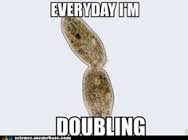
1.

Name the process in the diagram.

a)

Meiosis

b)

Mitosis

c)

Endocytosis

d)

Phagocytosis

2.
Which type of reproduction leads to increased genetic variation on a population? 
a)
Parthenogenesis 
b)
Asexual reproduction 
c)
Sexual reproduction 
d)
Vegetative reproduction 
3.
Which of the following best describes cancer?
a)
absence of cyclins in the DNA
b)
Multiple gene mutations on a chromosome of DNA
c)
Uncontrolled cell growth caused by mutations in genes that control the cell cycle.
d)
Presence of genetic defects caused by hereditary disorders. 
4.
Which of the following phases of mitosis is represented by the diagram below? 
a)
Prophase
b)
Metaphase 
c)
Anaphase 
d)
Telophase 
5.
What letter correctly represents structure X in the diagram? 
a)
Spindle fibers
b)
Cleavage Furrow 
c)
Chromosomes
d)
Centrioles
6.

Which phase of Mitosis is shown here?

a)

Anaphase

b)

Cytokinesis

c)

Telophase

d)

Metaphase

7.

Which phase of Mitosis is shown here?

a)

Cytokinesis

b)

Interphase

c)

Anaphase

d)

Metaphase

8.

Which phase of Mitosis is shown here?

a)

Cytokinesis

b)

Anaphase

c)

Telophase

d)

Prophase

9.

Humans have ________ pairs of chromosomes.

a)

21

b)

23

c)

46

d)

None of the above

10.

The structures labeled B are

a)

centrioles

b)

sister chromatids

c)

centromeres

d)

chromatin

11.

The structure labeled A is a(n)

a)

chromatid

b)

centriole

c)

centromere

d)

chromophere

12.

If a somatic (body) cell in a butterfly contains 24 chromosomes, a butterfly egg would contain

a)

3

b)

6

c)

12

d)

24

13.

How many daughter cells are produced at the end of meiosis?

a)

1

b)

2

c)

3

d)

4

14.

A male shark has 40 chromosomes in each of its sex cells. How many would be present in its body cells?

a)

20

b)

40

c)

80

d)

160

15.

What is the result of mitotic cell division?

a)

1 cell

b)

2 genetically identical cells

c)

2 genetically different cells

d)

4 genetically identical cells

16.
Which of the following terms means cytoplasmic division?
a)
interphase
b)
mitosis
c)
cytokinesis
d)
cell cycle
17.

What phase is represented by letter A?

a)

Anaphase

b)

Metaphase

c)

Prophase

d)

Telophase

18.
What phase is represented by letter C?
a)
Anaphase
b)
Metaphase
c)
Prophase
d)
Telophase
19.

The structure of coiled DNA and proteins that forms in the nucleus prior to mitosis, so that the DNA can be organized and split evenly, is

a)

centriole

b)

chromatin

c)

chromosome

20.
Put the stages of mitosis in the correct order.
a)
prophase - metaphase - anaphase - telophase
b)
metaphase - anaphase - prophase - telophase
c)
anaphase - prophase - telophase - metaphase
d)
telophase - metaphase - prophase - anaphase
21.
What is the longest stage of the cell cycle called?
a)
Cytokinesis
b)
M phase
c)
Interphase
d)
G1 Phase
22.
During which stage of the cell cycle does mitosis and cytokinesis occur?
a)
Interphase
b)
S phase
c)
M phase
d)
G1 phase
23.
During what phase of the cell cycle is DNA replicated?
a)
G1 phase
b)
S phase
c)
G2 phase
d)
M phase
24.
During what phase of the cell cycle does the cell grow?
a)
G1 phase
b)
S phase
c)
M phase
d)
Cytokinesis
25.
During what phase of the cell cycle does the cell prepare for mitosis?
a)
G1 phase
b)
S phase
c)
G2 phase
d)
M phase
26.
Cancer creates abnormal cells by disrupting
a)
the cell cycle
b)
red blood cell formation
c)
DNA replication
d)
ATP synthesis
27.

An abnormal mass of cells is called a

a)

tumor

b)

cyst

c)

lesion

d)

growth factor

28.
Metastasis is
a)
the spread of cancer from one part of the body to another.
b)
the growth of tumors in the lungs
c)
cancer of the blood cells
d)
cancer that is found in connective tissues
29.
What is cell differentiation?
a)
Process by which cells produce more cells
b)
Process by which cells become specialized
c)
Process by which cells become unspecialized
d)
Process by which cells die
30.
Stem cells are
a)
cells that grow uncontrollably
b)
undifferentiated and can be any type of cell
c)
never go through cell division
d)
only found in embryos
31.
Crossing over occurs in which phase ?
a)
metaphase I
b)
anaphaseII
c)
telophaseII
d)
prohase I
32.
A fertilized egg is called
a)
egg
b)
lettuce
c)
zygote
d)
sperm
33.
What phase is shown here?
a)
Prophase II
b)
Metaphase I
c)
Metaphase II
d)
Anaphase I
34.
What phase is shown here?
a)
Metaphase II
b)
Telophase I
c)
Telophase II
d)
Metaphase I
35.
What phase is shown here?
a)
Anaphase I
b)
Prophase I
c)
Metaphase II
d)
 Metaphase I
36.
What phase is shown here?
a)
Telophase II
b)
Anaphase II
c)
Metaphase I
d)
Interphase I
37.
What phase is shown here?
a)
Telophase I
b)
Metaphase II
c)
Telophase II
d)
Anaphase I
38.
What phase is this?
a)
Interphase II
b)
Prophase I
c)
Metaphase I
d)
Anaphase II
39.
What phase is shown here?
a)
Anaphase II
b)
Metaphase I
c)
Anaphase I
d)
Telophase II
40.
Which process and type of resulting cells are represented?
a)
mitosis, gametes
b)
mitosis, body cells
c)
meiosis, gametes
d)
meiosis, body cells
41.

What is it called when a sperm and egg fuse?

a)

meiosis

b)

fertilization

c)

cell division

d)

mitosis

42.
The chromosomes that pair up during meiosis, are called __________ chromosomes.  
a)
homozygous 
b)
asexual
c)
homologous
d)
genes
43.
Crossing over helps promote 
a)
male genotype
b)
genetic variation
c)
DNA replication
d)
mitosis
44.
A human zygote should have _____ chromosomes inside.
a)
46
b)
23
c)
92
d)
64
45.
Females have ____ and males have _____ chromosomes.
a)
XX, XY
b)
XY, XX
c)
XX, XX
d)
XY, XY
46.

What is the abnormality?

a)

Trisomy 13

b)

Monosomy 21

c)

47, XXY

d)

Trisomy 21

47.
Diploid Cells are represented by
a)
2n
b)
n
c)
4n
d)
1/2 n
48.
What causes genetic variation in meiosis?
a)
chromosomes lining up
b)
crossing over of chromosomes
c)
separation of chromosomes
d)
chromosomes pulling apart
49.
What is one reason why we need meiosis?
a)
To double the number of chromosomes going into sex cells
b)
To halve the number of chromosomes going into sex cells
c)
To triple the number of chromosomes going into sex cells
d)
To not change the number of chromosomes going into sex cells
50.
When does the nuclear membrane break down?
a)
anaphase
b)
telphase
c)
prophase
d)
metaphase
51.
Which of the following is NOT a part of mitosis?
a)
prophase
b)
anaphase
c)
metaphase
d)
interphase
52.

If a parent cell has 26 chromosomes, how many chromosomes would each daughter cell contain after mitosis and cytokinesis?

a)

42

b)

13

c)

26

d)

1738

53.
In the G1 stage of the cell cycle, the cell ______.
a)
Grows
b)
Rests
c)
Replicates DNA
d)
Divides
54.
Mitosis results in...
a)
Four 1n cells
b)
Four 2n cells
c)
Two 1n cells
d)
Two 2n cells
55.
Which sex chromosomes would indicate a typical human male?
a)
XX
b)
X
c)
XY
d)
XXY
56.
Is this Karyotype human?
a)
Yes
b)
No
c)
Impossible to Determine
57.

Which structure is labeled as A in the diagram?

a)

Centromere

b)

Replicated Chromosome

c)

Sister chromatids

d)

Unreplicated Chromosome

58.
A pair of identical chromosomes shown in a karyotype, one inherited from mom, and one inherited from dad are called
a)
sister chromotids
b)
centromeres
c)
homologous chromosomes
d)
autosomes
59.
Which would be considered a somatic cell?
a)
Sperm cell
b)
Egg Cell
c)
Skin Cell
d)
All of these
60.

What would you call the failure of one or more pairs of homologous chromosomes or sister chromatids to separate normally during meiosis?

a)

nondisjunction

b)

anaphase I

c)

nondiploidy

d)

karyotype