wayground logo

Free Printable Worksheets

NEW

Font size

S
M
L
XL
Worksheets

3/11 Quiz Food Chains/Energy Pyramid

Total questions: 50

Worksheet time: 49mins

Name
Class
Date
1.

Makes its own food

a)

Herbivore

b)

Carnivore

c)

Heterotroph

d)

Autotroph

2.

Cannot make its own food

a)

Autotroph

b)

Producer

c)

Heterotroph

d)

Biomass

3.

Only eats plants

a)

Herbivore

b)

Carnivore

c)

Omnivore

d)

Decomposer

4.

Only eats meat

a)

Herbivore

b)

Carnivore

c)

Omnivore

d)

Producer

5.

Get their energy from the sun and make their own food

a)

Decomposer

b)

Heterotroph

c)

Biomass

d)

Producer

6.

Eats other organisms

a)

Producer

b)

Decomposer

c)

Consumer

d)

Autotroph

7.

Eats dead organisms and returns nutrients to soil

a)

Autotroph

b)

Decomposer

c)

Biomass

d)

Carnivore

8.

Process through which plants make their own food

a)

Photosynthesis

b)

Autotroph

c)

Biomass

d)

Trophic

9.

Which organisms eat only producers?

a)

Secondary Consumers

b)

Apex Predators

c)

Tertiary Consumers

d)

Primary Consumers

10.

Which level is found at the top?

a)

Primary Consumers

b)

Tertiary Consumers

c)

Producers

d)

Secondary Consumers

11.

What would happen to the bird if the green fish died out?

a)

the bird population would grow

b)

the bird population would die out

c)

the smaller fish will die out

12.

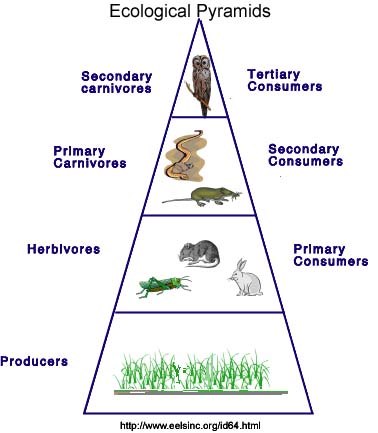
What does an energy pyramid show?

a)

Energy flow in a community

b)

Longest lifespans

c)

The stronger animal the higher it is on the pyramid

13.

What would happen if their were no producers?

a)

Every population would grow larger

b)

Everything would die out

c)

The animals would make their own food

14.

What would happen if the primary consumers died out?

a)

the producers would grow and the secondary and tertiary consumers would die

b)

producers would die out

c)

consumers would grow

15.
In an energy pyramid, energy_______ as you move up the pyramid.
a)
Increases
b)
Decreases
c)
Stays the same
d)
Changes up and down
16.
In the energy pyramid here, how much of the energy in the producers gets passed to the herbivores?
a)
10%
b)
20%
c)
80%
d)
90%
17.
A food pyramid represent the relative amount of energy in trophic levels. Which of the following correctly shows a food pyramid?
a)
A
b)
B
c)
C
d)
D
18.
The deer, grasshopper, and bird are all examples of which type of consumers on this food pyramid?
a)
decomposers
b)
omnivores
c)
carnivore
d)
herbivore
19.
In the energy pyramid here, which organisms have the most energy available?
a)
Producers
b)
Carnivores
c)
Herbivores
d)
Top Predator
20.
In the energy pyramid below, which organism has the least amount of energy available?
a)
Producers
b)
Herbivores
c)
Carnivores
d)
Top Predator
21.
If there is 1000 Kcal available in the producers in trophic level 1, how much energy is available in the herbivores in trophic level 2?
a)
10 Kcal
b)
1 Kcal
c)
100 Kcal
d)
1000 Kcal
22.
If these organisms were arranged in a food pyramid, which organism would have the least amount of total energy available?
a)
coyote
b)
insect
c)
lizard
d)
shrub
23.
The largest group of organisms found in a food web would be:
a)
Primary Consumers
b)
Producers
c)
Decomposers
d)
Tertiary Consumers
24.
All organisms need _____ to survive.
a)
Environment
b)
energy
c)
sun
d)
plants
25.
what is a human considered?
a)
producer
b)
consumer
c)
decomposer
26.
Bacteria and fungi typically serve what role in an ecosystem?
a)
herbivore
b)
carnivore
c)
omnivore
d)
decomposer
27.
Where does the energy start in this food chain?
a)
Plant
b)
Sun
c)
Deer
d)
Wolf
28.

Which of these is an organism that does not depend on another living thing for food?

a)

the Sun

b)

an insect

c)

a plant

d)

an animal

29.

What does the arrow point to in a food chain?

a)

only the plants in a food chain

b)

only the animals in a food chain

c)

the organism that gets the energy

d)

the organism that lives the longest

30.

Which organism is getting energy from the mouse?

a)

cricket

b)

grass

c)

fox

d)

Sun

31.
Which best describes what a food chain shows you?
a)
Energy flow through an ecosystem
b)
Food flowing through an ecosystem
c)
Consumers going into other consumers
d)
Who eats who
32.
What's the role of consumers in a food chain?
a)
Use sunlight to make food 
b)
Eat other species and keep them from overpopulating
c)
Break down dead stuff
d)
Add nutrients to the soil
33.
Which type of consumer could be a first or second consumer?
a)
Herbivore
b)
Omnivore
c)
Carnivore
d)
Producer
34.
Which type of consumer is always a first consumer?
a)
Herbivore
b)
Omnivore
c)
Carnivore
d)
Producer
35.

The shortgrass prairie is an ecosystem found in the Great Plains. Many different populations of animals depend on the prairie ecosystem for survival. A typical community includes animals such as snakes, birds, mice, rodents, and insects.


Which food chain most accurately demonstrates the flow of energy in a shortgrass prairie ecosystem?

a)

grasshopper → bird → rodent → buffalo

b)

hawk → snake → mouse → grasshopper

c)

grasshopper → mouse → snake → hawk

d)

snake → hawk → skunk → mouse

36.

Observe the food chain above. Which organism’s population would increase if finches were removed from the ecosystem?

a)

Grass

b)

Grasshopper

c)

Snake

d)

Hawk

37.

The roadrunner is a desert bird that eats fruits and seeds. It also eats insects, spiders, scorpions, and rattlesnakes.


What would likely happen if the roadrunner population disappeared from its ecosystem?

a)

There would be no more fruits or seeds.

b)

There would a decrease in spider populations.

c)

The rattlesnake population would stay the same.

d)

There would be an increase in scorpion populations.

38.

The diagram shows a grassland food chain. If the mice are removed from this food chain, which animal population would most likely be affected first?

a)

Plant Seeds

b)

Field Mice

c)

Snakes

d)

Mountain Lions

39.

In this food chain, where does the lizard get its energy from?

a)

plant

b)

grasshopper

c)

mushrooms

d)

sun

40.
Which of the following best describes the blue bird's (in the middle) role in this ecosystem?
a)
carnivore
b)
omnivore
c)
herbivore
d)
decomposer
41.
Which of the following best describes the deer's role in the ecosystem?
a)
herbivore
b)
omnivore
c)
carnivore
d)
decomposer
42.
Which of the following would be the most likely effect, if there were a sudden increase in the cricket population?
a)
There would be a decrease in the small bird population.
b)
There would be a decrease in the grass/flowers population.
c)
There would be a decrease in the mice population.
d)
There would be an increase in the grass/flowers population.
43.
Which food chain is in the correct order?
a)
cat, grass, bird, snail
b)
bird, snail, grass, cat
c)
grass, snail, bird, cat
d)
grass, cat, bird, snail
44.
Plants need what to do photosynthesis?
a)
Food absorbed from ground
b)
Sun's energy
c)
Food broken down
d)
Minerals from the soil
45.
What three things are needed for a plant to do photosynthesis?
a)
Glucose, Oxygen, Sunlight
b)
CO2, Oxygen, Sunlight
c)
CO2, Water, Sunlight
d)
Oxygen, Water, Sunlight
46.
What two products does a plant make during photosynthesis?
a)
Water and Glucose
b)
Oxygen and Glucose
c)
Oxygen and Water
d)
CO2 and Glucose
47.
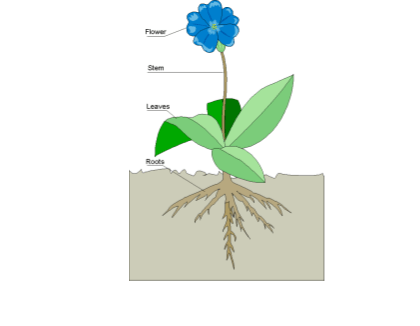
Which plant part absorbs water and nutrients?
a)
Leaf
b)
Stem
c)
Roots
d)
Flower
48.
Which plant part collects the sun's energy and makes food?
a)
Leaf
b)
Stem
c)
Roots
d)
Flower
49.
What is the name of the green pigment inside plants?
a)
Monophyll
b)
Chlorophyll
c)
Epiphyll
d)
Glorophyll
50.

What is the energy transfer in photosynthesis?

a)

chemical energy to radiant energy

b)

radiant energy to electrical energy

c)

radiant energy to chemical energy

d)

mechanical energy to electrical energy