wayground logo

Free Printable Worksheets

NEW

Font size

S
M
L
XL
Worksheets

AP Unit 5 Review

Total questions: 57

Worksheet time: 42mins

Name
Class
Date
1.

In Darwin's thinking, the more closely related two different organisms are, the

a)

more similar their habitats are.

b)

less similar their DNA sequences are.

c)

more recently they shared a common ancestor.

d)

less likely they are to have the same genes in common.

e)

more similar they are in size.

2.

During drought years on the Galapagos, small, easily eaten seeds become rare, leaving mostly large, hard-cased seeds that only birds with large beaks can eat. If a drought persists for several years, what should one expect to result from natural selection?

a)

Small birds gaining larger beaks by exercising their mouth parts.

b)

Small birds mutating their beak genes with the result that later-generation offspring have larger beaks.

c)

Small birds anticipating the long drought and eating more to gain weight and, consequently, growing larger beaks.

d)

More small-beaked birds dying than larger-beaked birds. The offspring produced in subsequent generations have a higher percentage of birds with large beaks.

e)

Larger birds eating less so smaller birds can survive.

3.

Structures as different as human arms, bat wings, and dolphin flippers contain many of the same bones, these bones having developed from very similar embryonic tissues. How do biologists interpret these similarities?

a)

By identifying the bones as being analogous

b)

By the principle of convergent evolution

c)

By proposing that humans, bats, and dolphins share a common ancestor

d)

By looking at where the animals live

4.

When we say that an individual organism has a greater fitness than another individual, we specifically mean that the organism

a)

lives longer than others of its species.

b)

competes for resources more successfully than others of its species.

c)

mates more frequently than others of its species.

d)

utilizes resources more efficiently than other species occupying similar niches.

e)

leaves more viable offspring than others of its species.

5.

Which describes an African butterfly species that exists in two strikingly different color patterns?

a)

artificial selection

b)

directional selection

c)

stabilizing selection

d)

disruptive selection

e)

sexual selection

6.

Fossil evidence indicates that horses have gradually increased in size over geologic time. Which of the following terms best describes this?

a)

artificial selection

b)

directional selection

c)

stabilizing selection

d)

disruptive selection

e)

sexual selection

7.

Most Swiss starlings produce four to five eggs in each clutch. Those producing fewer or more than this have reduced fitness. Which of the following terms best describes this?

a)

artificial selection

b)

directional selection

c)

stabilizing selection

d)

disruptive selection

e)

sexual selection

8.

Males of different species of the fruit fly Drosophila that live in the same parts of the Hawaiian islands have different elaborate courtship rituals that involve fighting other males and stylized movements that attract females. What type of reproductive isolation does this represent?

a)

habitat isolation

b)

temporal isolation

c)

behavioral isolation

d)

gametic isolation

e)

postzygotic barriers

9.

The greatest degree of genetic variability would be expected among organisms that reproduce via

a)

budding

b)

sexual recombination

c)

vegetative propagation

d)

mitosis

e)

sporulation

10.

Homologous structures are often cited as evidence for evolution. All of the following are examples of homologous structures EXCEPT

a)

the wings of a bird and with wings of a bat

b)

the flippers of a whale and the arms of a man

c)

the pectoral fins of a porpoise and the flippers of a seal

d)

the forelegs of an insect and the forelimbs of a dog

e)

the hind legs of a lizard and the legs of a chicken.

11.

All of the following are part of Hardy Weinberg law for populations in equilibrium EXCEPT

a)

Large population

b)

No immigration or emigration

c)

No natural selection

d)

Non random mating

e)

No genetic mutations

12.

All of the following are part of Hardy Weinberg law for populations in equilibrium EXCEPT

a)

Large population

b)

No immigration or emigration

c)

No natural selection

d)

Non random mating

e)

No genetic mutations

13.

What does a phylogenetic tree show?

a)

shows how living organisms are related to each other using evidences

b)

organizes living organisms by color

c)

shows how living organisms interact with each other in the real world

d)

shows how certain organisms grow based on their genes

14.
Using the cladogram:  a common ancestor of amphibians and ray-finned fish would have
a)
a bony skeleton
b)
four limbs
c)
scaly skin
d)
eggs with shells
15.

In a population that is in Hardy-Weinberg equilibrium, the q value is .4.  What is the percentage of the population heterozygous for this allele?

a)

4 percent

b)

16 percent

c)

32 percent

d)

48 percent

16.
The establishment of a genetically unique population through genetic drift
a)
adaptive radiation
b)
divergent evolution
c)
founder effect
d)
convergent evolution
17.
The Tasmanian devil is a marsupial that resembles the North America wolf, which is a placental mammal.
a)
adaptive radiation
b)
divergent evolution
c)
founder effect
d)
convergent evolution
18.
variations in a population are maintained by
a)
mutations
b)
genetic recombination
c)
gene flow
d)
all of the above
19.
which of the following is NOT a requirement for Hardy-Weinberg equilibrium?
a)
small population
b)
no gene flow
c)
no mutations
d)
no selection
20.
What is speciation?
a)
combining of tow species to form one with different traits
b)
isolation that affects mating behaviors
c)
timing of mating that prevents normal sexual selection
d)
divergence of two or more species from an existing one
21.
What is suggested by the similarity of early embryos of different species of vertebrates?
a)
no evolutionary relationships between the groups
b)
recent common ancestry
c)
similar environments in the past
d)
evolution from a distant common ancestor
22.
If an organism has a vestigial structure, that structure likely once had a function in a(n)
a)
close relative
b)
early ancestor
c)
unrelated organism
d)
embryological stage
23.
Which of the following statements is correct based on the information shown in this cladogram?
a)
the turtle and the frog are more similar to each other than the turtle and the bass
b)
frogs have existed for a longer time that bass
c)
the frog is more closely related to the bass than to the leopard
d)
the bass is exinct
24.
All of the following should be used to construct evolutionary trees EXCEPT 
a)
DNA sequencing comparison
b)
morphological similarities and differences
c)

physical relationships

d)
fossil records
25.
What explains the inclusion of rabbits?
a)
they are an outgroup
b)
they are the most recent ancestor of primates
c)
they have a short generation time and are easy to study
d)
they possess shared derived characteristics of the included species
26.
A common ancestor for both C and E could be at position __.
a)
1
b)
2
c)
3
d)
4
27.
Which statement correctly explains how resistance to penicillin appeared after a few years of its widespread use to fight bacterial infection? 
a)
in order to survive exposure to penicillin, bacteria developed a resistance to the drug 
b)
a few bacteria became resistant to penicillin, and through sexual reproduction , most bacteria acquired the resistance
c)
penicillin never really successfully wiped out populations of bacteria, scientist did not use proper controls in their studies
d)
some bacteria were resistant to penicillin and their population spread rapidly, without competition from bacteria that were killed by penicillin
28.
Two populations of a species of squirrel are isolated from each other. One population is larger in number than the other. A new disease, which is easily spread and extremely contagious, affects both populations at the same time. Which of the following is the best prediction of how the new disease will affect the two populations?
a)
The two populations will be equally affected as they are the same species
b)
The larger population will be more affected as they have greater genetic variation
c)
The smaller population will be more affected as they have less genetic variation
d)
The smaller population will not be affected
29.
The eye structures of cephalopods, such as the blue ringed octopus, and mammals evolved independently to perform very similar functions. This type of evolution is called
a)
Allotopic separation
b)
Convergent evolution
c)
Divergent evolution 
d)
Sympatic association 
30.
Fossils of animals that  lived during the early Permian period. From 299 million years ago to 271 million years ago,  have been found in South Africa and Brazil. What is the best explanation for these fossils being found in these two countries?
a)
There are many fossils of these worldwide, many have not been discovered yet.
b)
Climate change forced the speciation of this organism in two separate countries
c)
The original organisms only lived in small area that then separated due to continental drift
d)
The organism expanded its range due to genetic drift
31.
A group of mice was released into a large field to which no other mice had access. Immediately after  the​ release,a representative sample of the mice was captured, and the fur color of each individual in the sample was observed and recorded. There were 10% gray mice, 80% brown mice and 10% black mice. The mice were then returned to the field. After twenty years, another representative sample of the mice was captured, and the fur color of each individual in the sample was again recorded. This time there were 60% gray mice, 30% brown mice and 10% black mice
a)
The allele for gray fur color is unstable
b)
The field was composed primarily of light-colored soil and little vegetation, affording gray mice protection from predators.Increasing the number of mice which have the allele for gray fur
c)
Natural selection led to increased mating frequency of black and brown versus gray and brown
d)
The gray mice were hardest to capture and so were underrepresented in the twenty-year sample
32.
In a population of mice, long hair (h) is recessive and short hair (H) is dominant. The population of the mice is 100, and there are 9 mice with long hair. What is the heterozygous frequency?
a)
0.3
b)
0.49
c)
0.42
d)
0.7
33.

How many derived characteristics are represented on the diagram above?

a)

2

b)

3

c)

5

34.

Which organism does not have a Vertebral Column?

a)

Lamprey

b)

Lancelet

c)

Tuna

35.

According to this cladogram, sharks are MOST closely related to which organism?

a)

Amphibians

b)

Ray-Finned Fish

c)

Primates

36.
A farmer uses triazine herbicide to control pigweed in his field. For the first few years, the triazine works well and almost all the pigweed dies; but after several years, the farmer sees more and more pigweed. Which of these explanations best explains what happened?
a)
The herbicide company lost its triazine formula and started selling poor-quality triazine.
b)
Natural selection caused the pigweed to mutate, creating a new triazine-resistant species.
c)
Triazine-resistant pigweed has less-efficient photosynthesis metabolism.
d)
Triazine-resistant weeds were more likely to survive and reproduce.
37.

A common ancestor for both A and E could be at position __.

a)

1

b)

2

c)

3

d)

4

38.
A table of arachnid and insect characteristics is shown. Which characteristic could be used to distinguish between
arachnids and insects?
a)
Jointed legs
b)
Body segments
c)
Presence of eyes
d)
Presence of antennae
39.
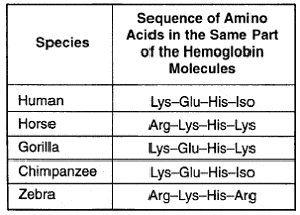
You look at two species and see very similar amino acid sequences. What does this likely tell you?
a)
These are the same animal.
b)
These animals have a common ancestor.
c)
These animals are not likely related.
d)
These animals are likely becoming one species.
40.

How long ago was common ancestor in this phylogenetic tree alive?

a)

53.7-54.1 mya

b)

61.5-61.9 mya

c)

50.7-54.9 mya

d)

37.9-46.5 mya

41.

Which group of animals on this tree are most closely related to birds?

a)

Saurischian dinosaurs

b)

Ornithischian dinosaurs

c)

Crocodiles

d)

None of these are related to birds

42.

Which is true about allopatric and/or sympatric speciation?

a)

In allopatric speciation, members of the population live in the same land

b)

In sympatric speciation, members of the population live in the same land

c)

Speciation takes longer in allopatric situations

d)

There are very few examples of sympatric speciation

43.
Which Hardy-Weinberg factor represents the frequency of heterozygous individuals in a population?
a)
p2
b)
2pq
c)
q2
d)
p2 + 2pq
44.

The allele frequency of p=.20 What is the percentage of recessive genotype?

a)

.80

b)

.04

c)

.32

d)

.64

45.

A population's recessive genotypic frequency is 25%. What is the percentage of the Homozygous Dominant genotype?

a)

.5625

b)

.3750

c)

.0625

d)

.25

e)

.5

46.

Widow's peak is dominant to a straight hairline. 64% of the population has a straight hairline. What is the frequency of the recessive allele?

a)

.04

b)

.32

c)

.64

d)

.2

e)

.8

47.

Free earlobes are dominant over attached ears. 64% of the population has attached ears. What is the dominant allele frequency?

a)

.04

b)

.32

c)

.64

d)

.2

e)

.8

48.

16 of every 25 individuals in a the population have the recessive genotype. What is the percentage for Rr?

a)

.04

b)

.32

c)

.64

d)

.2

e)

.8

49.

Brown wings in moths are recessive to white wings. 1 in every 5 moths have brown wings. What is the percentage for RR?

a)

.3056

b)

.4472

c)

.4944

d)

.2

e)

.8

50.
a)
The image shows analogous structures.
b)
The image shows convergent evolution.
c)
The image shows adaptive radiation. 
d)
The image shows organisms that are not closely related.
51.

If a population experiences no migration, is very large, has no mutations, has random mating, and there is no selection, which of the following would you predict?

a)

The population will evolve, but much more slowly than normal

b)

The makeup of the population's gene pool will remain virtually the same as long as these conditions hold.

c)

The composition of the population's gene pool will change slowly in a predictable manner.

d)

Dominant alleles in the population's gene pool will slowly increase in frequency while recessive alleles will decrease.

e)

The population probably has an equal frequency of A and a alleles.

52.
In the Hardy-Weinberg Equation, q2 is the frequency of what?
a)
The recessive allele 
b)
the dominant allele
c)
the recessive genotype
d)
the dominant genotype
53.

In Hardy-Weinberg, 99% of the time you are given value such as 1 in every 25 possess a recessive trait. What HW value is (1/25 in this example) this that you ALWAYS start with?

a)

P

b)

q

c)

q^2

d)

2pq

54.

The yellow, blue, and read bubbles represent different phylogenies. How would you describe the yellow bubble?

a)

monophyletic

b)

paraphyletic

c)

polyphyletic

d)

anaphyletic

55.
A group that includes ALL of the organisms descended from a common ancestor that share common features. Like Mammals
a)
Cladogram
b)
Monophyletic
c)
Paraphyletic
d)
Taxonomic Character
56.
A group of organisms descended from a common ancestor that EXCLUDES some of the descendants. Like birds are excluded from the group Reptiles, even though they are descended from a common ancestor
a)
Cladogram
b)
Monophyletic
c)
Paraphyletic
d)
Taxonomic Character
57.

What kind of group?

a)

clade

b)

paraphyletic

c)

Polyphyletic

d)

Monophyletic