wayground logo

Free Printable Worksheets

Font size

S
M
L
XL
Worksheets

DNA / RNA

Total questions: 53

Worksheet time: 43mins

Name
Class
Date
1.

Before the cell divides by mitosis, what process needs to happen to DNA?

a)

transcription

b)

translation

c)

replication

d)

protein synthesis

2.

The process of making mRNA from DNA is called.

a)

replication

b)

transcription

c)

translation

d)

protein synthesis

3.

Where in the cell does transcription take place?

a)

nucleus

b)

ribosome

c)

cytoplasm

d)

smooth ER

4.

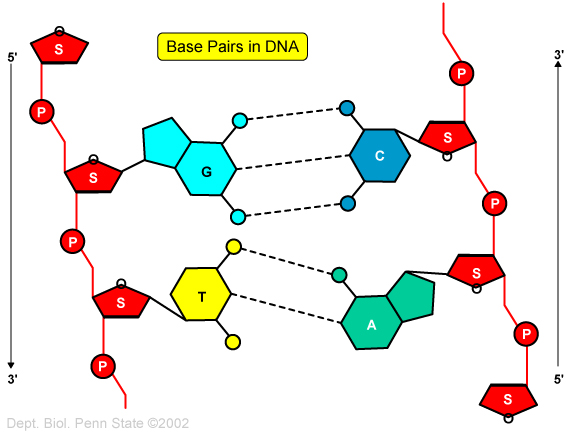
In DNA which is a correct base pairing?

a)

A with G

b)

G with T

c)

A with U

d)

A with T

5.

RNA is different from DNA in what way? (two answers selectable)

a)

RNA is single stranded

b)

RNA has thymine

c)

RNA has the sugar ribose

d)

RNA is found in the nucleus; DNA in the cytoplasm

6.

mRNA stands for

a)

my RNA

b)

messenger RNA

c)

mitosis RNA

d)

mutated RNA

7.

The five carbon sugar found in DNA

a)

ribose

b)

deoxyribose

c)

glucose

d)

dextrose

8.

The five carbon sugar found in RNA

a)

ribose

b)

deoxyribose

c)

glucose

d)

lactose

9.

What are the 3 basic components of a DNA molecule?

a)

Sugar, Base, H2 Bond

b)

Ribose, Base, Phosphate

c)

Deoxyribose, Base, Phosphate

d)

Sugar, Phosphate, Base pair

10.

Adds a nucleotides to the newly synthesized strand of DNA

a)

helicase

b)

DNA polymerase

c)

primase

d)

ligase

11.

Experiment that radioactively labeled the proteins and DNA of bacteriophages to determine if DNA or protein was the transforming agent

a)

Avery

b)

Watson & Crick

c)

Messelson & Stahl

d)

Hershey & Chase

12.

In a molecule of double-stranded DNA, the amount of adenine present is always equal to the amount of

a)

cytosine

b)

guanine

c)

thymine

d)

uracil

13.

Guanine bonds with ______________.

a)

adenine

b)

uracil

c)

cytosine

d)

thymine

14.
Nitrogenous bases are joined by which type of bond?
a)
polar bonds
b)
ionic bonds
c)
covalent bonds
d)
hydrogen bonds
15.

Replicate the following strand of DNA:

AATCATGGA

a)

AATCATGGA

b)

TTAGTACCT

c)

UUAGUACCU

d)

GGATAUCUA

16.

DNA replication results in two DNA molecules,

a)

each one with two original strands

b)

each one with two new strands

c)

each one with one new strand and one original strand

d)

one with two new strands and the other with two original strands

17.

How many different unique DNA nucleotides are there?

a)

impossible to count

b)

12

c)

6

d)

4

18.

This process is _____

a)

replication

b)

transcription

c)

translation

d)

duplication

19.

This process is _______

a)

transcription

b)

translation

c)

replication

d)

duplication

20.

These 2 scientists won the Nobel prize for determining the structure of DNA.

a)

Watson and Crick

b)

Franklin and Darwin

c)

Einstein and Newton

d)

Degrasse and Tyson

21.

What is DNA?

a)

Do Not Attend

b)

Don't Nap Anywhere

c)

Deoxyribonucleic Acid

d)

Determined New Armadillos

22.

This type of mutation occurs when a nitrogen base is added into a sequence and drastically changes the resulting protein.

a)

Point mutation

b)

Insertion mutation

c)

Deletion mutation

d)

Chromosome mutation

23.

This type of mutations occurs when one nitrogen base is taken out of the sequence, drastically changing the resulting protein.

a)

Point Mutation

b)

Insertion Mutation

c)

Deletion Mutation

d)

None of these

24.

The twisted ladder shape of a DNA molecule is referred to as a

a)

Extension Ladder

b)

Twisted Helix

c)

Single Ladder

d)

Double Helix

25.
If a DNA molecule contains the sequence CCA TGG, what is the complementary mRNA strand?
a)
GGU ACC
b)
GGT ACC
c)
CCU TGG
d)
CCA UGG
26.

Which base is NOT found in RNA?

a)

cytosine

b)

thymine

c)

uracil

d)

adenine

27.

In RNA, Adenine pairs up with _____.

a)

uracil

b)

guanine

c)

thymine

d)

cytosine

28.

Which base is NOT found in DNA?

a)

uracil

b)

thymine

c)

adenine

d)

cytosine

29.
Three nucleotide bases on a strand of mRNA are a(n) ____.
a)
mutation
b)
karyotype
c)
codon
d)
anticodon
30.
How many bases code for 1 amino acid in a codon?
a)
1
b)
2
c)
3
d)
4
31.
What does rRNA do?
a)
carries copies of DNA's instructions
b)
transfers amino acids to ribosomes
c)
helps with RNA splicing
d)
makes ribosomes
32.
What does tRNA do?
a)
carries copies of DNA's instructions
b)
transfers amino acids to ribosomes
c)
helps with RNA splicing
d)
makes ribosomes
33.
Which amino acid is made from the RNA codon GUA?
a)
Phenylalanine
b)
Leucine
c)
Serine
d)
Valine
34.
A change in our genetic material or instructions can lead to a: 
a)
trait
b)
transcription
c)
mutation
d)
translation
35.
A change in a chromosome is called: 
a)
Gene expression
b)
Gene mutation
c)
Chromosome mutation
d)
Replication
36.
DNA molecule segment is : TTACGCAAG
The mutated DNA segment is TTCGCAAG. This is an example of ___ mutation.
a)
Substitution
b)
Deletion
c)
Insertion
d)
Inversion
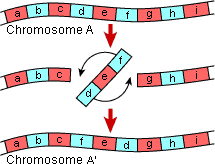
37.
What type of chromosomal mutation is this?
a)
Translocation
b)
Inversion
c)
Deletion
d)
Duplication
38.

What part of the tRNA complements the mRNA when the two bond?

a)

amino acid

b)

d-loop

c)

active site

d)

anticodon

39.
A promoter is a
a)
binding site for DNA Polymerase
b)
binding site for RNA Polymerase
c)
signal for replication
d)
anti-codon
40.

What are the building blocks of proteins called?

a)

DNA

b)

RNA

c)

Ribosomes

d)

Amino Acids

41.

Whom does this X-ray crystolography photo belong to?

a)

Rosey Greer

b)

Dr. Roselind Franklin

c)

Dr. Maurice Wilkins

d)

Watson and Crick

42.

What type of chromosomal mutation is this?

a)

Translocation

b)

Inversion

c)

Deletion

d)

Duplication

43.
DNA holds the code for
a)
lipids
b)
carbohydrates
c)
protein
d)
sugar
44.

Bond formed between two amino acids that results in a water molecule being released

a)

peptide bond

b)

complete protein

c)

dipeptide

d)

casein

45.
Analysis of the DNA of an organism reveals that it is composed of 20% T (thymine). Based on this information, what would you predict the % C (cytosine) to be?
a)
60%
b)
30%
c)
20%
d)
10%
46.
A single-base mutation in a DNA sequence that is GTCATA would be...
a)
GTCTTA
b)
GGTTCCAATTAA
c)
GTCCCT
d)
ATACTG
47.
What is a gene?
a)
A segment of RNA that encodes for a protein
b)
A chromosome
c)
A segment of DNA that encodes for a protein
d)
Your genome
48.
Most gene regulation happens at which step along the way?
a)
translation
b)
transcription
c)
signal transduction
d)
DNA replication
49.

What does a promoter do?

a)

it allows a gene to be transcribed

b)

it creates a DNA segment

c)

it is another word for ribosomes

d)

it is another word for RNA

50.
In the lac operon model the genes within the operon will be expressed if:
a)
lactose is absent in the cell
b)
glucose is present in the cell
c)
lactose is present in the cell
51.
What is a TATA box? What does a TATA box do?
a)
A short region of DNA that contains a sequence of T and A base pairs. The protein that binds to this site helps position RNA polymerase.
b)
A group of genes that are regulated together.
c)
They control transcription. Some of these regulatory proteins help switch genes on,
while others turn genes off.
d)
Regulate their activities, producing only those genes necessary for the cell
to function.
52.
In flies, the group of homeobox genes that determines the identities of each segment of a fly's body is the group known as
a)
Silencing Complexes
b)
Promoters
c)
Hox Genes
d)
Operators
53.
What is it called when these genes are operated together?
a)
Operator region
b)
Lac operon
c)
Lac repressor
d)
Promoter region