
 Worksheets
Unit 4 DNA Part I- Mitosis
Total questions: 52
Worksheet time: 24mins
Cytokinesis
M phase (Mitosis and cytokinesis)
Interphase
G1 Phase
G2 Phase


Anaphase
Cytokinesis
Telophase
Metaphase

Cytokinesis
Interphase
Anaphase
Metaphase


The cell membrane splits and 2 new daughter cells are formed
Metaphase
Anaphase
Telephase
Cytokinesis

How many chromosomes do humans have?
46
21
10
23

In one type of cell division, a single cell forms two new cells. This process is called mitosis.
What is the reason that human skin cells frequently undergo mitosis?
to get energy for the cell.
to prevent bruises on the body
to replace dead or damaged skin cells
to replace damaged nerve cells

DNA is called chromatin in this phase
Interphase
Prophase
Metaphase
Anaphase
During telophase
DNA lines up in the middle of the cell and DNA attaches to spindle fibers
centrioles and spindle fibers appear
Each DNA gets pull to the opposite sides of the cell
2 new nuclei form
Why is the metaphase important?
The DNA gets copied and the cell grows and develops
The DNA lines up so exact copies can be pulled to each side
The nuclear membrane disappears and the spindle fibers appear
Two identical daughter cells are formed
When a cell cannot control it's cell cycle due to a mutation, it reproduces out of control. What is the result of this overgrowth of cells?
Cell cluster
Scar formation
Apoptosis
Cancer


What is the image above:
Chromosome
Chromatid
Centromere
Centriole
Chromatin
A chromosome is packaged
DNA
Protein
Carbohydrates
Lipids

What stage of mitosis is depicted here
Prophase
Anaphase
Telophase
Metaphase

What stage of mitosis is depicted here
Prophase
Metaphase
Anaphase
Telophase

What stage of mitosis is depicted here
Prophase
Metaphase
Anaphase
Telophase
Nuclear membrane breaks down, spindle fibers form describes:
Prophase
Anaphase
Metaphase
Telophase
Spindle fibers attach, centrioles line chromosomes in the center of the cell describes:
Prophase
Telophase
Metaphase
Anaphase
Centrioles pull the chromosomes apart towards the opposite sides of the cell describes:
Prophase
Metaphase
Telophase
Anaphase

What phase of Mitosis is the picture showing?
Interphase
Prophase
Telophase
Metaphase
Which of the following are CORRECT observations about the differences between MITOSIS and MEIOSIS? (Check all that apply.)
Mitosis produces cells that identical to the parent cell.
Meiosis produces cells that have half the number of chromosomes as the parent cell.
All cells go through INTERPHASE as part of the cell cycle, whether it goes to mitosis or meiosis next.
In both types of cell division, the chromosomes are only duplicated once.
Only in Mitosis, do you see chromosomes pair up to form a tetrad.
What is cancer?
Regulated meiosis
Uncontrolled meiosis
Regulated Mitosis
Uncontrolled Mitosis
Which of the following is an environmental factors that may lead to cancer?
smoking
viruses
toxins
all of the above
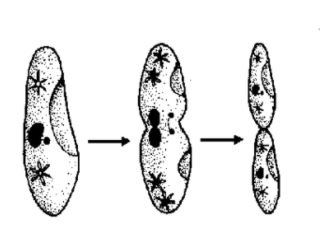
What type of asexual reproduction is illustrated in the diagram?
binary fission
budding
sporulation
regeneration
A cell with 46 chromosomes divides by mitosis, how many chromosomes will be present in the resulting daughter cells?
92
46
23
12

What type of asexual reproduction is it?
budding
regeneration
sporulation
binary fission
What happens in interphase (choose 2)
Cell grows and developes
DNA lines up in middle
DNA pulls apart
DNA replicates
What happens in Prophase (choose 3)
DNA condenses (packs up)
Spindle fibers appear
Daughter cells separate
DNA lines up in middle
Nuclear envelope (membrane) dissolves
What happens in metaphase? (choose 1)
DNA splits apart
Cell divides
DNA lines up in middle
New nuclei form
What happens in anaphase? (choose 1)
DNA replicates
Chromatids pull apart to opposite sides
DNA lines up in middle
Cell divides
What happens in cytokinesis? (choose 1)
Daughter cells separate completely as cytoplasm is split into two
Nuclear envelope dissolves
DNA separates apart to opposite sides of the cell
DNA replicates
What happens in anaphase? (choose 1)
DNA replicates
Chromatids pull apart to opposite sides
DNA lines up in middle
Cell divides

Identify letter "j" in the image.
prophase
cytokinesis
interphase
mitosis
As a cell grows in the cell cycle, the ratio of surface area to volume _____. Cells must divide for homeostasis.
Increases
Stays the same

