wayground logo

Free Printable Worksheets

NEW

Font size

S
M
L
XL
Worksheets

Unit 10 APUSH Test Review

Total questions: 70

Worksheet time: 23mins

Name
Class
Date
1.

What were the 3 Rs of the New Deal?

a)

Relent, Release, Recoil

b)

Relief, Resume, Resolve

c)

Reform, Relieve, Remove

d)

Relief, Recovery, Reform

2.

Which of the following was part of the opposition to the New Deal?

a)

Keynesian economics

b)

American liberalism

c)

American Liberty League

d)

New Deal Democratic Party Coalition

3.

Which of the following best describes Hoover's initial approach to handling the Great Depression

a)

voluntarism and rugged individualism

b)

direct relief through government assistance

c)

limited government assistance of banking systems

d)

bailout of failing businesses

4.

Which Progressive Era amendment was repealed with the passage of the 21st amendment?

a)

16th amendment

b)

17th amendment

c)

18th amendment

d)

19th amendment

5.
This president thought the federal government should not get involved in the economy. As a result, many Americans blamed him for the Great Depression. This caused him to lose the election in 1932.
a)
Franklin Delano Roosevelt
b)
Theodore Rooselvelt
c)
Herbert Hoover
d)
Calvin Coolidge
6.

An obvious defect in the United States' banking system that was exposed during the Great Depression was

a)

excessive government regulation of banks.

b)

the federal government's ownership of banks.

c)

an excessive amount of currency in circulation.

d)

the lack of protection for funds deposited by individuals in banks.

7.

Which event in history is seen by many people as the beginning of the Great Depression in the United States?

a)

the Stock Market Crash of 1929

b)

the beginning of the Dust Bowl

c)

the end of fighting in World War I

d)

the creation of the Federal Reserve

8.
Which was NOT a LONG-TERM cause of the Great Depression?
a)
Buying stock on margin
b)
Stock market crash (Black Tuesday)
c)
too much production and consumer spending
d)
Laisezz-faire economic policies
9.

Which of the following was an obvious problem in the United States' banking system during the late 1920s and during the start of the Great Depression

a)

the lack of protection for funds deposited by individuals in banks

b)

complete government ownership of America's banking system

c)

Massive inflation due to releasing too much money into circulation.

d)

Too much foreign money being put into the American banking system.

10.

Why was Senator Huey Long of Louisiana critical of President Roosevelt's New Deal?

a)

He did not believe that FDR was going far enough to fix the issues which faced the nation

b)

He felt that FDR was creating too much government involvement in order to combat the Great Depression

c)

He thought that FDR should let Congress take the lead in creating the remedies for the Great Depression

d)

He was a Hoover supporting Republican who felt that the economy would improve on its own in time.

11.

Social Security is an example of what common style of reform during the Great Depression?

a)

government intervention in the economy

b)

laissez faire policies

c)

Social Darwinism

d)

government taking over private businesses

12.
Passage of the Social Security Act (1935) helped American workers by
a)
creating jobs for the unemployed
b)
providing financial assistance after retirement
c)
guaranteeing a minimum wage
d)
legalizing the right to join labor unions
13.
The criticism of President Franklin D. Roosevelt's plan to court-pack the Supreme Court was that the he was
a)
The criticism of President Franklin D. Roosevelt's plan to court-pack the Supreme Court was that the he was
b)
seeking the Supreme Court’s help against his political opponents
c)
attempting to exercise too much executive power over the Supreme Court
d)
refusing to allow the Supreme Court to review legislation
14.
A major difference between the philosophies of President Herbert Hoover and President Franklin D. Roosevelt in responding to the Great Depression is that Roosevelt
a)
wanted to rely on private charities to provide assistance
b)
stressed the need for individual self-reliance
c)
supported direct relief to people out of work
d)
thought the government should not be involved in economic reform
15.
An important factor contributing to the start of the Great Depression in the United States was the
a)
uneven distribution of wealth
b)
increase in military spending
c)
reduction of tariff rates
d)
failure to maintain the gold standard
16.
The election of Franklin D. Roosevelt to the Presidency in 1932 reflected the desire of many Americans to
a)
return to a policy of laissez-faire
b)
abandon capitalism in favor of socialism
c)
continue the domestic policies of the Hoover administration
d)
have government take an active role in solving economic problems
17.
Critics charged that President Franklin D. Roosevelt’s plan to increase the number of Supreme Court Justices was clearly in conflict with
a)
the Supreme Court’s practice of judicial restraint
b)
the constitutional principle of checks and balances
c)
attempts of Congress to limit judicial responsibilities
d)
efforts to restrict the number of terms a President could serve
18.
In the 1930s, the enactment of New Deal programs demonstrated a belief that
a)
corporations were best left to operate without government interference
b)
state governments should give up control over commerce inside their states
c)
the Federal Government must concern itself with the people’s economic well-being
d)
the United States Constitution was not relevant to 20th-century life
19.
New Deal programs such as the Civilian Conservation Corps (CCC) and the Works Progress Administration (WPA) were primarily intended to help
a)
 farmers
b)
homeowners
c)
businesses
d)
unemployed workers
20.
Which event is most closely associated with the end of the Great Depression?
a)
passage of the Social Security Act
b)
beginning of World War II
c)
reelection of President Franklin D. Roosevelt in 1940
d)
announcement of the Marshall Plan
21.
The creation of the Tennessee Valley Authority is an example of
a)
federal intervention to meet regional needs
b)
state-funded regional transportation
c)
free-market capitalism
d)
laissez-faire economics
22.
In the 1930s, one factor that accounted for the westward migration of farmers from the Great Plains was
a)
the Dust Bowl 
b)
high farm prices
c)
new technologies
d)
 the baby boom
23.
This new deal program helped with the recovery process by hiring the unemployed to work on outdoor projects such as deforestation 
a)
PWA
b)
CCC
c)
AAA
d)
FDIC
24.
The Works Progress Administration was an enormous program that put unemployed people back to work ...
a)
building highways and bridges
b)
painting murals and creating sculptures that decorate public buildings across the nation
c)
building public buildings, parks, and airports
d)
all of the answers are correct
25.
The TVA helped transform the Tennessee River Valley from poverty to productivity by ...
a)
soil conservation and tree planting
b)
building highways, bridges, public buildings, public parks, and airports
c)
building hydroelectric dams throughout a seven-state region to control floods and generate electricity
d)
provide assistance to farmers
26.

Which two sections of the New Deal below served as safeguards for wealth & investments?

a)

AAA & TVA

b)

Social Security & FDIC

c)

NAACP & WPA

d)

SEC & FDIC

27.
What cause of the Great Depression did the Agricultural Adjustment Act (AAA) attempt to solve?
a)
Stock market speculation
b)
Overproduction
c)
Weak banking system
d)
Unsafe loans
28.

What impact did Eleanor Roosevelt have on the role of “First Lady”?

a)

She preserved the traditional role of First Lady despite attacks by critics.

b)

She turned the position into an office for fundraising and campaigning for her husband.

c)

She made it a position for hosting dinner parties to diplomats to enhance America’s status abroad.

d)

She changed its role by using her position to champion those Americans most in need.

29.

In Roosevelt's speech after ____ ,he called it , " A day that will live in infamy."

a)

Normandy ,France

b)

Invasion of North Africa

c)

Pearl Harbor , Hawaii

d)

Bombing of Japan

30.
Japanese and Japanese Americans from the West Coast of the USA during WWII who were sent to camps called "War Relocation Centers" in remote portions of the nation's interior
a)
Cornelia Fort
b)
Japanese Internment
c)
Allied Powers
d)
Axis Powers
31.
A secret research and development project of the US to develop the atomic bomb
a)
The Manhattan Project
b)
Totalitarianism
c)
Pearl Harbor
d)
USS Arizona
32.
Restricting the amount of food and other goods people may buy during wartime to assure adequate supplies for the military
a)
holocaust
b)
nazism
c)
fascism
d)
rationing
33.

What was the Allied strategy in the Pacific known as?

a)

island-hopping

b)

island-jumping

c)

appeasement

d)

rationing

34.

Where did the largest land-sea-air invasion in world history take place?

a)

Hiroshima, Japan

b)

Normandy, France

c)

Nagasaki, Japan

d)

Berlin, Germany

35.

What battle, fought in June 1942, was the first major victory for the United States in the Pacific. It marked a turning point in the war with Japan.

a)

Coral Sea

b)

Leyte Gulf

c)

Midway

d)

Pearl Harbor

36.
Which of the following events during WWII brought the United States into the war?
a)
Germany's invasion of Poland
b)
D-Day invasion of Normandy
c)
Nazi Germany's treatment of the Jewish people
d)
Japan's bombing of Pearl Harbor
37.
Why was President Franklin Roosevelt hesitant to get involved in World War II?
a)
He considered Germany and Japan strong allies of the United States
b)
He wanted to maintain the U.S. foreign policy of isolationism
c)
He was opposed to the Lend-Lease Act
d)
He had supported the Japanese invasion of China in 1937
38.
What did allied forces do on D-Day, June 6, 1944?
a)
They sent thousands of troops to Berlin.
b)
They stormed the beaches of Normandy, France.
c)
The fought the Nazi troops in Russia.
d)
They took control of many Japanese islands.
39.
The United States essentially ended World War II by:
a)
bombing Tokyo
b)
launching the D-Day invasion
c)
capturing Hitler
d)
dropping atomic bombs on Japanese cities
40.

Which policy had the goal of supporting the allies and maintaining neutrality?

a)

Atlantic Charter

b)

Appeasement

c)

Cash and Carry

d)

Mutually Assured Destruction

41.

What did A. Philip Randolph do?

a)

served as a spy and stole German battle plans

b)

spoke out against racial discrimination in the war industries

c)

increased reserves of natural resources

d)

Well-known poet during the Harlem Renaissance

42.

What stated that the US would not sell war materials or give loans to nations at war?

a)

Neutrality Acts

b)

Lend-Lease Act

c)

Atlantic Charter

d)

Cash and Carry

43.

This was a major reason for dropping the atomic bomb on Japan

a)

promote US Isolationism

b)

destroy Japan's industrial centers and save American lives

c)

Scare Hitler

d)

To keep China out of the war

44.

What was the purpose of rationing?

a)

increase supply of natural resources

b)

cause a shortage of crops

c)

provide supplies to the troops

d)

Punish Americans for gluttony

45.

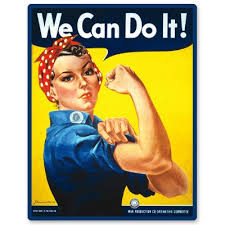
Who is this a image of and what did she a symbol of .....

a)

June the Fighter symbol of women's suffrage

b)

Susan the solider symbol of women working on airplanes

c)

Rosie the Riveter symbol of women working in factories during the war.

d)

Eleanor Roosevelt's fight for equality

46.

What was the purpose of the Double V campaign?

a)

to motivate people to buy war bonds

b)

to allow more women to join the armed forces

c)

to gain two victories; one at home by ending discrimination in war-related jobs and one victory over Hitler.

d)

To win in both Asia and Europe

47.

What industry manufactured about 1/3 of military equipment during WWII

a)

steel industry

b)

ship-industry

c)

intercultural sector

d)

automobile industry

48.

The American program to build an atomic bomb was known as the

a)

Manhattan Project

b)

Operation overlord

c)

New York Project

d)

Operation A-bomb

49.

What was President Roosevelt referring to in this speech?

a)

The victory at Normandy and liberation of France.

b)

the Japanese bombing of Pearl Harbor.

c)

The Battle of Britain.

d)

D-Day

50.

What is another name for the Invasion of Normandy?

a)

Battle of France

b)

Battle of the Bulge

c)

D-Day

d)

V-E Day

51.

Which two cities were attacked with atomic bombs by the United States?

a)

Nagasaki & Hiroshima

b)

Tokyo & Kyoto

c)

Tokyo & Yokohama

d)

Osaka & Kyoto

52.

Which president of the United States died during World War II?

a)

Dwight Eisenhower

b)

Franklin Roosevelt

c)

Harry Truman

d)

Woodrow Wilson

53.
Which famous scientist wrote the letter alerting the U.S. President, FDR, about the German's discovery of nuclear fission?
a)
Marie Curie
b)
Albert Einstein
c)
Robert Oppenheimer
d)
Katherine Johnson
54.
In which U.S. state was the city of Los Alamos, which is where the physicists worked to create the atomic bomb?
a)
New Mexico
b)
Washington
c)
Pennsylvania
d)
Massachusetts
55.
The first African-American flying unit in the United States military?
a)
Tuskegee Airmen
b)
Rough Riders
c)
7th Calvary
d)
82nd Airborne
56.
During World War II, many Japanese Americans living on the West Coast were relocated to detention centers primarily because they
a)
were known spies for Japan
b)
were seen as a security threat
c)
refused to serve in the United States military
d)
expressed their support for Italy and Germany
57.
This allowed the US to make war materials for the Allies and deliver it to them
a)
Cash and Carry
b)
Lend-Lease Act
c)
Neutrality Acts
d)
Dawes Act
58.
This allowed the US to sell military supplies to the Allies, but they had to come pick up the materials.
a)
Cash and Carry
b)
Lend-Lease Act
c)
Neutrality Acts
d)
Pendleton Act
59.
During WWII, families were issued coupons to use for things like meat and gas. This is an example of
a)
rationing
b)
conservation
c)
government spending
d)
internment
60.
Aside from taxes, _______ was responsible for most of the war funding...
a)
Rationing Coupons
b)
International Donations
c)
Government Savings
d)
War Bonds
61.

The planned 1941 March on Washington promoted greater opportunities for African Americans in the defense industry and the desegregation of the military. Which labor and civil rights leader organized this event?

a)

Thurgood Marshall

b)

A. Phillip Randolph

c)

James Meredith

d)

Martin Luther King Jr.

62.
Who was Rosie the  Riveter?
a)
The first woman to work in a factory during WWII
b)
a representation of American women that went to work during WWII
c)
A pretty girl used for make-up advertisements
d)
A famous pilot
63.

During World War II, many women experienced a change in role in that they

a)

served in military combat positions

b)

worked in jobs formerly held by men

c)

controlled most corporations

d)

chaired several congressional committees

64.

Known as the turning point in the Pacific Theater, as American forces sank ALL 4 Japanese aircraft carriers

a)

Battle of Coral Sea

b)

Battle of Iwo Jima

c)

Battle of Guadalcanal

d)

Battle of Midway

65.

What does VE Day stand for?

a)

Vengeance Enemy Day

b)

Victory in Europe Day

c)

Virtual Earth Day

d)

Victims Everywhere Day

66.

On September 2, 1945, the two sides signed formal surrender papers on the US battleship Missouri. This is known as VJ Day. What is VJ Day?

a)

Victory in Jima Day

b)

Victory in Europe Day

c)

Victory in Japan Day

d)

Victorious Japan Day

67.

Which describes Executive Order 9066?

a)

To create a draft lottery system for military service

b)

It officially brought the U.S. into World War II

c)

It forced Japanese-Americans into internment camps against their will

d)

It forced the repatriation of Mexican Americans to reduce job competition

68.

The committee set up by FDR to investigate charges of discrimination in the work place was called

a)

Federal Deposit Insurance Corporation

b)

Fair Employment Practice Committee

c)

Works Progress Administration

d)

Nuremberg Trials

69.

What US policy allowed the sale, loan, or lease of war materials to any country whose defense was necessary for US security?

a)

Lend Lease

b)

Neutrality Act

c)

Cash and Carry

d)

Borrow and Pay

70.

The action of a country or its government preparing and organizing troops for active service

a)

Mobilization

b)

Reparations

c)

U-Boat

d)

Neutral