wayground logo

Free Printable Worksheets

NEW

Font size

S
M
L
XL
Worksheets

3rd Quarter CSA Review

Total questions: 64

Worksheet time: 1hrs 20mins

Name
Class
Date
1.
0 degrees latitude; an imaginary line that runs around the middle of Earth, like a belt
a)
Tropic of Cancer
b)
Equator
c)
Prime Meridian
d)
Tropic of Capricorn
2.
0 degrees longitude; an imaginary line that runs up and down through the United Kingdom
a)
Prime Meridian
b)
Equator
c)
International Date Line
3.
180 degrees longitude; an imaginary line that runs up and down through the Pacific Ocean
a)
International Date Line
b)
Equator
c)
Time Zone Line
d)
Prime Meridian
4.
Which letter would you find at 15oS, 60oW?
a)
A
b)
C
c)
L
d)
H
5.
What is the approximate location of letter B?
a)
80oN, 0o
b)
0o, 80oW
c)
80oS, 0o
d)
0o, 80oE
6.
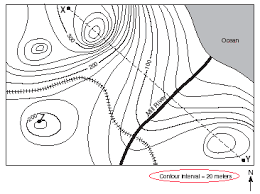
What is the map symbol (darker lines)?
a)
roads
b)
index contour
c)
contour interval
d)
waves
7.
Contour lines that are very close together indicate the land is _______________
a)
gentle/gradual
b)
a forest
c)
steep
d)
a swamp
8.
In which direction is Bird Creek flowing?
a)
West
b)
North
c)
South
d)
East
9.

Which locations have the same elevation?

a)

A and C

b)

B and E

c)

C and I

d)

F and G

10.

Points A, B, X, and Y are locations on a map. Elevations are shown in feet.


Which diagram best represents the topographic profile along a straight line from point A to point B?

a)
b)
c)
d)
11.
The number of satellites needed to triangulate your position on Earth
a)
one
b)
three
c)
27
12.
a map feature that explains the meaning of colors and symbols used on the map
a)
Map Key
b)
Map Contents
c)
Map Glossary
d)
Map Index
13.
a map feature that compares distance on a map to the real distance 
a)
Scale
b)
Odemeter
c)
Latitude
d)
Longitude
14.

How many individual peaks are seen on the map? (hill tops)

a)

4

b)

3

c)

2

d)

1

15.

If we were in a plane above this map, we can see that Path B --> C is about the same distance as path E --> N. But, which path is the easier walk?

a)

B --> C is the easier walk

b)

E --> N is the easier walk

c)

B --> C and E --> N are the same walking distance

d)

the are of equal difficulty

16.

Match the topographic map to its topographic profile picture.

a)
b)
c)
d)
17.

Which side of the hill is steepest?

ASSUME: North is top, South is bottom, West is left, & East is right

a)

North side

b)

South side

c)

West side

d)

East side

18.

If sea level always equals (0), and the contour interval is 10 feet, what is the highest possible elevation for this hill?

a)

69 ft

b)

40 ft

c)

59 ft

d)

60 ft

19.

True or false: All world map projections create distorted images of the Earth to some degree. These distortions relate to size, shape, direction, and distance.

a)

True

b)

False

20.
What does the theory of continental drift state?
a)
The continents were once joined in a super-continent and have moved over time
b)
Continents are stationary and do not move
c)
The Earth is broken into lithospheric plates that move due to convection currents
d)
none of the above
21.
What evidence did Wegener use in his theory?
a)
Continents and fossils fitting together/matching-up like puzzle pieces 
b)
glacier scars and evidence from temperature
c)
mountain ranges and coal deposits line up across continents
d)
all of the above
22.
Why did no one believe Wegener's thoery?
a)
He could not explain HOW the continents moved
b)
He didn't have evidence
c)
His data was wrong
d)
He didn't use the right technology to gather data
23.
What two specific continents fit together most noticeably?
a)
Africa and North America
b)
South America and Europe
c)
South America and Africa
d)
Antartica and Africa
24.
How does evidence of glaciation in Africa support the Theory of Continental Drift?
a)
It shows that the continents must have been in a different location.
b)
It doesn't. 
c)
I shows that it was colder at the equator in the past.
d)
It shows that it was warmer at the equator in the past.
25.
What is the force that moves the continents? 
a)
Conduction 
b)
Convection 
c)
Radiation 
d)
Conveyor belts 
26.
What are the two types of crust?
a)
continental and oceanic
b)
ocean and basin
c)
lower and upper
d)
thick and thin
27.
The geological theory that states that pieces of Earth's lithosphere are in constant, slow motion is the theory of
a)
subduction
b)
plate tectonics
c)
evolution
d)
seafloor spreading
28.
What is a theory?
a)
An idea based on hypothesis and problems observed using five senses
b)
A belief, policy, or procedure that is not proposed or followed as the basis of action
c)
A supposition or a system of ideas intended to explain something, especially one based on general principles independent of the thing to be explained.
d)
A set of concepts that uses tests without evidences but uses the scientific method in order to prove a specific phenomena that happened on Earth or may happen to Earth
29.

New oceanic crust (sea floor) is created at this boundary.

a)

Divergent Oceanic

b)

Divergent Continental

c)

Convergent Oceanic

d)

Transform

30.

Oceanic crust (sea floor) is destroyed at this boundary.

a)

Convergent Oceanic

b)

Divergent Oceanic

c)

Convergent Continental-Continental

d)

Divergent Continental

31.

The process where oceanic crust slides under another plate and is melted is called ___________.

a)

seafloor spreading

b)

subduction

c)

continental drift

d)

recycling

32.

What two crustal features occur near every subduction zone?

a)

Volcanoes and Trenches

b)

Rift Valleys and Mid Ocean Ridges

c)

Volcanoes and Rift Valleys

d)

Mid Ocean Ridges and Trenches

33.

A divergent boundary on land creates what feature?

a)

Mid Ocean Ridge

b)

Rift Valley

c)

Subduction Zone

d)

Deep Ocean Trench

34.

A divergent boundary in the ocean creates what feature?

a)

Mid Ocean Ridge

b)

Rift Valley

c)

Deep Ocean Trench

d)

Subduction Zone

35.

The process that occurs at a divergent oceanic boundary that creates new crust (sea floor) is called?

a)

Subduction

b)

Seafloor Spreading

c)

Continental Drift

d)

Volcanism

36.

When two continental plates converge (collide) what type of crustal feature is formed?

a)

Mid Ocean Ridge

b)

Subduction Zone

c)

Rift Valley

d)

Folded Mountains

37.

What is the only event associated with ALL plate boundaries?

a)

Volcanoes

b)

Earthquakes

c)

Subduction

d)

Deep Trenches

38.

These are NOT plate boundary features. They are areas where hot mantle plumes push up through the lithospheric plates to create volcanic islands such as Hawaii.

a)

Hotspots

b)

Convergent Boundary

c)

Divergent Boundary

d)

Transform Boundary

39.
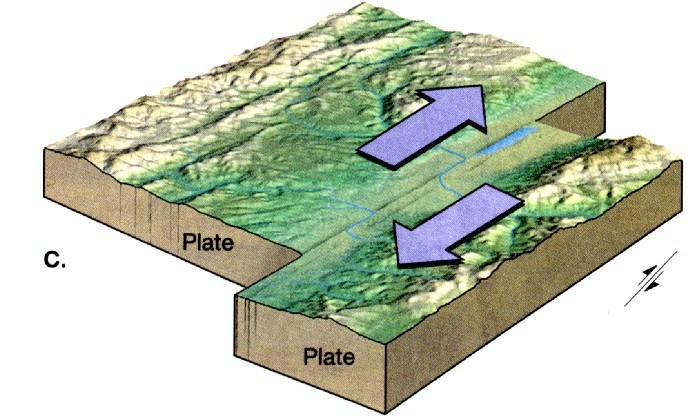
What type of plate boundary is this?
a)
Transform
b)
Convergent
c)
Divergent
d)
Plate
40.

The diagram shows a cross section of a portion of the Earth. Which letter represents a mid-ocean ridge?

a)

W

b)

X

c)

Y

d)

Z

41.

A rock deep within the Earth experiences extreme temperature and pressure. After a long period of time it becomes which rock?

a)

Magma

b)

Igneous

c)

Metamorphic

d)

Sedimentary

42.
What type of rock might contain fossils? 
a)
sedimentary
b)
igneous
c)
metamorphic
43.
What type of rock might contain holes from gases of quickly cooled lava? 
a)
sedimentary
b)
igneous
c)
metamorphic
44.

You would most likely find this rock near a volcano.

a)

Sedimentary

b)

Igneous

c)

Metamorphic

45.

What kind of rock is "Marble"?

a)

Sedimentary

b)

Igneous

c)

Metamorphic

46.
Formed by weathering & erosion
a)
magma
b)
sediments
c)
sedimentary rock
d)
intrusive igneous
47.
Formed by melting
a)
magma
b)
sediments
c)
sedimentary rock
d)
intrusive igneous
48.

The process by which metamorphic rock changes to igneous rock begins with

a)

melting

b)

erosion

c)

deposition

d)

crystallization

49.
What mineral is used for pencils?
a)
Graphite
b)
Galena
c)
Magnetite
d)
Quartz
50.
A naturally occurring, inorganic solid with a crystal structure and a definite chemical composition is referring to
a)
density
b)
streak
c)
mineral
d)
non silicate mineral
51.
A mineral breaks into pieces like are shown in the picture. How would you describe its breakage?
a)
Fracture
b)
Cleavage
c)
Glassy
d)
Waxy
52.
Which mineral property is being shown here?
a)
luster
b)
hardness
c)
cleavage
d)
streak
53.
Refer to the Mohs Hardness Scale. A mineral with a hardness of 7 can scratch -
a)
orthoclase feldspar, but cannot scratch talc
b)
calcite, but cannot scratch apatite.
c)
topaz, but cannot scratch fluorite
d)
gypsum, but cannot scratch corundum
54.
Large crystals are going to form
a)
when lava erupts from a volcano
b)
when a shallow sea evaporates
c)
when magma underground cools off
d)
all of the above
55.

Which of the following minerals has a metallic luster, a black streak, and could scratch Gold?

a)

Magnetite

b)

Graphite

c)

Galena

d)

Hematite

56.

Use the mineral identification sheet from the back of your study guide to complete the following problem.

A reddish brown mineral was found. It has a gray streak and can be scratched by a fingernail. What mineral is it?

a)

copper

b)

talc

c)

Bauxite

d)

corundum

57.

Use the mineral identification sheet from the back of your study guide to complete the following problem.

A mineral was found with a metallic luster. It was yellow in color and had a greenish black streak. Is it gold?

a)

yes

b)

no

58.

Use the mineral identification sheet from the back of your study guide to complete the following problem.

A mineral was found that can be scratched by quartz but not fluorite. It is green in color but has a colorless streak. What mineral is it?

a)

Bauxite

b)

Garnet

c)

Hornblende

d)

Feldspar

59.

Use the mineral identification sheet from the back of your study guide to complete the following problem.

This mineral can be scratched by hornblende but is harder than sulfur. It is pink with a white streak. What is it?

a)

Dolomite

b)

Gypsum

c)

Feldspar

d)

Chromite

60.

what is the rock cycle.

a)

molten rock that is stored underground.

b)

rock material that forms where rocks are broken down into smaller pieces.

c)

a process that changes one type of rock into another type of rock.

61.
Choose the number where the following description best fits:  Great pressure and heat.
a)
1
b)
2
c)
3
d)
4
62.
Choose the number where the following description best fits:  Great heat from the center of the Earth causes melting.
a)
1
b)
3
c)
4
d)
5
63.
Choose the number where the following description best fits:  Hot lava cools.
a)
1
b)
3
c)
4
d)
5
64.

Which city is located at 38 degrees north and 120 degrees west?

a)

San Fransisco

b)

New York

c)

New Orleans

d)

London