
 Worksheets
Chemical Equations Review
Total questions: 69
Worksheet time: 2hrs 18mins

How many hydrogen atoms are in this chemical formula:
4 hydrogen atoms
1 hydrogen atom
2 hydrogen atoms
3 hydrogen atoms

How many molecules are in this chemical formula?
4 Molecules
6 Molecules
2 Molecules
5 Molecules

How many Iron (Fe) atoms are in this chemical formula?
2 iron atoms
6 iron atoms
5 iron atoms
4 iron atoms

How many oxygen atoms are in this chemical formula?
6 oxygen atoms
2 oxygen atoms
3 oxygen atoms
4 oxygen atoms

How many molecules are in this chemical formula?
5 molecules
4 molecules
2 molecules
6 molecules
Is this balanced?...
Fe + S --> FeS
YES!
NO!
How many atoms of aluminum are on each side of the following equation: 4Al + 3O2 --> 2Al2 O3
2
6
1
4
What coefficient should be used to make the following equation balanced?
N2+O2--> _NO
1
2
3
4
Balance this equation...
HgO --> 2Hg + O2
It is balanced
2HgO --> Hg + O2
2HgO --> 2Hg + O2
Is this balanced?...
Al + O2 --> 2Al2O3
Yes!
NO!
C2H6 + 5O2 → 2CO2 + 3H2O2
Given this chemical equation, what are the REACTANTS?
C2H6 and 5O2
2CO2 and 3H2O2
C2H6 + 5O2 → 2CO2 + 3H2O2
Given this chemical equation, what are the PRODUCTS?
C2H6 and 5O2
2CO2 and 3H2O2
What is the arrow in a chemical equation...
H2 + O --> H2O
Reactants
Products
Yields
Chemical Equation
What is the right part of a chemical equation called...
H2 + O --> H2O
Reactants
Products
Yields
Chemical Equation
What is the left part of a chemical equation called...
H2 + O --> H2O
Reactants
Products
Yields
Chemical Equation
Chemical formulas are used to represent _________________.
reactions
substances
processes
none of the above
Chemical equations are used to represent _________________.
reactions
substances
processes
none of the above
The small numbers under and to the right of element symbols in a formula are called _________________.
element symbols
exponents
coefficients
subscripts
The large numbers before a chemical formula that are used as multipliers are known as __________________.
element symbols
exponents
coefficients
subscripts
A ___________________ uses chemical formulas, plus signs, and an arrow to represent a chemical reaction
chemical formula
chemical equation
element symbol
inventory
The materials we start with in a reaction are known as __________________.
chemicals
reactants
products
creations
The materials we end with in a reaction are known as __________________.
chemicals
reactants
products
creations
Determine the type of reaction for the following:
2 K + FeCl2 → 2KCl + Fe
Single Replacement
Double Replacement
Synthesis
Combustion
Determine the type of reaction for the following:
2AgNO3 + Ca(OH)2→ Ca(NO3)2 + 2Ag2O
Single Replacement
Double Replacement
Synthesis
Decomposition
Determine the type of reaction for the following:
2CuI→ Cu + I2
Single Replacement
Double Replacement
Synthesis
Decomposition
AB + CD = AD + CB
Double Replacement
Single Replacement
Combustion
Decomposition
Classify
Fe + O2 → Fe2O3
synthesis
decomposition
double replacement
single replacement
Classify
FeS + HCl → H2S + FeCl2
synthesis
combustion
single replacement
double replacement
Fill in the blank:
A __________________ chemical equation shows that the same number of atoms in the reactants are also in the product.
balanced
transferred
rearranged
beautiful
An element plus additional element reacts to form one product is an example of which type of chemical reaction?
Decomposition
double replacement
synthesis
single replacement
A reaction in which two reactants switch to form a new product.
Decompostion
double replacement
synthesis
single replacement
A reaction in which substances break down into its parts after a chemical reaction.
Decompostion
double replacement
synthesis
single replacement
Classify
Zn + H2S → ZnS + H2
synthesis
combustion
single replacement
double replacement
Classify
CH4 + O2 → CO2 + H2O
single replacement
double replacement
synthesis
combustion
Classify
FeS + HCl → H2S + FeCl2
synthesis
combustion
single replacement
double replacement
Pb(NO3)2 + KI --> PbI2 + KNO3
What type of reaction is this?
Synthesis
Decomposition
Single Replacement
Double Replacement
2HI --> H2 + I2
synthesis
decomposition
single replacement
double replacement
Mg + HCl --> MgCl2 + H2
combustion
synthesis
decomposition
single replacement
Mg + N2 →Mg3N2
Synthesis
Decomposition
Single replacement
Combustion
Two Reactants and One Product
Decomposition
Synthesis
Combustion
Single Replacement
One reactant into several products.
Decomposition
Synthesis
Combustion
Single Replacement
One element replaces another in a compound.
Synthesis
Combustion
Single Replacement
Double Replacement
The metal ions in two compounds switch.
Synthesis
Combustion
Single Replacement
Double Replacement
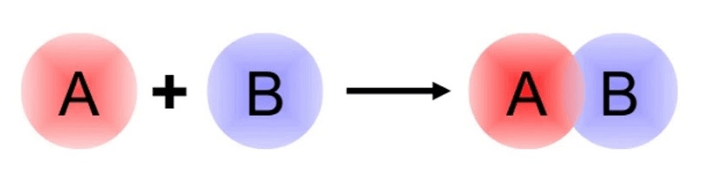
What is the type of reaction shown above?
Synthesis
Decomposition
Single Replacement
Double Replacement
Identify the reaction type:
C2H6 + O2 --> CO2 + H2O
Double replacement
Synthesis
Acid base
Combustion
Identify the type of reaction:
ZnCl2 + Mg --> Zn + MgCl2
Precipitate
Single Replacement
Double Replacement
Decomposition
PCl5 + ___ H2O → ___ HCl + H3PO4
4, 5
1, 6
3, 8
2,2
__ Al + __ FeO → Al2O2 + __ Fe
1, 1, 2
2,1,2
2, 2, 2
2,4,2
Mg + ___ HCl → MgCl2 + H2
1
2
3
4
Which problem is balanced?
PbO2 + 2H2
SO2 + H20 --> H2SO4
2Na + 2H2O --> 2NaOH + H2
Is Li3PO4 soluble?
Yes, Li is always soluble
No, PO4 is never soluble
No, no rules apply
Is NH4Cl soluble?
Yes
No
Is Mg(NO3)2 soluble?
Yes, NO3 is usually soluble.
No, Mg is not soluble
No, there is no rule that applies
Is MgCl2 soluble?
Yes, chlorides are soluble
No, Mg is an exception to the rule
No, no rule applies
Is PbF2 soluble?
Yes, fluorides are soluble
No, lead is exception to the rule
No, no rule applies
Is aluminum sulfate soluble?
Yes, sulfates are usually soluble
No, aluminum is an exception to the rule
No, no rule applies
Is HgSO4 soluble?
Yes, sulfates are usually soluble
No, mercury is an exception to the rule
No, no rule applies
Is Al2O3 soluble?
Yes
No
Is Ca3N2 soluble?
Yes
No
Which of the following compounds made with a group 7 anion is soluble?
AgCl
PbF2
MgBr2
Which oxide is soluble?
magnesium oxide
lithium oxide
carbon dioxide
Select ALL compounds that are soluble.
lithium chloride
lead (II) fluoride
magnesium sulfide
magnesium sulfate
Will fluorine and sodium chloride react?
Yes, fluorine will replace chlorine.
Yes, fluorine will replace sodium.
No, there won't be a reaction.
Will bromine and sodium chlorine react?
Yes, bromine will replace chlorine.
Yes, bromine will replace sodium.
No, they will not react.
Will iodine and sodium chloride react?
Yes, iodine will replace chlorine.
Yes, iodine will replace sodium.
No, they will not react.
Will chlorine and sodium iodide react?
Yes, chlorine will replace iodine.
Yes, chlorine will replace sodium.
No, they will not react.
Will magnesium and hydrochloric acid (HCl) react?
Yes, magnesium will replace the hydrogen.
Yes, magnesium will replace the chlorine.
No, they will not react.
Will copper and hydrochloric acid (HCl) react?
Yes, copper will replace hydrogen.
Yes, copper will replace chlorine.
No, they will not react.
Will fluorine and hydrochloric acid (HCl) react?
Yes, fluorine will replace the hydrogen
Yes, fluorine will replace the chlorine.
No, they won't react.

