Wayground logo

Free Printable Worksheets

Font size

S
M
L
XL
Worksheets

Midterm review

Total questions: 142

Worksheet time: 9hrs 16mins
Name
Class
Date
1.

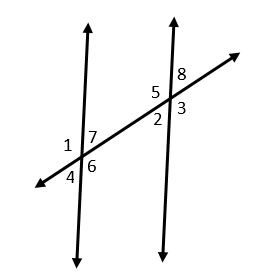
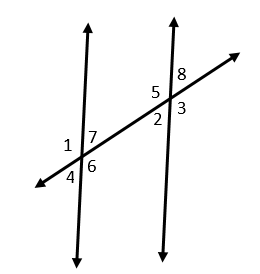
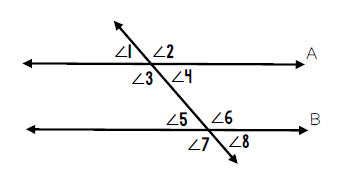
Angle 3 and Angle 6 are examples of which type of angle pair?

a)

Alternate exterior angles

b)

Alternate interior angles

c)

Vertical angles

d)

Corresponding angles

2.

Angle 1 and Angle 5 are examples of which type of angle pair?

a)

Alternate exterior angles

b)

Alternate interior angles

c)

Vertical angles

d)

Corresponding angles

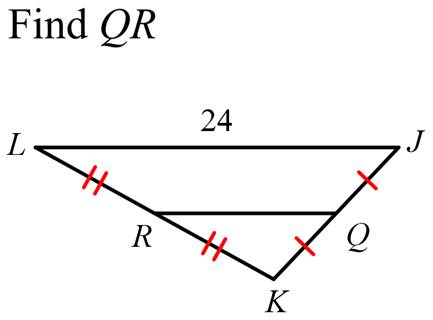
3.

Angle 6 and Angle 7 are examples of which type of angle pair?

a)

Alternate exterior angles

b)

Alternate interior angles

c)

Vertical angles

d)

Corresponding angles

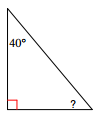
4.

Which of the following angles would NOT be congruent to the measure of  ∠7\angle7 ?

a)

 ∠2\angle2  

b)

 ∠3\angle3  

c)

 ∠6\angle6  

d)

 ∠8\angle8  

5.

If the  m∠7 = 115°,m\angle7\ =\ 115\degree,  find the measure of  ∠2.\angle2.  

a)

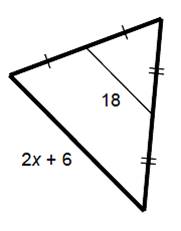
 115°115\degree  

b)

 65°65\degree  

c)

 180°180\degree  

d)

Cannot be determined

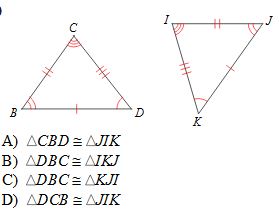
6.

If the  m∠5 = 63°,m\angle5\ =\ 63\degree,  find the measure of  ∠3.\angle3.  

a)

 63°63\degree  

b)

 117°117\degree  

c)

 180°180\degree  

d)

Cannot be determined

7.

If the  m∠1 = 57°,m\angle1\ =\ 57\degree,  find the measure of  ∠6.\angle6.  

a)

 123°123\degree  

b)

 57°57\degree  

c)

 180°180\degree  

d)

Cannot be determined

8.

Find the value of x if the  m∠1 = 11x − 9°m\angle1\ =\ 11x\ -\ 9\degree and the  m∠5 = 7x +9°m\angle5\ =\ 7x\ +9\degree .

a)

-4.5

b)

4.5

c)

1

d)

0

9.
Solve for y.
a)
y = 20
b)
y = 120
c)
y = 60
d)
y = 10
10.
If m∠1 = 30°, then m∠3 = 
a)
30°
b)
60°
c)
150°
d)
undetermined
11.

Check all the angles that are supplementary to  ∠6\angle6  

a)

 ∠1\angle1  

b)

 ∠2\angle2  

c)

 ∠3\angle3  

d)

 ∠4\angle4  

e)

 ∠5\angle5  

12.

Which of the following statements about the relationship between angle 4 and 3 is NOT TRUE

a)

They are supplementary

b)

They are on the same side of the transversal

c)

They are between the parallel lines

d)

They are same-side exterior angles

e)

None, all of these statements are true

13.
What is the value of "x"?
a)
19
b)
20
c)
21
d)
22
14.

Angle 1 is supplementary to which of the following angles

a)

 ∠3\angle3  

b)

 ∠5\angle5  

c)

 ∠6\angle6  

d)

 ∠2\angle2  

e)

None of the angles are supplemetary to Angle 1

15.

Which of the following statements about angle 4 is NOT TRUE 

a)

It corresponds with angle 2

b)

It is on the same side of the transversal as angle 3

c)

It is supplementary to angle 7

d)

It has the same  measure as angle 8

e)

None of these statements are false

16.

1) Given the two parallel lines cut by a transversal.


What is the vertical angle to angle 4?

a)

Angle 2

b)

Angle 6

c)

Angle 8

d)

Angle 7

17.

 ∠5\angle5  and  ∠6\angle6  are ___.  

a)

Alternate Interior Angles

b)

Alternate Exterior Angles

c)

Same-side Interior Angles

d)

Corresponding Angles

e)

None of these

18.
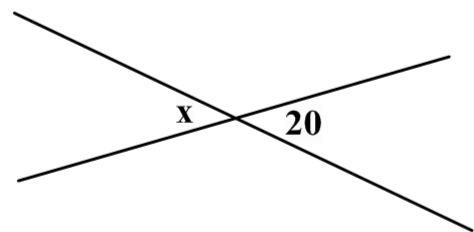
Find the missing angle.  Find x.
a)
20o
b)
70o
c)
160o
d)
180o
19.
What is the measure of the missing angle?
a)
39°
b)
129°
c)
119°
d)
129°
20.
Find the m∠1
a)
67
b)
113
c)
180
d)
23
21.
These angles are...
a)
Complementary
b)
Supplementary
c)
Neither
22.
Are these angles an example of complementary, supplementary, or neither?
a)
Complementary
b)
Supplementary
c)
Neither
23.
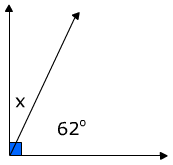
Find the missing angle.
a)
47
b)
37
c)
57
d)
137
24.
What is the measure of the missing angle?
a)
76
b)
86
c)
166
d)
156
25.
What is an example of a pair of complementary angles?
a)
13° and 45°
b)
10° and 170°
c)
81° and 9°
d)
90° and 3°
26.
Find the supplement of the angle
a)
160
b)
20
c)
-70
d)
180
27.
Find the value of x.
a)
18°
b)
28°
c)
38°
d)
118°
28.
Find the measure of the missing angle.
a)
90o
b)
100
c)
130o
d)
50o
29.
Solve for x.
a)
16
b)
11
c)
50
d)
6
30.

 EJ→ \overrightarrow{EJ}\   bisects  ∠DEF\angle DEF ,  m∠DEJ=5x+7m\angle DEJ=5x+7  ,  m∠JEF=8x−8m\angle JEF=8x-8 .
Find x.

a)

5

b)

2

c)

6

d)

13

31.

What is a vertical angle?

a)

Two angles who sum is 180.

b)

Two angles that are congruent, and are opposite of each other, that share a common vertex.

c)

Two angles who sum is 90

d)

Two angles that are adjacent.

32.

Find the value for x

(a)  

33.
Find SV
a)
18
b)
36
c)
21
d)
9
34.
Find HG
a)
28
b)
14
c)
41
d)
7
35.
Find m< JKM
a)
90
b)
76
c)
38
d)
83
36.
Find x, then the measure of TS
a)
x=6, TS=15
b)
x=6, TS=30
c)
x=5, TS=15
d)
x=5, TS=30
37.
Find x, then the measure of AC
a)
x=2, AC=8
b)
x=2, AC=16
c)
x=4, AC=8
d)
x=4, AC=16
38.
Find x, then the measure of ∠1
a)
x=8, m∠1=8
b)
x=6, m∠1=58
c)
x=8, m∠1=29
d)
x=6, m∠1=8
39.
Find x, then the measure of JK
a)
x=10, JK=50
b)
x=10, JK=100
c)
x=15, JK=100
d)
x=15, JK=50
40.
Find x, then the measure of ∠2
a)
x=-2, ∠2=70
b)
x=8, ∠2=70
c)
x=-2, ∠2=35
d)
x=8, ∠2=35
41.
Find n, then the measure of PR
a)
n=5.4, PR=19.8
b)
n=5, PR=19
c)
n=5, PR=38
d)
n=5.4, PR=39.6
42.
The Triangle Sum Theorem states that the sum of all angles in a triangle is ______. 
a)
45°
b)
90°
c)
180°
d)
360°
43.
What is the third angle of a triangle whose 1st angle is 34 and 2nd angle is 101?
a)
32
b)
39
c)
45
d)
54
44.
Find the measure of the indicated angle. 
a)
95
b)
85
c)
35
d)
45
45.
Find the measure of each angle indicated.
a)
62
b)
53
c)
71
d)
50
46.
Find the measure of each angle indicated.
a)
50
b)
20
c)
29
d)
48
47.

A triangle has one angle that measure 45° and one that measures 60°. What is the measure of the third angle?

a)

135°

b)

75°

c)

120°

d)

105°

48.

A triangle has one angle that measures 75° and one angle that measures 19°. What is the measure of the third angle?

a)

86°

b)

94°

c)

105°

d)

161°

49.
What type of angle is shown?
a)
a 90 degree angle
b)
a 180 degree angle
c)
an acute degree angle
d)
an obtuse angle
50.

What is the

 m∠Um\angle U  ?


(a)  

51.

What is the

 m∠Tm\angle T  ?


(a)  

52.

What is the measure of

 EFEF  ?


(a)  

53.

Find the value of x

(a)  

54.

solve for x; x=

a)

11

b)

60

c)

52

d)

55

55.

solve for x; x=

a)

12

b)

24

c)

-12

d)

-24

56.

solve for x; x=

a)

60

b)

45

c)

70

d)

10

57.
Find the missing length.
a)
9
b)
18
c)
4.5
d)
16
58.
Name the parallel segment.
a)
WY
b)
YX
c)
WX
d)
PN
59.
Find the missing length.
a)
12
b)
48
c)
24
d)
18
60.
Find the missing length.
a)
12
b)
3
c)
24
d)
6
61.
Find the missing length.
a)
x = 12
b)
x = 11
c)
x = 15
d)
x = 9
62.
Find the missing length.
a)
x = 12
b)
x = 11
c)
x = 15
d)
x = 9
63.
The length of a midsegment between two sides of a triangle is ______ the length of the third side.
a)
equal to
b)
double
c)
half
d)

parallel to

64.
Which is a correct congruence statement.
a)
A
b)
B
c)
C
d)
D
65.
Which is a correct congruence statement.
a)
A
b)
B
c)
C
d)
D
66.
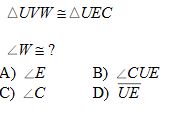
Name the corresponding angle or side.
a)
A
b)
B
c)
C
d)
D
67.
Name the corresponding angle or side.
a)
A
b)
B
c)
C
d)
D
68.
State if the two triangles are congruent.  If they are, state how you know.
a)
A
b)
B
c)
C
d)
D
69.
State if the two triangles are congruent.  If they are, state how you know.
a)
A
b)
B
c)
C
d)
D
70.
State if the two triangles are congruent.  If they are, state how you know.
a)
A
b)
B
c)
C
d)
D
71.

A dilation produces a similar figure

a)

True

b)

False

72.

When the scale factor of a dilation is less than one, the dilation is a reduction (gets smaller).

a)

True

b)

False

73.

An image is dilated at a scale factor of 1.5. This means the dilation is an enlargement and the dilated image will be bigger.

a)

True

b)

False

74.
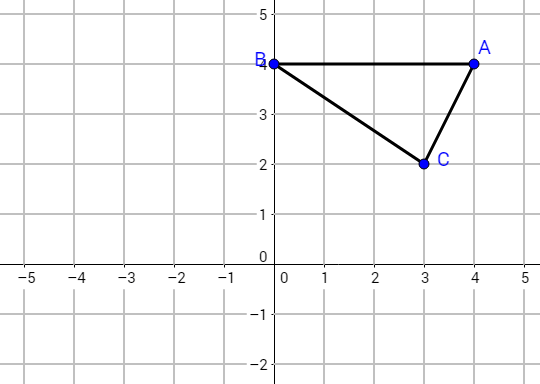
Dilate Point B by a scale factor of 3:
a)
(12,0)
b)
(12,12)
c)
(4,3)
d)
(0,12)
75.

A dilation is which of the following:

a)

an enlargement

b)

a reduction

c)

Either an enlargement or a reduction

d)

Neither an enlargement or a reduction

76.
Does the image show a Dilation?
a)
Yes
b)
No
77.

A dilation produces a congruent figure

a)

True

b)

False

78.
Dilate the figure by a scale factor of 3 with the origin as the center of dilation. What are the coordinates of the image?
A(3,3) B(6,6) C(9,3)
a)
A'(9,9) B'(18,18) C'(27,9)
b)
A'(6,6) B'(9,9) C'(12,6)
c)
A'(0,0) B'(3,3) C'(6,0)
d)
A'(1,1) B'(2,2) C'(3,1)
79.

Translate the blue shape to the pink shape...

a)

5 Right

2 Down

b)

5 Left

2 Up

c)

3 Right

1 Down

d)

3 Left

1 Up

80.

Translate the pink shape to the blue shape...

a)

5 Right

2 Down

b)

5 Left

2 Up

c)

3 Right

1 Down

d)

3 Left

1 Up

81.

Translate the blue shape to the green shape...

a)

3 Left

3 Down

b)

3 Right

3 Up

c)

2 Right

3 Up

d)

2 Left

3 Down

82.

Translate the green shape to the blue shape...

a)

3 Left

3 Down

b)

3 Right

3 Up

c)

2 Right

3 Up

d)

2 Left

3 Down

83.

Translate the blue shape to the green shape...

a)

4 Down

b)

4 Up

c)

3 Down

d)

3 Up

84.

Translate the green shape to the blue shape...

a)

4 Down

b)

4 Up

c)

3 Down

d)

3 Up

85.

Translate the blue shape to the green shape...

a)

5 Right

2 Up

b)

5 Left

2 Down

c)

5 Right

5 Up

d)

5 Left

5 Down

86.

Translate the green shape to the blue shape...

a)

5 Right

2 Up

b)

5 Left

2 Down

c)

5 Right

5 Up

d)

5 Left

5 Down

87.

Translate shape A to shape B...

a)

5 Right

3 Up

b)

5 Left

3 Down

c)

3 Right

3 Up

d)

3 Left

3 Down

88.
Determine where X' would be if you translated 3 units to the left and 9 units down.
a)
(-4, 4)
b)
(-10, 2)
c)
(-4, -5)
d)
(-1, 5)
89.
Determine how to translate triangle A'B'C' to triangle ABC.
a)
(x+2, y-5)
b)
(x+2, y-9)
c)
(x-2, y-9)
90.
How is trapezoid ABCD translated to trapezoid A'B'C'D'?
a)
Translated 5 units down and 5 units to the right
b)
Translated 5 units down and 1 to the right
c)
Translated 8 units down and 5 units to the right
d)
Translated 5 units down and 4 units to the right
91.
What transformation is happening?
(x, y) ----> (x + 2, y - 3) 
a)
slide up 2, left 3
b)
slide right 2, up 3
c)
slide right 2, down 3
d)
slide left 3, right 2
92.
What does a translation do to an image?
a)
Turns it 90* clockwise
b)
Mirrors it
c)
Shrinks it
d)
Slides it
93.

Reflect the point (2, -4) over the y-axis and then over the line y = x.

a)

(-4, -2)

b)

(-2, 4)

c)

(-2, -4)

d)

(2, 4)

94.

Reflect (6, -3) over the line y = -x and then over the x-axis.

a)

(6, 3)

b)

(-6, -3)

c)

(-3, 6)

d)

(3, 6)

95.

Triangle A is rotated 90° clockwise with the origin as the center of rotation to create a new figure. Which triangle shows the new location?

a)

A

b)

B

c)

C

d)

D

96.

What are the coordinates of A', the image of A(-3,4), after a rotation of 180º about the origin?

a)

(4, -3)

b)

(-4, -3)

c)

(3, 4)

d)

(3, -4)

97.

Point A is located at (4,-7). The point is reflected over the x-axis and then rotated 180° CW. Its image is located at...

a)

(-4, 7)

b)

(-4, -7)

c)

(4, 7)

d)

(7, -4)

98.

If point (5,2) is rotated counterclockwise 90° about the origin, its image will be point...

a)

(2, 5)

b)

(2, -5)

c)

(-2, 5)

d)

(-5, -2)

99.

What are the coordinates of M', the image of M(2,4), after a counterclockwise rotation of 90º about the origin and then reflected over the line y = x?

a)

(-2, 4)

b)

(2, -4)

c)

(-4, 2)

d)

(-4, -2)

100.

The preimage above is rotated 90o counterclockwise. How do the side lengths in the preimage compare to the side lengths in the image?

a)

Some of the side lengths increase in measure and other side lengths decrease in measure.

b)

The measures of the side lengths double.

c)

The measures of the side lengths decrease by one third.

d)

The measures of the side lengths are the same.

101.

What line is this figure reflected over?

a)

x-axis

b)

y = -1

c)

y-axis

d)

x = -1

102.

If (3,2)→(-3,-2) represents a counterclockwise rotation of the point on a coordinate plane, how many degrees is the rotation?

a)

90

b)

180

c)

270

d)

360

103.

If (4,-2) → (-2, -4) represents a counterclockwise rotation of the point on a coordinate plane, how many degrees is the rotation?

a)

90

b)

180

c)

270

d)

360

104.

Reflect (6, -3) over the line y = -x. What are the new coordinates of that point after the reflection?

a)

(6, 3)

b)

(-6, -3)

c)

(-3, 6)

d)

(3, -6)

105.

Reflect the point (2, -4) over the y-axis. What are the new coordinates of that point after the reflection?

a)

(-4, 2)

b)

(-2, 4)

c)

(-2, -4)

d)

(2, 4)

106.

Which graph is not a reflection?

a)

d

b)

c

c)

b

d)

a

107.
The image A'B'C' is a rotation of ABC.
a)
True
b)
False
108.
The triangles are similar by...
a)
SAS
b)
AA
c)
ASA
d)
SSS
109.
The triangles are similar by...
a)
SAS
b)
AA
c)
ASA
d)
SSS
110.
The triangles are similar by...
a)
SAS
b)
AAS
c)
ASA
d)
SSS
111.
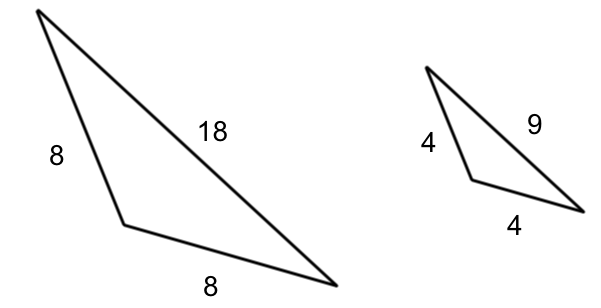
Determine whether the triangles are similar.
a)
SSS
b)
AA
c)
SAS
d)
not similar
112.
How are these triangles similar? 
a)
A
b)
B
c)
C
d)
D
113.
Find AE
a)
12.5
b)
18
c)
11.75
d)
13
114.
What is the vertex of y= x2 - 8x + 14 ?
a)
(2, 4)
b)
(-4, -2)
c)
(4, -2)
d)
(-2, 4)
115.
Find the vertex of the quadratic:
y = -2x2 + 4x + 3
a)
(0, 3)
b)
(-1, 5)
c)
(1, 5)
d)
(1, -5)
116.
a)
A
b)
B
c)
C
d)
D
117.
a)
A
b)
B
c)
C
d)
D
118.
Does the equation open up or down? 
Y = -3x2 +7x - 2
a)
up
b)
down
c)
Neither; it opens to the right.
d)
Neither; it opens to the left.
119.
What is the name of this form:
y = ax2 + bx + c
a)
vertex form
b)
standard form
c)
factored form
d)
zero form
120.
What is the maximum/minimum of a parabola called?
a)
vertex
b)
point
c)
top
d)
bottom
121.
What do we call the graph of a quadratic function?
a)
parabola
b)
linear
c)
cubic
d)
sinusoidal
122.
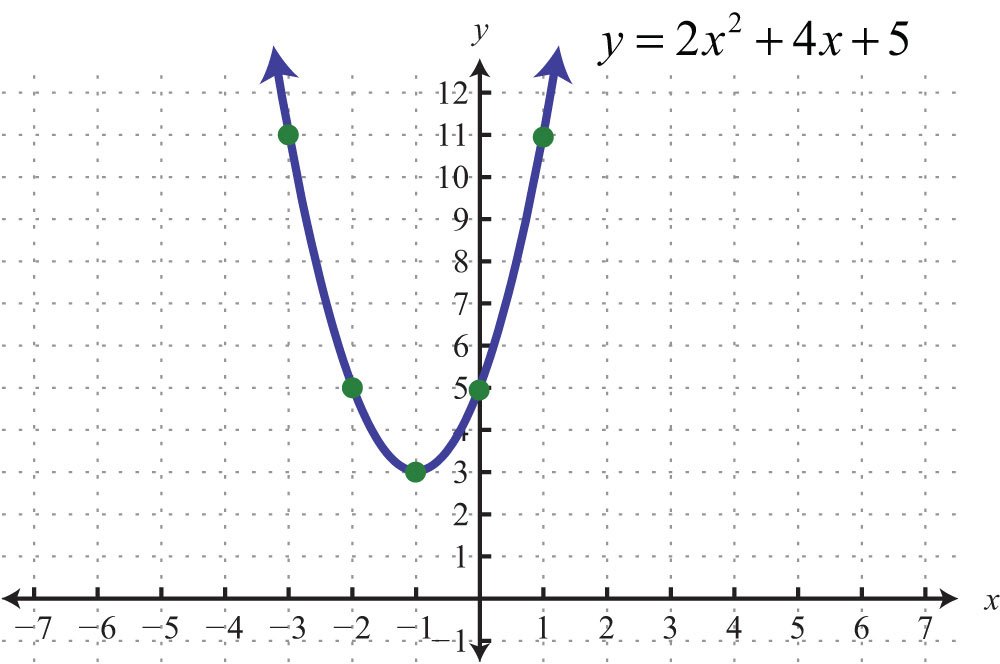
Where is the axis of symmetry for this parabola?
a)
x = −1
b)
x = 0
c)
y = 3
d)
x = −3
123.

How do you know if a parabola has a minimum?

a)

When ‘a’ is positive there is a minimum

b)

When ‘a’ is negative there is a minimum

c)

When all the numbers in the equation are negative there is a minimum

d)

When all the numbers in the equation are positive there is a minimum

124.

What is the equation for axis of symmetry?

a)

y = 3

b)

x = 3

c)

x = 5

d)

x = 1

125.
What do we call the highest or lowest point of a quadratic?
a)
parabola
b)
vertex
c)
graph
d)
point
126.
What is the axis of symmetry?
y = 3x2 - 6x + 4
a)
x=1
b)
x=-6
c)
x=2
d)
x=-1
127.
True or false:
The root, x-intercept, and zero are all the same thing
a)
True
b)
False, because the solution and root are the same but the x-intercept and zero are different
c)
False, because the x-intercept and root are the same but the zero and solution are different
d)
False, they are all different
128.
The parent function of a quadratic function is?
a)
y=mx+b
b)
y=x
c)
y=x2
d)
y=-x2
129.
If [a] >1, then the graph of the function?
a)
shrinks
b)
stretches
130.
Does y = -4x2 have a maximum or minimum value?
a)
maximum
b)
minimum
131.
If given the equation
y = 3(x + 5)2 - 4,
what is the vertex of the parabola?
a)
(5, -4)
b)
(-5, -4)
c)
(-15, -4)
d)
(15, -4)
132.
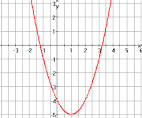
Given the equation for this parabola:
 y=-(x-4)2-3,
does this parabola have a maximum or minimum value?
a)
Maximum
b)
Minimum
133.
What is the equation of this graph?
a)
f(x) = (x -5)2 + 1
b)
f(x) = (x - 1)2 - 5
c)
f(x) = (x + 1)2 - 5
d)
f(x) = (x + 5)2 +1
134.
Identify the vertex and whether the graph opens up or down.
a)
(5, 2); opens up
b)
(5, 2); opens down
c)
(-5, 2); opens up
d)
(-5, 2); opens down
135.
What effects does "h" have on the parent function?
a)
Vertical stretch/compression
b)
Horizontal shifts (left/right)
c)
Vertical shifts (up/down)
136.
f(x) is transformed so that it maps onto g(x). Which equation would correctly represent g(x)
a)
g(x)=f(x + 3)
b)
g(x)=f(x - 3)
c)
g(x)=f(x) + 3
d)
g(x)=f(x) - 2
137.
Describe the transformation of y = 3(x - 3)2 + 3
a)
Narrow, Right, Up
b)
Narrow, Left, Down
c)
Wide, Right, Up
d)
Wide, Left, Down
138.

Which of the following is Standard Form?

a)

y=ax2+bx+cy=ax^2+bx+c

b)

y=a(x−p)(x−q)y=a\left(x-p\right)\left(x-q\right)

c)

y=a(x−h)2+ky=a\left(x-h\right)^2+k

139.

Which of the following is Vertex Form?

a)

y=ax2+bx+cy=ax^2+bx+c

b)

y=a(x−p)(x−q)y=a\left(x-p\right)\left(x-q\right)

c)

y=a(x−h)2+ky=a\left(x-h\right)^2+k

140.

What is an equation of a parabola with the vertex of  (3,−4)\left(3,-4\right)  ?

a)

 y=−12(x+3)2−4y=-\frac{1}{2}\left(x+3\right)^2-4  

b)

 y=2(x−3)2+4y=2\left(x-3\right)^2+4  

c)

 y=32(x−3)2−4y=\frac{3}{2}\left(x-3\right)^2-4  

d)

 y=(x+3)2+4y=\left(x+3\right)^2+4  

141.

What is an equation of a parabola with the vertex of  (−2,−4)\left(-2,-4\right)  ?

a)

 y=−(x+2)2−4y=-\left(x+2\right)^2-4  

b)

 y=32(x−2)2+4y=\frac{3}{2}\left(x-2\right)^2+4  

c)

 y=32(x−2)2−4y=\frac{3}{2}\left(x-2\right)^2-4  

d)

 y=(x+2)2+4y=\left(x+2\right)^2+4  

142.

Which of the following is Intercept (Factored) Form?

a)

y=ax2+bx+cy=ax^2+bx+c

b)

y=a(x−p)(x−q)y=a\left(x-p\right)\left(x-q\right)

c)

y=a(x−h)2+ky=a\left(x-h\right)^2+k