
 Worksheets
Geometry Term Benchmark Review
Total questions: 146
Worksheet time: 2hrs 26mins
Identify all the ACUTE angles...
37o
135o
23o
4o
175o
Identify all the OBTUSE angles...
187o
122o
203o
161o
145o

What is another name for ∠ a?
∠BAC
∠CBD
∠ABC
∠ABD

What is another name for ∠ X?
∠GKE
∠GKF
∠KEF
∠EKF

what does this angle measure
180 degrees
90 degrees
360 degrees
92 degrees


m∠ADB + m∠BDC = m∠ADC?


m∠KHJ=161
m∠KHJ=80.5
m∠KHJ=80.5
m∠KHJ=161

Calculate m∠ABC.
45°
60°
105°
15°

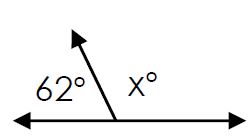


If m∠RST = (12x -1)°, m∠RSU = (9x -15)°,
and m∠UST = 53°, find each measure.
x = 13
m∠RST = 155°
m∠RSU = 102°
x = 3
m∠RST = 35°
m∠RSU = 12°
x = 22
m∠RST = 263°
m∠RSU = 183°
x = 8
m∠RST = 95°
m∠RSU = 57°

x = 5°
x = 11°
x = 33°
x = 55°


What is the relationship of the angle pair?
vertical
supplementary
complementary
adjacent

Identify the angle relationship.
vertical
supplementary
complementary
adjacent

Identify the angle pairs below that represent a vertical relationship. Select 2.
∠1
∠8
∠6
∠5
Identify the angles below that represent a supplementary relationship. Select 2.
∠1
∠3
∠8
∠5

Find the value of x


Find the value of b.
113 degrees
127 degrees
37 degrees
53 degrees

Select the pairs of angles that are Corresponding Angles. (Select all that apply)
∠1 and ∠5
∠2 and ∠6
∠3 and ∠7
∠3 and ∠6
∠1 and ∠4
Select the pairs of angles that are Alternate Interior Angles. (Select all that apply)
∠3 and ∠6
∠4 and ∠5
∠1 and ∠6
∠3 and ∠5
∠6 and ∠7
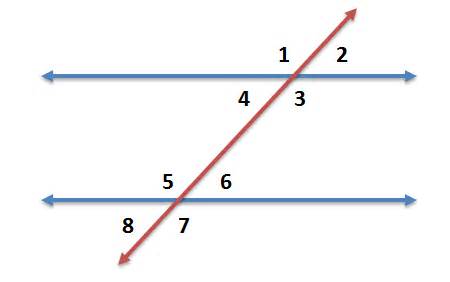
If angle 1 is 125 degrees, how many degrees is angle 6?
125 degrees
55 degrees
65 degrees
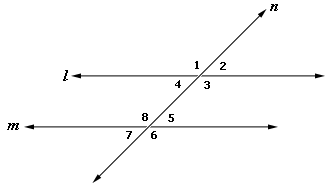
Lines l & m are parallel, angles 2 and 5 are corresponding angles, m<2=60 degrees, and m<5=(x+25). Find the value of x.
x=120
x=60
x=45
x=35

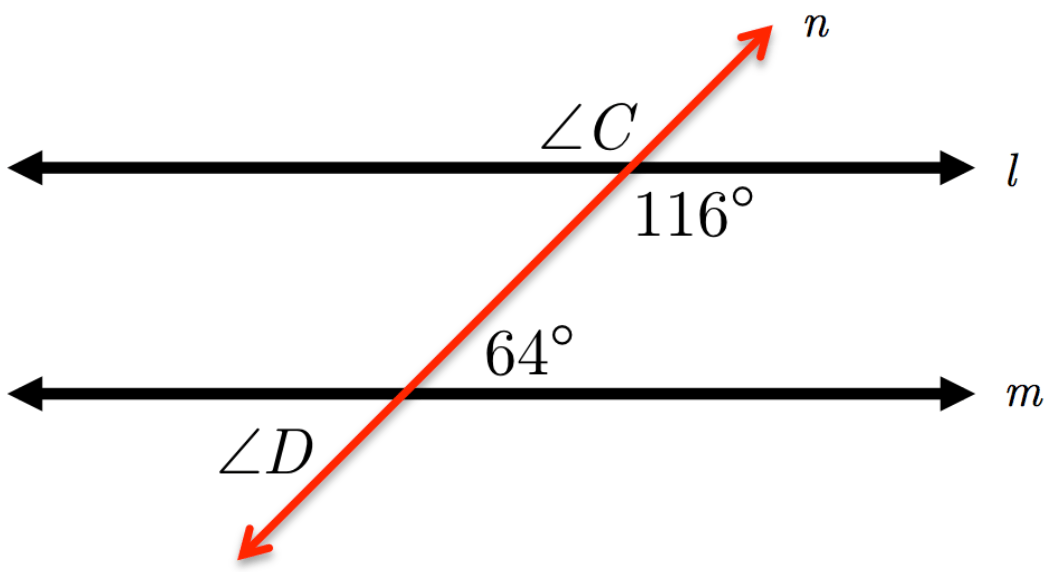
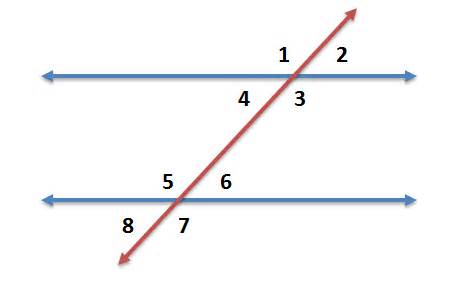
Angle 4 = x + 15
Angle 2 = 3x - 5
What is the value of x?
5
10
25
x + 15

.
Transitive Property of Equality
Substitution Property of Equality
Subtraction Property of Equality
Distributive Property of Equality

.
Multiplication Property of Equality
Reflexive Property of Equality
Angle Addition Postulate
Division Property of Equality

.
Reflexive Property of Equality
Division Property of Equality
Transitive Property of Equality
Subtraction Property of Equality

.
Addition Property of Equality
Reflexive Property of Equality
Angle Addition Postulate
Transitive Property of Equality

.
Addition Property of Equality
Segment Addition Postulate
Transitive Property of Equality
Substitution Property of Equality

.
Substitution Property of Equality
Addition Property of Equality
Symmetric Property of Equality
Angle Addition Postulate

.
Addition Property of Equality
Segment Addition Postulate
Symmetric Property of Equality
Distributive Property of Equality

.
Reflexive Property of Equality
Addition Property of Equality
Substitution Property of Equality
Identity Property of Addition

.
Symmetric Property of Equality
Substitution Property of Equality
Angle Addition Postulate
Segment Addition Postulate

.
Substitution Property of Equality
Symmetric Property of Equality
Transitive Property of Equality
Distributive Property of Equality

.
Distributive Property of Equality
Subtraction Property of Equality
Transitive Property of Equality
Reflexive Property of Equality
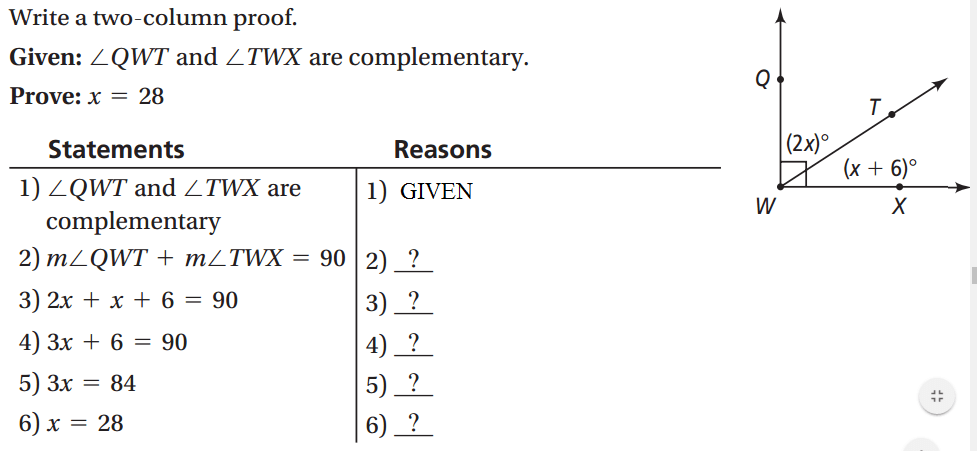
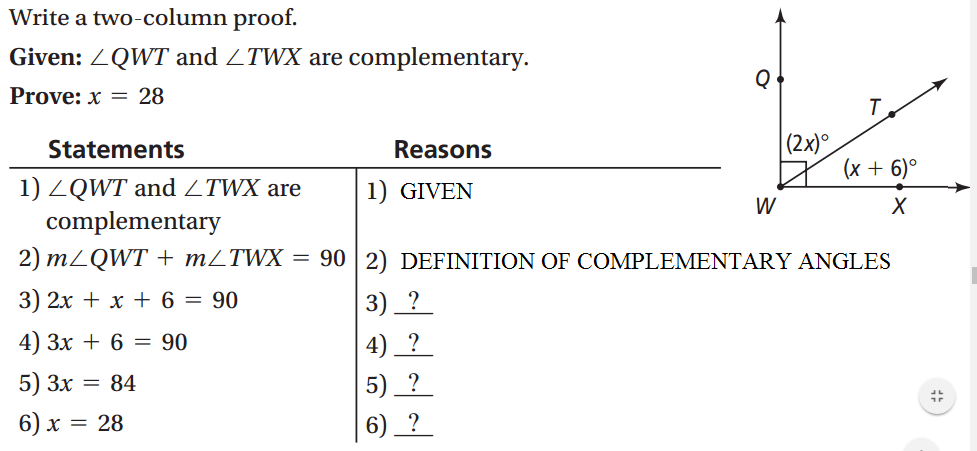
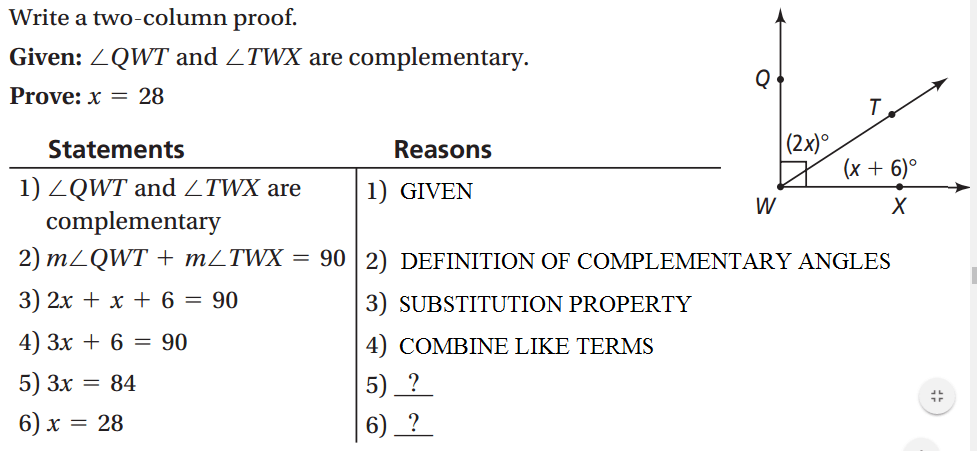
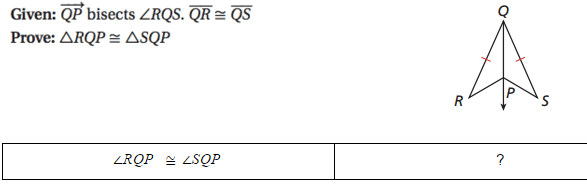
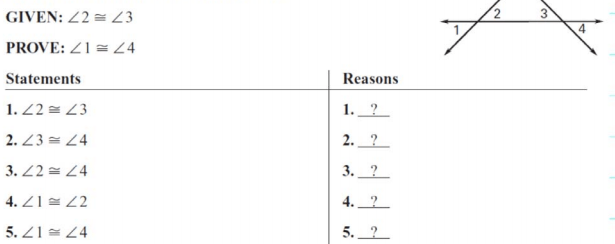
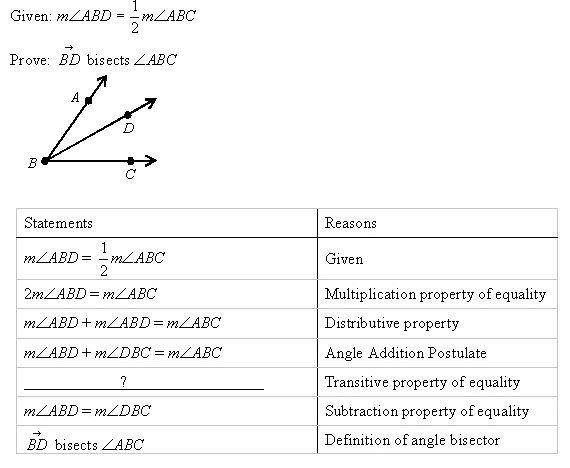
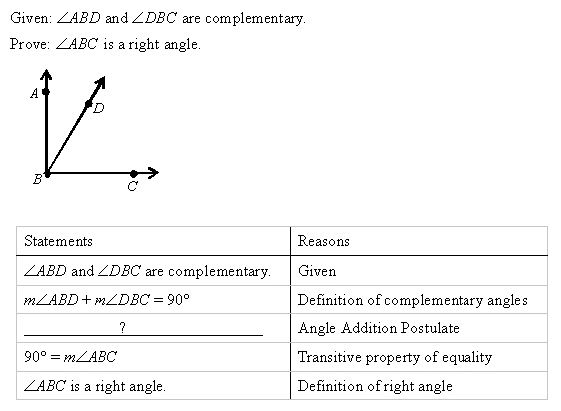

Given: BA⊥BC
Give a conclusion for the given and a reason for the conclusion.
m∠B=90° Definition of right angle
m∠B=90° Definition of perpendicular
∠B is a right angle Definition of perpendicular
∠B is a right angle Definition of right angle

In the given proof, what are the reasons for step 1 and 2?
Angles that form a linear pair are supplementary.
Substitution
Reflexive Property of Congruence
Angles of equal measure are congruent.

In the given proof, what is the reason for step 1?
Angles that form a linear pair are supplementary.
Angles of Equal Measure are Congruent
Reflexive Property of Congruence
Definition of a Perpendicular Bisector

In the given proof, what is the statement for step 2?
Angles that form a linear pair are supplementary. m∠1+m∠3=180°
m∠3+m∠5=180°
m∠1=m∠3
∠3≅∠5

In the given proof, what are the reasons for steps 1 and 3?
Alternate Exterior Angle are Congruent
Reflexive Property of Congruence
Angles that form a linear pair are supplementary.
Alternate Interior Angles are Congruent.
In the given proof, what is the reason for step 2?
Alternate Exterior Angle are Congruent
Reflexive Property of Congruence
Angles that form a linear pair are supplementary.
Alternate Interior Angles are Congruent.

What is reason 4?


What is reason 5?


Supply the second reason.
Linear Pair Postulate
Alternate Interior Angles Theorem
Vertical Angles Theorem
Corresponding Angles Postulate

Supply the third reason.
Vertical Angle Theorem
Corresponding Angles Postulate
Alternate Interior Angles Postulate
Same Side Interior Angles Theorem

The last statement is <4 = <6. What is the last reason
Prove
Definition of congruent angles
Transitive Property
Alternate Interior Angles Theorem

If parallel lines are cut by a transversal, alternate interior angles are congruent.
True
False

Select all that are true
Angles D and E are Linear Pairs
Angles A, B and C are supplementary
Angles A and E are congruent
Angles D and B are congruent

What is Reason #1?
Definition of a Linear Pair
Given
Angle Addition Postulate
Definition of Congruent Angles

Joana wrote this proof. What mistake did he make and what is the correct reason?
Reason #2 and Reason #3 need to switch spots.
Reason #1 and Reason #3 need to switch spots.
Reason #2 and Reason #4 need to switch spots.
Reason #4 and Reason #4 need to switch spots.
What is the formula for finding slope?
y=mx+b
Ax+By=C
x2−x1y2−y1
(2, 4) and (6, 12)
(-4, 7) and (-6, -4)


What is it's slope?
What is the slope of this line?
y = -6x + 2
These lines are...
y=52x+2
y=25x−3
These lines are...
Parallel
Perpendicular
Neither
m=85 What slope is perpendicular to:
−85
85
−58
58
Which of the following lines is PARALLEL to the graph of y=6x−3 ?
y=−6x+5
y=−61x−3
y=6x+1
y=61x−3
y=−32x+2
y=23x+9
These lines are...
Parallel
Perpendicular
Neither
Which is the equation of the line that is parallel to the graph of y = 5x + 7 and has a y-intercept at (0, -2)?
y = 5x - 2
y = -2x + 7
y = 5(x - 2)
y = -1/5x - 2
Which equation is parallel to the x-axis and goes through the point (2, 5)?
x = 2
x = 5
y = 2
y = 5
Which of these represents slope intercept form form?
Which of these represents standard form form?
x - y = 2
Write the equation in slope-intercept form: 3x + y = 12
Find the x and y intercepts.
4x - 5y = 40
y intercept is 8
y intercept is 20
y intercept is 10
y intercept is -8
Solve for the X-Intercept.
3x+4y=24
12
8
-12
-8
Solve for the X and Y Intercepts.
4x - 10y = 20
x = 4
y = -10
x = 5
y = 2
x = 5
y = -2
x = 4
y = -10

Write the equation of the line in standard form
y=2/3x-2
-2/3x-y=-2
-2x+3y=-6
2x-3y=6
Select all of the following equations in point-slope form.
y - 2 = 5(x - 2)
3x + 2y = 12
y + 2 = 1/4(x + 4)
y = 4x + 6
2y = 5x - 7

Which point-slope equation matches the graph?
y−4=23(x−2)
y−2=23(x−4)
y+2=32(x+4)
y+4=32(x+2)
For the equation
y + 3 = -4(x - 2),
which of the following is true?
The line has m = −4 passing through the point (2, -3)
The line has m = 4 passing through the point (3, −2)
The line has m = 3 passing through the point (-4, -2)
The line has m = −4 passing through the point (−3, 2)
For the equation
y + 2 = 5(x - 4),
the line has a slope of 5 and contains what point?
(4,−2)
(−4,2)
(5,0)
(4,2)
What is the equation of the line passing through the points (-2, 3) and (4, -5)?
y = 4/3x + 1/3
y = -4/3x + 1/3
y = 3/4x + 1/3
y = -3/4x + 1/3
What is the equation of the line that is perpendicular
to the line passing through the points (-2, 3) and (4, -5)?
y = 4/3x + 9
y = -4/3x + 9
y = 3/4x + 9
y = -3/4x + 9
What is the equation of the line going through (-1, 7) that is perpendicular
to the line passing through the points (-2, 3) and (4, -5)?
y = 4/3x + 31/4
y = -4/3x + 31/4
y = 3/4x + 31/4
y = -3/4x + 31/4
Find the equation of the line containing the points (−6, 2) and (0, 4).
y = 1/3x + 4
y = 3x + 4
y = -1/3x + 4
y = -3x + 4
Find the equation of a line that is parallel
to the line containing the points (−6, 2) and (0, 4).
y = 1/3x + 5
y = 3x + 5
y = -1/3x + 5
y = -3x + 5
Find the equation of a line that goes through the points (-8,6) and (7,-3).
y = 3/5x + 6/5
y = 5/3x - 6/5
y = -3/5x + 6/5
y = -5/3x + 2
Write an equation in slope intercept form of the lines that are perpendicular
to the line that passes through the two points given. (6, 5) (4, -3)
y = 1/4x + 29
y = -1/4x + 29
y = -1/4x + 19
y = 1/4x + 19
Are the Lines Parallel? How do you know?
Line 1 runs through the points (-6, 6) and (0, 5)
Line 2 runs through the points (0, -3) and (6, -4)
Yes, their slopes are opposite reciprocals
Yes, their slopes are the same
No, their slopes are opposite reciprocals
No, their slope are the same
Are the lines Perpendicular? How do you know?
Line 1 runs through the point (0, -1) and (7, 1)
Line 2 runs through the point (-1, 4) and (2, -5)
Yes, their slopes are opposite reciprocals
No, their slopes are not opposite reciprocals
Yes, their slope are the same
No, their slopes are not the same
(-2, -3), (4, 3)
Find the equation of the perpendicular bisector PQ for the given endpoints. P(5,2) and Q(7,4)
y=x-6
y=x+6
y=x+9
y=-x+9
Find the equation of the perpendicular bisector for the given endpoints. (-3,9) and (-1,5)
y=(-1/2)x+8
y=(1/2)x+8
Write an equation of the line in slope-intercept form of the perpendicular bisector of the segment with endpoints: A(3,1) & B(-3,6)
Write the equation of the perpendicular bisector that goes through the line segment with end points of ( 10, -10 ) and B ( 2 , 2 ).
y=(-3/2)x - 8
y=(2/3)x-8
y=(2/3)x+8
y=(-3/2)x-8
Write an equation of the line in slope-intercept form of the perpendicular bisector of the segment with endpoints: A(-2, 2) and B(6, 0).
y=−41x+7
y=41x+7
y=4x+7
y=4x−7
A(4,-2) & B(4,4)

Which statement about the perpendicular bisector of this segment is true?
The bisector will intersect at (0,2).
The slope of the bisector is 5/2.
The bisector passes through (-3,2).
The equation of the bisector is y=-2/5x + 2
A(1,3) & B(-3,5)
Find the equation of the line that is a perpendicular bisector of the line segment
with endpoints: (1, 7) and (9, 0)
y = -7/8 - 31/14
y = -7/8x + 31/14
y = 8/7x + 31/14
y = 8/7x - 31/14
Find the equation of the line that is a perpendicular bisector of the line segment
with endpoints: (6, 7) and (6, -5)
y = -6
y = 6
x = 6
x = -6
Write the equation in point-slope form of the line that passes through the given point and has the given slope:
(-2, -1); m= -3
y + 1 = -3(x - 2)
y + 1 = -3(x + 2)
y - 1 = 3(x - 1)
y + 2 = -3(x + 1)
Write the equation in point-slope form of the line that passes through the given point and has the given slope.
(4, -7); m = -1/4
y + 7 = -1/4(x - 4)
y - 4 = -1/4(x + 7)
y + 7 = 4(x - 4)
y - 7 = -1/4(x - 4)
What is the slope of the line
y + 9 = 3(x - 1)?
9
3
-1
-9
Write an equation of a line in point-slope form that goes through the point (0, 8) with a slope of -1.
y = 8(x + 1)
y = -(x - 8) + 0
y = -(x - 0) + 8
y = -(x) + 8
Write the equation in point-slope form
of the line that passes through the point
(4, -7) and has a slope of -1/4.
y + 7 = -1/4(x - 4)
y - 4 = -1/4(x + 7)
y + 7 = 4(x - 4)
y - 7 = -1/4(x - 4)

(HINT: PARALLEL LINES HAVE THE SAME SLOPE)

(HINT: PERPENDICULAR LINES - FLIP AND SWITCH)


The line with the equation
y + 1 = -3(x - 5),
contains the point (5, -1)
and has a slope of _______.
-1
1
-3
5

If the lines are perpendicular to each other and the slope of the blue line is 21 , what is the slope of the purple line?
2
-2
−21
21

If the lines are parallel to each other and the slope of the blue line is 1/4, what is the slope of the purple line?
4
-4
−41
41

What is the slope of the line?
Undefined
0
7
71
Which graph represents 2x + 4y = 12?


Which line(s) are perpendicular to the line: 8x+2y=22
y=41x−1
y=−41x+13
y−12=−41(x+13)
y−5=4(x+8)
y−2=41(x+3)
Which line is perpendicular to the line: 5x+6y=12
y=−65x−2
y=65x+13
y=56x+11
y=−56x−100
Which line is parallel to the line: 5x+6y=12
y=−65x−2
y=65x+13
y=5x+11
y=−5x−100
What is the equation of the line perpendicular to 3x + y = 10 that passes through the point
(0, -2)?
4x - 2y + 3 = 7 - 4y
What is the equation of the line passing through the points (-2, 3) and (4, -5)?
y = 4/3x + 1/3
y = -4/3x + 1/3
y = 3/4x + 1/3
y = -3/4x + 1/3
What is the equation of a line that is parallel
to the line passing through the points (-2, 3) and (4, -5)?
y = 4/3x + 3
y = -4/3x + 3
y = 3/4x + 3
y = -3/4x + 3
What is the equation of the line that is perpendicular
to the line passing through the points (-2, 3) and (4, -5)?
y = 4/3x + 9
y = -4/3x + 9
y = 3/4x + 9
y = -3/4x + 9
Find the equation of a line that is perpendicular
to the line that goes through the points (-8,6) and (7,-3).
y = 3/5x + 6/5
y = 5/3x - 6/5
y = -3/5x + 6/5
y = -5/3x + 2
Find the equation of a line that is parallel
to the line containing the points (−6, 2) and (0, 4).
y = 1/3x + 5
y = 3x + 5
y = -1/3x + 5
y = -3x + 5
Write an equation in slope intercept form of the lines that are perpendicular
to the line that passes through the two points given. (6, 5) (4, -3)
y = 1/4x + 29
y = -1/4x + 29
y = -1/4x + 19
y = 1/4x + 19
(6, 5) (4, -3)
Find the equation of the lines that are perpendicular
to the line that passes through the points (2, 4) and (6, 12).
y = 1/2x - 1
y = -1/2x - 1
y = 1/2x + 1
y = -1/2x + 1
Find the equation of a line that is parallel
to the line that passes through the points (2, 4) and (6, 12).
y = 1/2x - 1
y = -1/2x - 1
y = 2x - 1
y = -2x - 1

