wayground logo

Free Printable Worksheets

Font size

S
M
L
XL
Worksheets

Biology Final Exam Review

Total questions: 90

Worksheet time: 3hrs 55mins

Name
Class
Date
1.

Diffusion occurs because of...

a)

nonrandom movement of particles

b)

random movement of particles

c)

a chemical reaction between particles

d)

chemical energy

2.

Diffusion can be accelerated by...

a)

decreasing the pressure

b)

increasing the temperature

c)

decreasing the movement of particles

d)

increasing the dynamic equilibrium

3.

Proteins built into the cell membrane which require energy to bind and to allow signal molecules in and out of the cell

a)

receptor proteins

b)

transport proteins

c)

marker proteins

d)

channel proteins

4.

Molecules that are too large to be moved through the cell membrane can be transported OUT of the cell by

a)

osmosis

b)

endocytosis

c)

diffusion

d)

exocytosis

5.

If the concentration of sugar solution is lower outside the cell than inside the cell, which of the following will happen by osmosis?

a)

sugar will move into the cell

b)

sugar will move out of the cell

c)

water will move into the cell

d)

water will move out of the cell

6.

If someone sprays perfume in one room, soon people in another room can smell it. Which of the following is this an example of?

a)

facilitated diffusion

b)

osmosis

c)

diffusion

d)

active transport

7.

osmosis and diffusion are both examples of _____________.

a)

passive transport

b)

facilitated diffusion

c)

active transport

d)

endocytosis

8.

When the concentration of dissolved particles is the same throughout a solution, the system is said to be in ______________.

a)

dynamic isotonic

b)

dynamic equilibrium

c)

steady equilibrium

d)

cell transport

9.

If the concentration of sugar solution is lower outside the cell than inside the cell, what type of solution is present?

a)

hypertonic

b)

hypotonic

c)

isotonic

d)

exotonic

10.

The net movement of particles from an area of higher concentration to an area of lower concentration is called ______.

a)

dynamic equilibrium

b)

nonrandom movement

c)

concentration gradient

d)

diffusion

11.

Which of the following compounds may be polymers?

a)

carbohydrates

b)

nucleic acids

c)

proteins

d)

all of these

12.

When placed in the same container, oil and water do not mix because...

a)

they are both polar.

b)

water is polar and oil is nonpolar.

c)

they are both nonpolar.

d)

water is nonpolar and oil is polar.

13.

Which of the following best summarizes the relationship between condensation and hydrolysis?

a)

Condensation assembles polymers and hydrolysis breaks them down.

b)

Hydrolysis occurs during the day and condensation happens at night.

c)

Condensation occurs only after hydrolysis.

d)

Hydrolysis creates monomers and condensation destroys them.

14.

The picture below is of a...

a)

saturated fat

b)

unsaturated fat

c)

carbohydrate

d)

protein chain

15.

a)

Door and handle model

b)

Car and key model

c)

Lock and key model

d)

Window and door model

16.

In DNA, cytosine always pairs with

a)

guanine

b)

uracil

c)

thymine

d)

adenine

17.

DNA is made up of phosphates, sugars, and

a)

proteins

b)

lipids

c)

bases

d)

iodine

18.

Identify the cellular organelle that the process of photosynthesis occurs in:

a)

mitochondria

b)

chloroplast

c)

nucleus

d)

vacuole

19.

Identify the gas that is an input (reactant) of photosynthesis:

a)

oxygen

b)

Water

c)

carbon dioxide

d)

nitrogen

20.

Identify the cellular organelle that the process of cellular respiration occurs in:

a)

mitochondria

b)

chloroplast

c)

nucleus

d)

golgi

21.

What is the simplest level of organization in the body?

a)

cell

b)

tissue

c)

organ

d)

organ system

22.

Which of the following levels of organization BEST represents the sequence from smallest to largest?

a)

Cell, tissue, organism, organ

b)

Cell, organism, organ, tissue

c)

Cell, tissue, organ, organ system

d)

Cell, organism, tissue, organ system

23.

A gene is_______________________.

a)

located only in sex cells

b)

a whole chromosome

c)

a section of DNA that codes for a trait

d)

not expressed in the dominant form

24.

The diagram shows homologous chromosomes during prophase I of meiosis. Which of the following correctly describes the process being illustrated?

a)

Segregation of sister chromatids

b)

Mutation in which the DNA content of the gene is altered

c)

Crossing over in which alleles are exchanged

d)

Condensation and segregation of alleles

25.
Animals are prokaryotic.
a)
True
b)
False
26.
Which type of variable is chosen and controlled by the scientists?
a)
dependent
b)
independent
27.
Which word below properly describes cell membranes?
a)
impermeable
b)
permeable
c)
semi-permeable
28.
What are the products of photosynthesis?
a)
glucose + water
b)
glucose + oxygen
c)
oxygen + water
d)
oxygen + carbon dioxide
29.

Select all cell organelles that are found ONLY in plant cells.

a)

Cell Wall

b)

Central Vacuole

c)

Cell Membrane

d)

Chloroplast

e)

Golgi Apparatus

30.

What cell organelle is responsible for synthesizing proteins?

a)

Nucleus

b)

Ribosome

c)

Flagella

d)

Mitochondria

31.

What makes up a nucleotide?

a)

Sugar

b)

Polymer

c)

Nitrogen Base

d)

Polypeptide

e)

Phosphate

32.

What is the complementary strand of the DNA sequence ATA GCC AGC AAG? (Include spaces)

(a)  

33.

Which nitrogen base in found only in mRNA?

a)

Thymine

b)

Lysine

c)

Uracil

d)

Cytosine

34.

RNA and DNA are both made up of building blocks called...

a)

Cells

b)

Proteins

c)

Nucleotides

d)

Atoms

35.

Every 3 nucleotides codes for an

a)

Codon

b)

Amino Acid

c)

Protein

d)

Polypeptide

36.
A testable explanation to a problem that has not yet been tested. 
a)
data
b)
theory
c)
hypothesis
d)
fact
37.
An experiment is performed on plants to see how different liquids affect plant growth. Each plant in the experiment is given a different liquid; water, apple juice, or milk. Each plant has the same amount of soil, sunlight, and listens to the same music. In this investigation, the independent variable is ...
a)
The type of plant
b)
The amount of sunlight
c)
The type of music
d)
The type of liquid
38.
Dependent variable means
a)
the scientist controls what to test
b)
educated guess
c)
ask a question
d)
what is being measured
39.
If you increase the amount of spinach you eat, then you will increase the iron in your blood. 
What's the dependent variable?
a)
increase the amount of iron in your blood
b)
spinach you eat
40.
If I listen to Mr. Castro's instructions, then I will have less accidents in the lab. What is the independent variable?
a)
Yes
b)
Maybe
c)
Listening or not listening to instructions
d)
Likelihood of having an accident in lab 
41.
If I study for my scientific method test, then I will have a better test score. What is the dependent variable?
a)
Scientific Method
b)
Studying
c)
Independent variable
d)
Test score
42.
Nick wanted to see how high an ice cube would float in different temperatures of water. Identify the DEPENDENT variable
-Amount of water
-Height of Ice cube
-Temperature the ice cube was at its highest height
-Temperature of the water
-Size of the ice cube
a)
Amount of water 
b)
Height of Ice cube
c)
Temperature the ice cube was at its highest height 
d)
Size of the ice cube
43.
Which of the following is the correct equation for PHOTOSYNTHESIS?
a)
CO+ light + H2O --> O+ Sugar
b)
CO+ sugar + H2O --> O+ light
c)
O2 + light + H2O --> CO+ Sugar
d)
CO+ O2 + H2O --> Light+ Sugar
44.
What is the ultimate ORIGINAL source of energy for living things
a)
Sugar
b)
Sun
c)
Moon
d)
Carbon Dioxide
45.
What is the correct equation for cellular respiration?
a)
6O2 + C6H12O6 -> 6CO2 + 6H2O + Energy
b)
6O2 + C6H12O6 + Energy -> 6CO2 + 6H2O
c)
6CO2 + 6H2O -> 6O2 + C6H12O6 + Energy
d)
6CO2 + 6H2O + Energy -> 6O2 + C6H12O6
46.
Cellular Respiration's goal is to
a)
make water
b)
make ATP
c)
make glucose
d)
make  oxygen
47.

The scatterplot shows the amount of rainfall during six thunderstorms and the length of time that each storm lasted. Based on the scatterplot, which statement is true?

a)

During each storm that lasted longer than 1 hour, there was less than 1 inch of rain.

b)

During each storm that lasted longer than 1 hour, there was more than 1 inch of rain.

c)

No storms produced more than 2 inches of rain.

d)

No storms lasted longer than 1 hour.

48.
The graph below shows the number of sunny days and rainy days in a city during four months.

Based on the graph,how many more sunny days than rainy days did this city have during the months of April, May, and June?
a)
21
b)
56
c)
26
d)
20
49.

Based on this graph, which of the following statements is true?

a)

The anole weighs 2.5 grams after 3 days of observation

b)

The mass of the anole increased by 2.5 grams in 3 days

c)

The anole weighs 2.3 grams after 3 days

d)

The mass of the anole increased by 2.7 grams during the experiment

50.

A scientist performs an experiment to see if acids have an effect on the health of a particular type of plant. Three sets of plants were treated with acidic solutions of known pH while the control set was treated with a solution of neutral pH 7.

Which is the best conclusion for this experiment?

a)

Acid has no effect on the health of this type of plant

b)

High acidity, pH 2 is helpful to this type of plant.

c)

Low acidity, pH 6 is harmful to this type of plant.

d)

High acidity, pH 2 is harmful to this type of plant.

51.
a)

The reaction occurred FASTER with the enzyme

b)

The reaction occurred SLOWER with the enzyme

c)

Energy is absorbed and stored

d)

Energy absorbed increases, then decreases

52.
a)

Graph A best illustrates the relationship between the heat released by the foods listed in Table 1 and the change in water temperature.

b)

Graph B best illustrates the relationship between the heat released by the foods listed in Table 1 and the change in water temperature.

c)

Graph C best illustrates the relationship between the heat released by the foods listed in Table 1 and the change in water temperature.

d)

Graph D best illustrates the relationship between the heat released by the foods listed in Table 1 and the change in water temperature.

53.
a)

The overall trend in the data would be best described as increasing

b)

The overall trend in the data would be best described as decreasing

c)

The overall trend in the data would be best described as unchanging

d)

The overall trend in the data would be best described as unrelated

54.
The codon CGA codes for which amino acid?
a)
SER
b)
TRP
c)
ARG
d)
GLU
55.
Where does translation occur?
a)
nucleus
b)
ribosome
c)
cytoplasm
d)
mitochondria
56.
If a female sea otter (Aa) mates with a male otter (Aa),  what percent of the offspring will be (aa)?
a)
25%
b)
50%
c)
75%
d)
100%
57.
At the end of MEIOSIS, there are...
a)
2 identical cells
b)
2 different cells
c)
4 identical cells
d)
4 different cells
58.
Which biomolecule includes fats, such as triglycerides, oils, waxes, and steroids (cholesterol); insoluble in water; provides energy storage, insulation, part of cell membrane, and hormones 
a)
Nucleic Acid
b)
Lipids
c)
Carbohydrate
d)
Protein
59.
Which biomolecule is important source of energy for humans; glucose for human cells, tissues, and organs; provides fiber, sugar, and starches; provides structural support, cell wall, and cell membrane maker?
a)
Nucleic Acid
b)
Lipid
c)
Carbohydrate
d)
Protein
60.
What is the monomer for a protein?
a)
Monosaccharide
b)
Triglyceride
c)
Amino Acid
d)
Nucleotide
61.
What is the monomer of nucleic acids?
a)
Glycerol
b)
Monosaccharides
c)
Amino Acids
d)
Nucleotides
62.
If oxygen is not present what process will occur in yeast cells?
a)
Alcoholic fermentation
b)
Respiration
c)
Photosynthesis
d)
Lactic acid fermentation
63.
Which process produces the most ATP per molecule of glucose?
a)
lactic acid fermentation
b)
aerobic respiration
c)
alcoholic fermentation
d)
all are about the same
64.
the sequence of growth and division of a cell
a)
cell cycle
b)
mitosis
c)
anaphase
d)
cancer
65.
During what phase of the cell cycle is DNA replicated?
a)
G1 phase
b)
S phase
c)
G2 phase
d)
M phase
66.
During what phase of the cell cycle does the cell grow?
a)
G1 phase
b)
S phase
c)
M phase
d)
Cytokinesis
67.
During what phase of the cell cycle does the cell prepare for mitosis?
a)
G1 phase
b)
S phase
c)
G2 phase
d)
M phase
68.
Why would it be important to replicate DNA before a cell divides in mitosis or meiosis?
a)
In order for genetic information to be transferred into daughter cells.
b)
In order for the cell to be able to increase in size.
c)
In order for the DNA to be contained in the nucleus.
d)
In order for the cell to re-order the DNA sequencing in the new cells.
69.
What does heterozygous mean?
a)
An organism that has the same genes for a trait (TT or tt)
b)
An organism that has different genes for a trait (Tt)
c)
When neither gene is fully dominant; offspring is a mixture of both
d)
the different forms of a trait (hair color--> brown, blonde, red
70.
Which process and type of resulting cells are represented?
a)
mitosis, gametes
b)
mitosis, body cells
c)
meiosis, gametes
d)
meiosis, body cells
71.
Which of the following cell types is formed by meiosis?
a)
muscle cells
b)
skin cells
c)
sperm cells
d)
blood cells
72.
What is one advantage of sexual reproduction?
a)
offspring are identical to parents
b)
offspring are resistant to viruses
c)
offspring are born live, rather thna from eggs
d)
offspring inherit a wider variety of genetic information
73.
Term for homozygous organisms that display two dominant phenotypes at the same time
a)
codominance
b)
incomplete dominance
c)
multiple alleles
d)
linked genes
74.
What is a phenotype?
a)
The expression of a trait; what you see.
b)
refers to the genetic makeup of an individual
c)
An organism that has the same genes for a trait (ex. TT or tt)
d)
the passing of traits from parent to offspring
75.
The inherited combination of alleles is known as the offspring's
a)
heredity
b)
phenotype
c)
genotype
d)
redigree
76.
The man who studied genetics and came up with genetics is
a)
Watson
b)
Crick
c)
Mendel
d)
Darwin
77.
In a molecule of double-stranded DNA, the amount of Adenine present is always equal to the amount of
a)
cytosine
b)
guanine
c)
thymine
d)
uracil
78.
Which organelle is DNA usually found in?
a)
cell membrane
b)
vacuole
c)
chloroplast
d)
nucleus
79.
The enzyme that unzips the DNA to prepare for replication
a)
helicase
b)
replicase
c)
polymerase
d)
synthase
80.
Who were the first guys to build a model of a DNA molecule?
a)
Larry, Moe, and Curley Joe
b)
Watson and Crick
c)
Watson and Holmes
d)
Superman and Batman
81.
RNA is read in sections called:
a)
Triplets
b)
Genes
c)
Codons
d)
Genes
82.
The enzyme that produces RNA in Transcription is called
a)
RNA Polymerase
b)
DNA Polymerase
c)
Transcriptase
d)
RNA Intrase
83.
Translation begins with a(n):
a)
Start Codon
b)
Intron
c)
Promoter
d)
Origin
84.
The process of copying a gene's DNA sequence into a sequence of RNA is called:
a)
Transcription
b)
Translation
c)
Splicing
d)
Protein Synthesis
85.
The process to go from mRNA to a protein is called ____
a)
transcription
b)
rRNA
c)
replication
d)
translation
86.
The scientific name for an organism is made from the:
a)
class and family name
b)
genus and species name
c)
domain and kingdom name
d)
kingdom and phylum name
87.
Term given to describe the 2 name naming system is:
a)
dichotmous key
b)
binomial nomenclature
c)
2 scientific names
d)
binomial key
88.
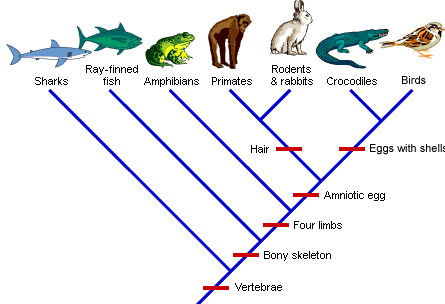
According to this cladogram, sharks are MOST closely related to which organism? 
a)
Amphibians
b)
Ray finned fish
c)
Crocodiles
d)
Birds
89.
A dichotomous key for trees is provided. Hikers found a tree that has large brown cones and single sharp needles. What species of tree have the hikers found?
a)
Juniper
b)
Pine
c)
Spruce
d)
Fir
90.
What are the 8 levels of classification of living things from most general to most specific?
a)
domain, kingdom, phylum, class, order, family, genus, species
b)
domain, kingdom, phylum, class, order, family, genius, species
c)
domain, kingdom, phamily, class, order, family, genus, species
d)
domain, king, phillip, class, order, family, genus, species