
 Worksheets
SC8 Quiz GCSE EDEXCEL KANAYATI CHEMISTRY ACIDS BASES SALTS
Total questions: 53
Worksheet time: 31mins

Colors of the universal indicator is as follows
respectively
Strong acid
weak acid
neutral
weak alkali
Strong alkali
Red Yellow violet Green Blue
Blue violet Red Yellow Green
Red Yellow Green Blue violet
Red Yellow Blue violet Green

What is the colour of methyl orange in a base ?
Pink
Blue
Yellow
Colourless
What is the colour of methyl orange an acid ?
Red
Yellow
Orange
Colourless
What is the colour of phenolphthalein an acid?
Pink
Yellow
Orange
Colourless
What is the colour of phenolphthalein in a base ?
Pink
Blue
Red
Colourless
What is the colour of phenolphthalein in neutral?
Colourless
Orange
Yellow
Purple
What is the colour of methyl orange in neutral?
Pink
Orange
Yellow
Colourless
Acids will increase the concentration of this ion in solution
hydrogen ions
hydroxide ions
sodium ions
oxygen ions
Acids are source of
hydrogen ions
hydroxide ions
Acids form Hydrogen ions only when in solution
True
False
... Are substances that combine with H+ ions from acids and neutralize them ?
Acids
Neutral compounds
Water
Bases
Which of the following are bases ?
Non metal oxides
Metal oxides
Ammonia
Metal hydroxides
Alkalis are source of what in solutions ?
Hydrogen ions
Hydroxide ions
Hyrdonium ions
Alkalis are insoluble in water
HCl + NaOH → NaCl + H2O

When an acid and base has been neutralized the pH will be?
1
4
7
10
Metal oxides reacts with acids and form corresponding salt and water .The reaction is called ____________
Neutralization reaction
Acid - base reaction
What are the products formed when a metal reacts with an acid?
salt and water
salt
hydrogen gas
salt and hydrogen gas
What are the products formed when a metal oxide reacts with an acid?
salt and water
salt
hydrogen gas
salt and hydrogen gas
What are the products formed when magnesium oxide + hydrochloric acid react?
magnesium chloride and water
magnesium chloride and hydrogen gas
hydrochloric oxygen and water
magnesium oxide and water
What are the products formed when aluminium + hydrochloric acid react?
magnesium chloride and water
aluminium chloride and hydrogen gas
aluminium chloride and water
aluminium oxide and water
What are the products formed when lead oxide + sulphuric acid react?
lead chloride and water
lead sulphate and hydrogen gas
lead sulphate and water
aluminium oxide and water
What are the products formed when zinc + ethanoic acid react?
magnesium chloride and water
aluminium chloride and hydrogen gas
aluminium chloride and water
zinc ethanoate and hydrogen gas
What are the products formed when copper oxide + hydrochloric acid react?
copper chloride and water
copper chloride and hydrogen gas
sodium ethanoate and water
aluminium oxide and water
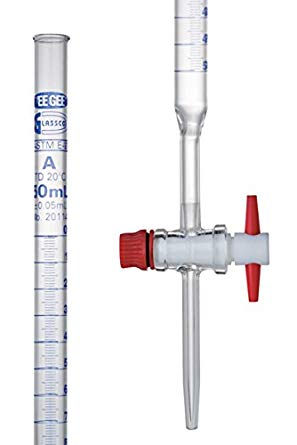
What is this piece of apparatus called
Pipette
Burette
Janette
Cuvette

What is the reading on this burette?
24.0cm3
25.8cm3
24.2cm3
23.9cm3
Which of these titres are concordant?
12.7cm3
12.3cm3
12.4cm3
12.0cm3

What is this piece of apparatus called
Pipette
Burette
Janette
Cuvette
Titration which is fast and used to know the average amount that will be used is called
Back titration
Rough titration
Redox titration
Average titration
We can use universal indicator for titration
True
False
Which of the following is insoluble?
silver chloride
zinc chloride
potassium chloride
ammonium chloride
Which method is used to prepare silver chloride?
Add excess solid reactant to acid
Titration
Precipitation
Which method is used to prepare barium sulphate?
Add excess solid reactant to acid
Titration
Precipitation
Which method is used to prepare lead (II) chloride?
Pb(NO3)2(aq) + NaCl (aq) --->
PbSO4(s)+ NaCl (aq) --->
PbCO3(s) + NaCl (aq) --->
__________ are soluble.
All carbonates
All chlorides
All nitrates
All sulfates
Precipitation involves mixing ___________ to form an insoluble solid that separates out from the reaction mixture.
acid and alkali
acid and metal
two acids
two solutions
Which of the following method is suitable to prepare iron(II) sulphate?
FeCl2 + H2SO4 --->
Fe(NO3)2 + H2SO4 --->
Fe + H2SO4 --->
Fe(OH)2 + H2SO4 --->
In order to obtain a soluble salt from a solution, which of the following methods should be used
filtration
crystallization
distillation
fractional distillation
Which of the following methods can be used to dry the solid?
I) using a filter paper
II) put it in a desiccator
III) Put it in an oven
I & II only
I & III only
II & III only
I, II & III
Which two solutions, when mixed together, will form a precipitate?
dilute hydrochloric acid and barium nitrate
dilute sulfuric acid and sodium hydroxide
dilute hydrochloric acid and lead (II) nitrate
dilute nitric acid and zinc chloride
Which pair of reagents can be used to prepare copper(II) sulfate salt?
Copper metal with dilute sulfuric acid
Copper(II) nitrate with sodium sulfate
Copper(II) chloride and dilute sulfuric acid
Copper(II) carbonate with dilute sulfuric acid
Why is solid calcium hydroxide added in excess to dilute nitric acid when preparing calcium nitrate salt?
To ensure all calcium hydroxide is used up
To speed up the reaction
To ensure all dilute nitric acid is used up
To have maximum yield of calcium nitrate

