
 Worksheets
M2 make up quiz
Total questions: 99
Worksheet time: 2hrs 1mins
Light is made up of...
electricity and waves
magnetism and waves
electricity and magnetism
electricity and energy
The color with the longest wavelength is...
Blue
Red
Green
Yellow
If you see a green leaf on a tree, that means...
Green is the color being reflected off the leaf.
Green is the color being absorbed by the leaf.
All the colors are being reflected off the leaf.
All the colors are being absorbed by the leaf.
Sunlight is special because it...
contains all the colors of the rainbow.
contains most of the colors of the rainbow.
contains white light and black light.
contains black light.
The sky is blue because...
blue is the color most scattered or reflected by our atmosphere.
red is the color most scattered or reflected by our atmosphere.
blue is the color most absorbed by our atmosphere.
blue is complimentary to orange.
The most dangerous type of light in the universe is...
a microwave
an x-ray
a gamma ray
an ultraviolet wave
What type of light does sunblock actually block?
Radio waves
Ultraviolet
Visible Light
Infrared Light
The 2 reflected rays that meet.
ray of incident
reflected image is produced
focal point
image is not produced
Which of the following is NOT a use of a concave mirror?
car lights
torches
security mirrors
mirrors used by dentist
Image behind the mirror is
virtual
real
upside down
upright
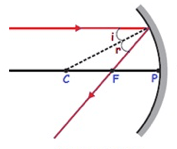
This ray diagram is for which mirror?
concave
convex
plane
window

what is A on the diagram?
center of curviture
focal length
reflected ray
focal point
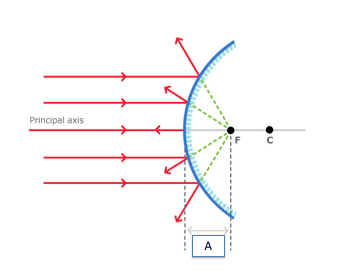
In the image, all the rays meet at F, What is F
focal length
focal point
center of curvature
reflection
this type of mirror is used in supermarkets to see around bends
concave
convex
plane
window

IF THE ANGLE OF INCIDENCE IS 20 DEGREES, WHAT WILL BE THE VALUE OF ANGLE OF REFLECTION?
0
10
20
40
The following are the image formed in plane mirror except....
erect
virtual
same size
inverted

Type of mirror used in a convenience store to provide a wide angle view...
Plane
Convex
Concave

Type of mirror used by a dentist to get magnified view of a patient's teeth...
Plane
Convex
Concave

Type of mirror found in a bathroom...
Plane
Convex
Concave

Type of mirror used as a side mirror on a vehicle to provide a wide angle view...
Plane
Convex
Concave

Type of mirror that can produce a real image...
Plane
Convex
Concave

Type of mirror that provides a wide angle view...
Plane
Convex
Concave

The size of an object and its image are the same in this type of mirror...
Plane
Convex
Concave

According to the law of reflection the angle of incidence is ____________ the angle of reflection.
less than
greater than
equal to
Type of mirror that can produce a virtual image...
Plane
Convex
Concave
All of the above

The above lens is a type of ___.
diverging lens
converging lens
divergent lens
convergent lens
Which lens represents the path light takes through a diverging lens?


Which figure represents the path light takes through a converging lens?
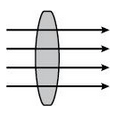
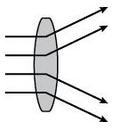
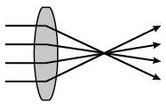
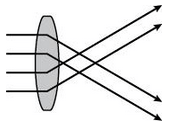
Which optical device bends light inward?
convex lens
concave lens
plane mirror
convex mirror

What type of lens is used in the shown instrument?
concave lens
convex lens
reflection lens
reduction lens

What type of lens creates the image seen in the eyeglasses?
convex
concave
reflection
plane
A lens that is thicker in the middle than on the outside is called ___.
diverging
concave
convex
achromatic
A lens that is thinner in the middle than on the outside is called ___.
diverging
concave
convex
achromatic
What word means to bend light rays toward each other?
Converging light
Diverging light
Virtual Light
Real Light
What word means to bend light rays away from each other?
Converging light
Diverging light
Virtual Light
Real Light


Formula for Hydroxide
OH
OH-1
OH=1
Formula of Chlorate polyatomic ion?
ClO-1
ClO3
ClO3-1
Formula for Sulfate polyatomic ion?
SO4-2
SO4
SO4+2
The name of FeCl₂ is
iron chloride
iron (II) chloride
iron (I) chloride
iron dichloride
LiBr is called
lithium bromine
lithium (I) bromine
lithium bromide
lithuim (I) bromide
Name the ionic compound SnSe2
Tin diselenide
Tin (IV) Selenide
Tin selenide
Tin (II) triselenide
Which of these combinations is an ionic compound made of?
Metal and Metal
Nonmetal and Nonmetal
Metal and Nonmetal
Cation and Cation
Name the following ionic compound: BeCl2
beryllium chlorine
beryllium II chloride
beryllium chloride
beryllium dichloride
Name the following ionic compound: Cs2S
cesium sulfide
cesium sulfate
cesium II sulfate
cesium II sulfide
Do acids and bases conduct electricity?
Only acids conduct electricity
Only bases conduct electricity
Bases and acids conduct electricity
Neither conduct electricity
Which of the following values would represent the pH of a strong base?
1
8
7
13
Which of the following are the characteristics of a BASE?
Very bitter in taste
Liberate OH- ions when dissolved in water
Have pH of less than 7
Turns blue litmus red
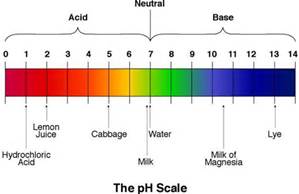
According to the pH range given in the image,which substance is more acidic than lemon juice?
Hydrochloric acid
Cabbage
Milk
Milk Of Magnesia
Which among the following is not a base?
NaOH
KOH
HCl
NH4OH
The periodic table is organized in horizontal rows called...
Groups
Periods
Families
Chemical Symbols
Lithium
Lm
Lt
Li
Lu
Arsenic
Ae
Ac
Ar
As
Which of the following will form an anion?
Tin
Lead
Chlorine
Zinc
Which of the following elements will form a cation?
Arsenic
Copper
Bromine
Fluorine
Sodium
red
orange
yellow
green
strontium
red
yellow
orange
blue

Flame tests are most useful for
blood testing
watching fireworks
identification of elements
none of the above

