
 Worksheets
Chemistry Class X - Acids, bases and salts Revision
Total questions: 50
Worksheet time: 2hrs 40mins
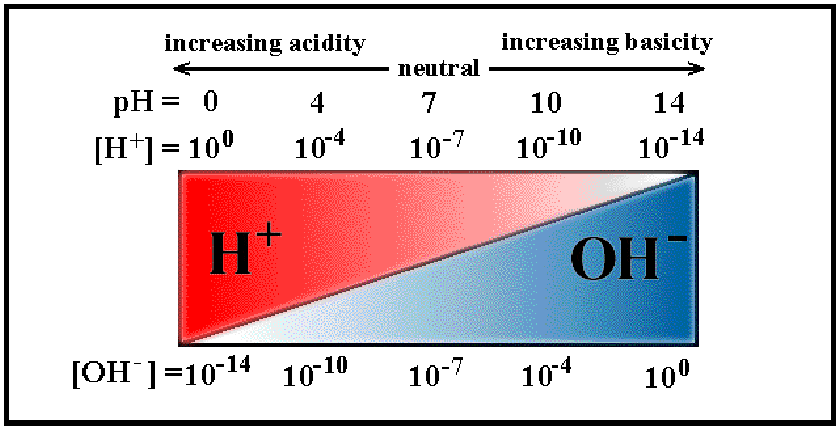
True or false: a neutral solution has equal amounts of H+ and OH-.
True
False
A substance is found to have the following characteristics:
Very bitter taste
Feels soapy to the touch
Produces OH- ions when dissolved in water
In what category would the substance be classified?
acid
base
Basic oxide
BaO
P2O5
ZnO
CO2
Which is NOT an amphoteric oxide?
zinc oxide
aluminium oxide
lead (II) oxid
sodium oxide
Which of the followings is an acidic oxide?
SO2
H2O
CO
ZnO
Potassium carbonate reacts with an acid Y to form potassium nitrate, water and carbon dioxide. What is the acid used for this reaction?
HNO3
H2SO4
HCl
Which indicator is colourless in acid and pink in alkali?
Litmus
Phenolphthalein
Universal Indicator
Methyl Orange

... are used to neutralise acid in the stomach.
Toothpastes
Bacterias
Antacids
More strong acids
After a compound X was added to water, the pH using indicator paper was less than 7. The resulting solution was added to some calcium carbonate and it was noted that effervescence took place. What could compound X be?
HNO3
MgO
Na2O
CaO
According to Arrhenius, what is the definition of an ACID?
a substance that contains hydroxide and ionizes to produce OH-
a substance that contains hydrogen and ionizes to produce H+
a substance that contains hydrogen and ionizes to produce OH-
a substance that contains hydroxide and ionizes to produce H+
Phosphoric Acid can be classified as a...
monoprotic acid
diprotic acid
triprotic acid
quadprotic
An acid has a pH
higher than 7
lower than 7
7
greater than 14
bleach is
an acid
a base
NH3 is:
a Bronsted Lowry base
an Arrhenius base
an acid
both an Arrhenius and a Bronsted Lowry base
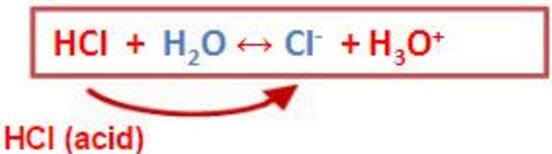


H2O is amphiprotic, can act as acid or base. Which of the following is TRUE?
H2O is only an acid because it can only donate a proton
H2O is only a base because it can only accept a proton
H2O can gain or lose a proton
H2O can easily form hydronium ion, H3O+
A Bronsted Lowry base:
donates H+ to another substance
accepts H+ from another substance
produces H+
produces OH-
CH3NH2 + H2O --> CH3NH3+ + OH-
CH3NH2 can be classified as which of the following? (HINT...follow the H+!!!)
HSO4-(aq)+H2O(l) → H3O+(aq)+SO42-(aq)
Identify the bronsted acid in the above reaction.
HSO4-
H2O
H3O+
SO42-
HCl is:
an Arrhenius acid
a Bronsted Lowry acid
both an Arrhenius and Bronsted Lowry acid
both an acid and a base

In the equation: HF + H2O ==> H3O+ + F-
H2O is an acid and HF is the conjugate base.
H2O is a base and HF is its conjugate acid.
HF is a base and H3O+ is its conjugate acid.
HF is an acid and F- is its conjugate base.
What is the difference between a conjugate Brønsted–Lowry acid–base pair?
Electron pair
Positive charge
Proton
Hydrogen atom
A substance that is more basic has a _____ pH than a substance that is acidic.
In a test of pH levels, a baking soda has a pH of 9 and bleach has a pH of 12. What is true about there relationship?
Both of the solution are Bases
Both of the solution are Acids
The Baking soda is an acid and the Bleach is a base
The baking soda is a base and the Bleach is an Acid.
A pH of 3 is how many times more acidic than a pH of 5?
2
20
10
100
A solution with a pH of 10 is mixed with an equal volume of a solution with a pH of 4. What would the pH of the mixture most likely be?
10
4
40
7
Which of the following will change the red litmus paper to blue?
Sodium hydroxide
Hydrochloric acid
Sulphuric acid
Nitric acid
Sodium hydroxide is used
to make fertilisers.
to make battery.
to cure gastritis.
to make detergent.

The preparation process of soap from the reaction between palm oil and natrium hydroxide solution are known as
Esterification
Saponification
Sulphonation
Polymerization
5 ml of solution of NaOH is completly neutralized by 4 ml of Hcl. If we take 10 ml of NaOH, the amount of Hcl required to neutralize it will be?
4ml
8ml
12ml
16ml
Identify the gas released if a solution of sodium hydrogen carbonate is heated.
H2
CO2
SO2
HCO3
What is the common name of calcium oxychloride?
Bleaching powder
Washing soda
Baking soda
Lime

What is the correctly written chemical formula for the ionic compound, strontium oxide?
[Hint: strontium, Sr is in Group 2]
Sr2O
SrO2
Sr2O2
SrO
Which of these products makes a cake spongy?
Water
Sodium Salt
Carbon dioxide
Acid
What is the difference of water molecules between Gypsum and Plaster of Paris?
2
1
1.5
0.5
TO REMOVE THE HARDNESS OF WATER WE USE
WASHING SODA
BLEACHING POWDER
BAKING SODA
NONE OF THE ABOVE
BAKING POWDER CONTAIN BAKING SODA WITH
TARTARIC ACID
SULPHURIC ACID
NITRIC ACID
ALL OF THE ABOVE
DRY SLAKED LIME FORMS BLEACHING POWDER BY ACTION OF GAS .NAME THE GAS
CHLORINE
HYDROGEN
NITROGEN
NONE
------------IS USED IN SODA ACID FIRE EXTINGUISHER.
BAKING SODA
WASHING SODA
Plaster of Paris hardens by-
(a) giving of CO2
(b) changing into CaCO3
(c) combining with water
(d) giving out water
Antacids contain
weak base
Strong base
Strong acid
weak acid
When CO2 is passed through lime water, it turns milky. the milkiness in due to formation of
H2 O
CaCO3
CaO
CO2

