
 Worksheets
Simple Harmonic Motion & Waves
Total questions: 40
Worksheet time: 1hrs 25mins
What's the period of a simple pendulum with a length of 7 m?
5.3 sec
7.4 sec
13.9 sec
11.3 sec
9.7 sec
What's the frequency of a simple pendulum with a length of 45 cm?
0.74 Hz
1.35 Hz
0.89 Hz
0.51 Hz
0.18 Hz

What's the length of a simple pendulum with a frequency of 0.33 Hz?
228 cm
145 cm
188 cm
259 cm
402 cm
Increasing which of the following will NOT increase the time it takes for a simple pendulum to complete one full oscillation? (SELECT ALL THAT APPLY.)
Length
Gravitational field strength
Frequency
Mass
Amplitude
Which of the following is true? (SELECT ALL THAT APPLY.)
A simple harmonic oscillator has the greatest kinetic energy at equilibrium.
A simple harmonic oscillator has the greatest potential energy at its turning points.
Every oscillation, kinetic energy and potential energy reach their greatest values twice, but never at the same time.
For any oscillation, either the period (in sec) or the frequency (in Hz) is greater than 1.
All waves require oscillation (or vibrations), but not all oscillations result in waves.
When is the pendulum at maximum velocity
At its lowest point
At its highest point
It moves at a constant velocity
It is at rest
When does the mass move at maximum velocity in a mass-spring system?
At equilibrium
At the farthest point from the equilibrium
At its hightest point
At its lowest point
When is a pendulum at 0 velocity?
At its lowest point
At its highest points
half way up
half way down

What is the unit for frequency?
seconds
hertz
lambda
nu

What will happen to the period of a pendulum when the length is quadrupled?
The period will be quadrupled.
The period will be doubled.
The period will be cut by a fourth.
The period will be cut in half.

____________ waves move perpendicularly to the direction the wave propagates.
Transverse
Longitudinal
Sine
Compression

____________ waves move parallel to the direction the wave propagates.
Transverse
Longitudinal
Sine
Compression

When two waves have the same wavelength but begin at different times are said ___________.
to be in phase.
to be out of phase.
to have the same amplitude.
to have the same cycle.

The speed of a mechanical wave is determined solely by the wave’s ____________________.
amplitude
medium
period
velocity

The ____________________ states that two or more waves that overlap combine by summing their
displacements algebraically.
superposition principle
wave interference
destructive interference
constructive interference

_______________ states that the force exerted by a spring is directly proportional to the amount that the spring is stretched
Hooke's Law
The Periodic Law
Peter's Law
Simple Harmonic Motion

What is the frequency of a merry-go-round that goes around 8 times a second?
50.24 Hz
0.125 Hz
0.12 Hz
8 Hz

A ______ is a disturbance that carries energy through matter or space
ocean
phase
frequency
amplitude
wave

The points along a sinusoidal wave at which displacement is zero is called a(n) ________.
node
antinode
crest
trough

Define amplitude.
maximum displacement from equlibrium position
total displacement
maximum distance from where the object is released

What is the wavelength of this wave?
3
10
4
8

If the Frequency of a disturbance is tripled, which of these is true regarding their emitted waves?
the Period would be a third of what it was
the Period would be 3 times larger
wave speed is the same for both
the Wavelength would be 3 times longer
the Wavelength would be one-third of what it was.
What is relation between period (T) and frequency (f)?
f = T
f = 1/T
f = 2 T
f = T/2
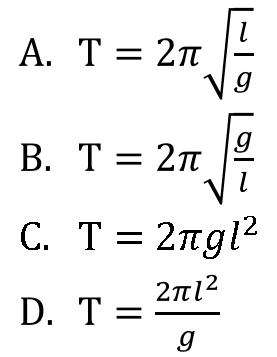
Based on your findings, which equation could best describe the pendulum’s period?
A
B
C
D
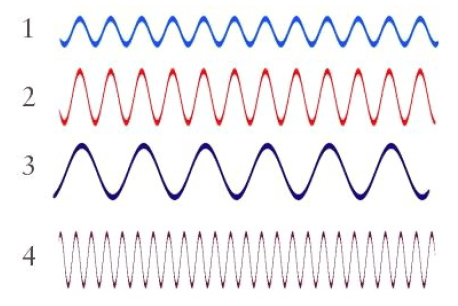


Which of the following is NOT a mechanical wave?
sound
light
ocean waves
seismic waves

Which are correct equations relating the speed of a wave ?
Speed = Frequency / Wavelength
Speed= Wavelength x Period
Speed = Wavelength / Frequency
Speed= Wavelength x Frequency
Speed = Wavelength / Period

