wayground logo

Free Printable Worksheets

Font size

S
M
L
XL
Worksheets

Unit 5 Roaring 20s Great Depression New Deal

Total questions: 75

Worksheet time: 1hrs 15mins

Name
Class
Date
1.

A period in the 1920s when African-American achievements in art and music and literature flourished

a)

Harlem Renaissance

b)

Nativism/Nativists

c)

Isolationism

d)

Emergency Quote Act of 1921

2.

the belief that those born in a country are superior to immigrants

a)

Nativism/Nativists

b)

Harlem Renaissance

c)

Isolationism

d)

Isolationism

3.

A national policy of avoiding involvement in world affairs

a)

Isolationism

b)

Emergency Quota Act of 1921

c)

Bohemian

d)

Jazz

4.

Became president when Harding died, 30th president

a)

Harding

b)

Coolidge

c)

Washington

d)

Trump

5.

A well-known case in which two Italian-American anarchists were found guilty and executed for a crime in which there was very little evidence linking them to the particular crime.

a)

Brady and Belichek

b)

Boyardee and Prego

c)

Mario and Luigi

d)

Sacco and Vanzetti

6.

Young women of the 1920s that behaved and dressed in a radical fashion

a)

Bohemian

b)

Napper

c)

Flapper

d)

Progressive

7.

Pres.1921 laissez-faire, little regard for gov't or presidency. "return to normalcy" after Wilson.

a)

Harding

b)

Coolidge

c)

Lincoln

d)

Roosevelt

8.

Movement of over 300,000 African American from the rural south into Northern cities between 1914 and 1920

a)

The Great Migration

b)

Emancipation

c)

White Flight

d)

Jim Crow

9.

African American leader during the 1920s who founded the Universal Negro Improvement Association and advocated mass migration of African Americans back to Africa. Was deported to Jamaica in 1927.

a)

Martin Luther King Jr

b)

Booker T Washinton

c)

Marcus Garvey

d)

WEB DuBois

10.
Which Amendment repealed prohibition?
a)
17
b)
19
c)
21
d)
23
11.
The Scopes Monkey Trial was important because it brought to light the teaching of ____ in schools.
a)
Evolution
b)
Creationism
c)
Christianity
d)
Temperance
12.
What is the purpose of the 1917 Immigration Act, Quota Act of 1921, Gentlemen's Agreement, and 1924 Immigration act?
a)
Reduce alliance relationships
b)
Limit immigration into the U.S.
c)
Kick out immigrants
d)
Give the US power
13.

Why did the economy experience a "boom" after WWI?

a)

African Americans were moving back to the farms to grow cotton and soybeans

b)

Consumers were preparing for a war and needed to bring extra supplies

c)

New technologies and consumer goods were being developed and people wanted to buy them

d)

Foreign trade grew after WWI

14.

Which one of these events happened during the 1920's?

a)

The Spanish-American War

b)

The bombing of the USS Maine

c)

Prohibition made playing cards in public illegal

d)

Women won the right to vote

15.

What is a "bootlegger"?

a)

A person who traded tobacco for alcohol products

b)

A person who made and sold liquor illegally

c)

A gangster like Al Capone

d)

A person who controlled the country's economy

16.

What new technology became widespread in homes by the end of the 1920's and brought news, entertainment, and advertisements to the family home?

a)

refrigerators

b)

telephones

c)

radios

d)

electric fans

17.
Who was the Chicago gangster that made millions in bootlegging?
a)
Al Capone
b)
Louis Armstrong
c)
Charlie Chaplin
d)
Babe Ruth
18.
What system allowed for mass production, the idea of products being created at a much faster pace?
a)
Ford System
b)
Assembly Line
c)
Mass Production
d)
Mass Media
19.

How did the role of women change in the 1920's?

a)

More women were able to work and make their own money, which helped them to be more independent and not have to get married

b)

Women were forced to take jobs in the factories, which made it difficult for them to take care of their families

c)

Women began to invent and use technology like the washing machine and vacuum

d)

Women began to protest Prohibition and fight for African Americans to have the right to vote

20.

Why did some groups, like the KKK, grow in numbers during the 1920's?

a)

The fought in WWI and thought they deserved more power

b)

These groups caused riots in large cities

c)

Many Americans began to believe the people born in the US were superior to immigrants

d)

African Americans were believed to be "un-American" and needed to be controlled

21.

Attorney General Palmer Mitchell believed that he needed to protect the American people from

a)

Big Business

b)

Political Radicals

c)

Corruption and Fraud

d)

Labor Union Members

22.
Which political party was in charge for most of the 1920s?
a)
Republicans
b)
Democrats
c)
Socialists
d)
Independents
23.
What was the nickname of the 1920s?
a)
Jazzy Twenties
b)
Roaring Twenties
c)
Exciting Twenties
d)
Wild Twenties
24.

Which music became popular during the 20s?

a)

Blue Grass

b)

Jazz

c)

Rock 'n Roll

d)

Classical

25.

The Ku Klux Klan was most closely associated with

a)

nativism

b)

education

c)

helping immigrants

d)

assembly line

26.
October 29th, 1929
a)
Black Monday
b)
Black Tuesday
c)
Black Wednesday
d)
Black Friday
27.
The Dust Bowl devastated what part of the U.S. during the Great Depression?
a)
West Coast
b)
New England
c)
Deep South
d)
Great Plains
28.
Paying a small % of a stock's price & borrowing the rest is known as what?
a)
buying on margin
b)
speculation
c)
fiat money
d)
price supports
29.
Buying stock without knowing the risks, assuming it will just go up is known as ________.
a)
speculation
b)
buying on margin
c)
market capitalization
d)
hammering the market
30.

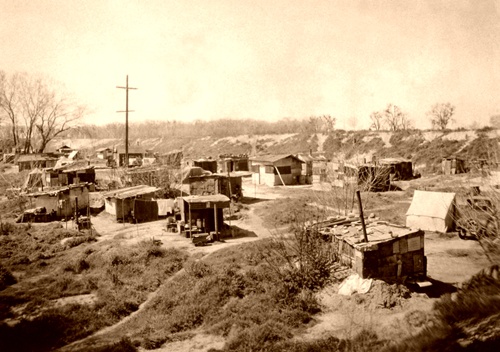
Who are these people?

a)

hoboes

b)

immigrants

c)

tourists

d)

carpet baggers

31.
A time in America following the roaring 20's where America experience rising unemployment that did not end until the onset of World War II. 
a)
New Deal
b)
Roaring 20's
c)
Great Depression
d)
Cold War 
32.
What percentage of Americans were unemployed in 1933?
a)
25%
b)
35%
c)
50%
d)
2%
33.
The Bonus Army incident in 1932 best illustrates the idea that
a)
F.D.R.'
s relief programs were unsuccessful.
b)
many felt that Herbert Hoover was not handling the Depression well.
c)
protests by veterans during the Depression were effective.
d)
the U.S. Army had increased in size and power during the Depression.
34.
What were the villages full of shacks located in cities filled with unemployed Americans called?
a)
Hoovervilles
b)
Okies
c)
Bonus Army Bases
d)
Rooseveltowns
35.
Pick the best answer.  Over-production of what led to the Great Depression?
a)
farm goods
b)
consumer goods
c)
farm and consumer goods
d)
iPhones
36.
What is a good title for this list?
a)
Culture of the 1920s
b)
The Great Migration
c)
Impact of the Great Depression
d)
Features of the New Deal
37.
All of the following were causes of the Great Depression except - 
a)
Prohibition
b)
Overspeculation on stocks
c)
failing banks
d)
high tariffs
38.

A stock market which is constantly increasing is called a

a)

Cat

b)

Dog

c)

Bull

d)

Bear

39.

What was the attitude of the group known as "the Bonus Army"?

a)

Support President Herbert Hoover

b)

Protest against veteran affrais

c)

Start a riot against FDR

d)

Demanded a bonus from WWI

40.

What led to the Dust Bowl in the Great Plains? (Midwest)

a)

Flash flooding?

b)

Lack of farming and drought

c)

High Winds and Fires

d)

A heat wave

41.

What does the image represent?

a)

Buying on margin

b)

stock market

c)

installment plans

d)

speculation

42.

Which group did Hoover's goverment blame for social unrest at this time?

a)

Women

b)

African Americans

c)

The Irish

d)

Communists

43.

BONUS: WHAT ENDED THE GREAT DEPRESSION?

a)

The New Deal

b)

WWII

c)

In time it figured it out

d)

The Cold War

44.
Who was President of the US when the stock market crashed and Depression began?
a)
Theodore Roosevelt
b)
Franklin D. Roosevelt
c)
Herbert Hoover
d)
William McKinley
45.
Who was elected president because he had a plan to pull America out of the Great Depression?
a)
William McKinley
b)
Woodrow Wilson
c)
Theodore Roosevelt
d)
Franklin D. Roosevelt
46.

The Events listed are most closely associated with which decade?


~ Major drought coditions in Texas, Oklahoma, and Kansas

~ Large numbers of bank failures

~ Widespread unemployment

~ Expanded role of the federal government

a)

1910-1919

b)

1920-1929

c)

1930-1939

d)

1940-1949

47.

Overproduction is when

a)

Factories make too much of an item with no one to buy them.

b)

People buy too many items and cannot afford them all.

c)

Banks produce too much money and devalue the dollar.

d)

All answers are correct.

48.
 Define The Great Depression
a)
Loan given to help you buy items you normally cannot buy on your own.
b)
homeless person who travels looking for work.
c)
The time in American history when the U.S. was at it's lowest point.
49.
Define Black Tuesday
a)
Group of government programs created to try and end the Great Depression.
b)
October 29, 1929 when the stock market crashed. It was the official start of the Great Depression
c)
Minimal improvement in economy. FDR urged congress to pass additional programs.
50.
What caused millions to lose their family wealth during The Depression?
a)
Bank closures
b)
Foreclosures on their farms and homes
c)
Stockmarket
d)
All of the above
51.
What New Deal program restricted agricultural production by paying farmers to grow less crops
a)
AAA
b)
CCC
c)
REA
d)
SSA
52.
What was created to protect bank deposits up to $5,000?
a)
WPA
b)
CCC
c)
TVA
d)
FDIC
53.
New Deal program tasked with providing electricity to the people through dams and other means.
a)
Works Progress Administration
b)
Tennessee Valley Authority
c)
Tennessee Valley Electrical Organization
d)
Civilian Conservation Corps
54.

It defined unfair labor practices and legalized the right to form unions.

a)

Wagner Act

b)

Federal Deposit Insurance Corporation

c)

Civilian Conservation Corp

d)

Public Works Administration

55.
It provided a pension for retired workers and their spouses and the unemployed. 
a)
Social Security Administration 
b)
Wagner Act 
c)
Public Works Administration 
d)
Federal Deposit Insurance Corporation 
56.
What are the 3 R's of the New Deal?
a)
Relief, Rebuild, and Reform
b)
Recover, Rebuild, and Reform
c)
Relief, Recovery, and Reform
d)
Recover, Revive, and Reform
57.

In this New Deal program, workers constructed things like roads, bridges, public buildings and parks but it also employed artists and performers...

a)

Tennesee Valley Authority

b)

FDIC

c)

FERA

d)

Works Progress Administration

58.
Created government jobs (natural resource conservation) for young men in 1933.
a)
National Recovery Administration (NRA)
b)
Tennessee Valley Authority (TVA)
c)
Works Progress/Projects Administration (WPA)
d)
Civilian Conservation Corps (CCC)
59.

This program provided electricity to areas that hadn't had it before.

a)

CWA

b)

REA

c)

FHA

d)

FDC

60.
What New Deal agency monitors the stock market?
a)
FBI
b)
CCC
c)
FDIC
d)
SEC
61.

What was the "New Deal" of the 1930s?

a)

a government program that gave free land to homesteaders

b)

a government program that helped women get the vote

c)

a government program that spread civil rights throughout the country

d)

a government program designed to help people during the depression

62.
One difference between the administrations of President Roosevelt and President Hoover was that Roosevelt was-
a)
more willing to use government intervention to solve economic problems
b)
unwilling to allow government agencies to establish jobs
c)
able to ignore economic issues for most of his first term in office
d)
opposed to any type of government regulation of financial institutions
63.
What was one economic consequence of President Franklin D. Roosevelt’s New Deal?
a)
Bank deregulation 
b)
Major industries were nationalized.
c)
Balanced budgets became the model for economic stability.
d)
The role of the federal government in the economy expanded.
64.
Opponents of the New Deal criticized President Franklin D. Roosevelt for
a)
expanding the role and size of the federal government
b)
permitting banks to operate without government regulation
c)
weakening the executive branch
d)
reducing spending to balance the budget
65.
Critics charged that President Franklin D. Roosevelt’s plan to increase the number of Supreme Court Justices was clearly in conflict with
a)
the Supreme Court’s practice of judicial restraint
b)
the constitutional principle of checks and balances
c)
attempts of Congress to limit judicial responsibilities
d)
efforts to restrict the number of terms a President could serve
66.
In the 1930s, the enactment of New Deal programs demonstrated a belief that
a)
corporations were best left to operate without government interference
b)
state governments should give up control over commerce inside their states
c)
the Federal Government must concern itself with the people’s economic well-being
d)
the United States Constitution was not relevant to 20th-century life
67.
How did the power of government change during the Great Depression?
a)
Presidential powers were expanded.
b)
Congress exerted greater leadership
c)
The Supreme Court expanded civil liberties.
d)
Power shifted from the federal government to the states.
68.
The creation of the Tennessee Valley Authority is an example of
a)
federal intervention to meet regional needs
b)
state-funded regional transportation
c)
free-market capitalism
d)
laissez-faire economics
69.
This 1937 cartoon is criticizing President Franklin D. Roosevelt’s plan to
a)
reduce the number of federal courts
b)
 impeach current Supreme Court justices
c)
 give states the power to appoint Supreme Court justices
d)
 increase the number of justices on the Supreme Court
70.
What popular southern Governor opposed FDR with a Share or Wealth program proposal that would have provided a guaranteed income to all Americans?
a)
Geroge Wallace
b)
Lester Maddux
c)
Orval Faubus
d)
Huey Long
71.
A New Deal program that is still in operation today is the 
a)
Social Security Administration.
b)
FDIC
c)
SEC
d)
All of the above
72.

How did Mary McLeod Bethune use her position to benefit the African American community?

a)

She led programs helping migrant workers integrate in northern cities

b)

She organized a group of African Americans to advise the president on racial issues

c)

She coordinated efforts to bring electricity to African Americans in the South

d)

She set up programs to teach African Americans farming methods

73.
Eleanor's husband became ill with polio and could not travel as he needed to.  She became his ____________________.  
a)
arms and legs
b)
eyes and ears
c)
fingers and toes
d)
gloves and shoes
74.
What is spending that is greater than revenue?
a)
balanced
b)
suplus
c)
deficit
75.

What were the three aims of the New Deal?

a)

Relief, Recovery and Reform

b)

Reform, remember and recover

c)

Register, refund and recover

d)

relief, protect and recover