
 Worksheets
Teacher M's Botany Review
Total questions: 104
Worksheet time: 17hrs 20mins
Botany is the study of...
(a)
The scientific name for plants are
Greek
Latin
English
Botanist study living things in the Family -
Plantae
Animalia
Bi- means
one
two
nome means
name
gnome
binomial means
one name
two names
one gnome
two gnomes
All Botanists are Biologists
TRUE
FALSE
All Biologists are Botanists
TRUE
FALSE
Vascular plants have (a) that carry liquid inside the plant.
Water and chemicals run up the plant through the tubes called
Phloem
Xylem
Sugar and chemicals run up the plant through the tubes called
Phloem
Xylem

Do you see the one vein in the middle that is thicker than the rest? That's called the
midrib
ribbone
midridge
ridgebone
Select the non-vascular plants
moss
sunflower
liverwort
hornwort
bladderwort
Angiosperm means
seed container
uncovered seed
uncovered container
angel seed
Gymnosperm means
seed container
uncovered seed
uncovered container
angel seed
Conifer is Latin for
cone bearer
cone fur
con fart
coney being
Phyta means
plant
feet
feature
Ptero means
wing
land
sea
fire

Why is a fern called a pterophyta?
Because it's leaves look like wings
Because it was alive during the pterodactyl age
Because it is a land plant
Because it sets on fire without warning

Sporangia means
seed container
spore container
spore angerer
seed angerer

Lichens are not really plants. they are actually two living things rolled up in one!
Fungus
Animal
Algae
Bacteria
A dormant seed needs _ _ and _ to wake up
warmth
sun
water
air
fertilizer

A is the -
testa
cotyledons
embryo
B is the -
testa
cotyledons
embryo
C is the -
testa
cotyledons
embryo

The RED one is
epicotyl
hypocotyl
radicle
dicot
The YELLOW one is
epicotyl
hypocotyl
radicle
dicot
The BLUE one is
epicotyl
hypocotyl
radicle
dicot
The epicotyl holds the _
plumule
embryo
seed
diacotyl
Plumule is Latin for -
feather
leaf
beans
people
pupil

The - is the first thing to push its way out of a seed.
Epicotyl
Hypocotyl
Radicle
Cotyledon
The - is the embryo's root.
Epicotyl
Hypocotyl
Radicle
Cotyledon
The - will become the stem.
Epicotyl
Hypocotyl
Radicle
Cotyledon
The - holds the plumule, which will become the first true leaves of the plant.
Epicotyl
Hypocotyl
Radicle
Cotyledon
The - is the food storage of the embryo.
Epicotyl
Hypocotyl
Radicle
Cotyledon
mono means
one
two
three
zero
di means
one
two
three
zero
a monocot is a seed with
one cot
one cotyledon
two cot
two cotyledon
a dicot is a seed with
one cot
one cotyledon
two cot
two cotyledon
- leaves have straight veins going towards the top of the leaf, not branching out.
monocot
dicot
tricot
quadcot
- leaves have veins that branch out from the midrib.
monocot
dicot
tricot
quadcot
- flowers' petals are in multiples of 3 - 3, 6, 9 etc.
monocot
dicot
- flowers' petals are in multiples of 4 or 10 - 4, 8, 5, 10. etc.
monocot
dicot

The picture on the LEFT is
monocot
dicot
The picture on the RIGHT is
monocot
dicot

This is a _
monocot
dicot

This is a _
monocot
dicot

This is a _
monocot
dicot

This is a _
monocot
dicot

This is a _
monocot
dicot

A
anther
filament
stigma
style
carpel
B
anther
filament
stigma
style
carpel
C
anther
filament
stigma
style
carpel
D
anther
filament
stigma
style
carpel
E
anther
filament
stigma
style
carpel
This will become the seed and is surrounded as it matures. In some plants, this becomes a fruit.
ovary with ovules
stem
stigma
anther
These are modified leaves that surround the flower when it is still a bud.
sepals
stigma
stem
petal
The stalk that supports the whole flower.
style
stigma
stem
sepal
These are modified leaves that surround the reproductive parts. Often the are brightly colored to attract pollinating insects and animals.
petal
style
stigma
stem
Pollen moves from the
stamen to the stigma
stigma to the stamen
stamen to the chloroplast
stigma to the sepal
Flowers pollinated by insects have brightly coloured and scented
sepals
petals
stigmas
stamens
The part of the flower that forms the fruit
sepal
egg
pollen
ovary
What are the two types of pollination
by water
by wind
by animals
by photosynthesis
Why do insects go to the flowers?
to get pollen
to feed on nectar
they like the colourful flowers
They like the smell
What does scented mean?
colourful
very pretty
very quiet
smells nice
The yellow powder insects move from the stame to the stigma is called
pollen
Glucose
nectar
sugar
The male part of the flower is called
stigma
stamen
petal
sepal
The female part of the flower is called....
stamen
stigma
leaf
root
The flower is the ............................ part of the plant
digestive
sensitive
photosynthesis
reproductive
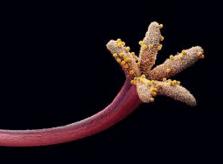

Identify this part of a flower.
Petal
Sepal
Receptacle
Pistil

Identify this part of a flower.
Style
Anther
Filament
Stigma

Identify this part of a flower.
Stigma
Style
Ovary
Ovule

What is the name of this flower?
Mickey Mouse
Donald Duck
Daisy Duck
Minnie Mouse
Have flower heads consisting of disk and ray flowers
composite family
honeysuckle family
milkweed family
mint family
pea family
During germination, a plant's food is provided by the what?
cotyledons
seed coat
radicle
plumule
Germination begins when the seed swells by absorbing what?
soil
nutrients
water
oxygen
Which one of these is carnivorous?
an oak tree
a rabbit
a giraffe
a lion
Which of these are likely to get eaten by a carnivorous plant?
a bat
a mouse
an insect
a frog
What do the environments where carnivorous plants grow all have in common?
They're all extremely dry
They all have nutrient-poor soil
They are all south of the Equator
They are all extremely cold
In the sentence "The pitcher plant entices insects with it's nectar" what does "entices" mean?
kills
smells
baits
digests
How do pitcher plants differ from Venus flytraps?
Pitcher plants eat small animals, Venus flytraps only eat insects
Pitcher plants don't need water, flytraps do
Pitcher plants capture prey passively, flytraps capture actively
Pitcher plants capture prey actively, flytraps capture passively
Why do carnivorous plants eat meat?
to make up for low nutrient levels in their habitats
because insects compete with plants for food
to support their rapid growth
to allow them to undergo photosynthesis
How do some carnivorous plants attract their prey?
nectar or by smelling sweet
they sing to them
they move like a worm
mimic the smell of that animal
What do venus flytraps and pitcher plants do to help capture their prey?
They trap them inside
They attack bugs that are already dying
They don't capture them
They capture them with their tongues

What is the name of this plant?
pitcher plant
honeydew
venus fly trap
rose bush

What is the name of this plant?
pitcher plant
oak tree
honeydew
venus fly trap
According to what we saw about Large Pitcher plants, what happens after the insect or frog falls into the pitcher?
Digestive enzymes break the prey down, so the plant can eat them
The preys start to get slippery, so they fall into another hole, where a frog lives

Is this plant an active or passive plant?
active
passive

Is this plant an active or passive plant?
active
passive

Is this an active or passive plant?
active
passive
What part of the plant struggles to do its job in a carnivorous plant?
flowers
leaves
stems
roots
How do carnivorous plants get their food?
From the soil
From eating things
What do underwater carnivorous plants eat?
Chicken nuggets
Cheeseburgers
Tiny things called micro-organisms
One type of carnivorous plant eats birds, bats and frogs. True or false?
True
False
Why do insects go to the plant?
Because it smells nice
Because the plant is their friend
How do the insects get trapped?
Sometimes they slip and then the plant eats it
Sometimes they get stuck to the sticky leaves
Sometimes the mouth snaps shut
All of these things
What is the only continent with no carnivorous plants?
Europe
Asia
Antarctica

Identify the plant
bladderwort
dodder
venus flytrap
sundew

Identify the plant
dodder
sundew
bladderwort
cuscutta
Insectivorous plants eat insects to fulfill their needs of
Energy
nitrogen,
potassium
calcium

Identify what is shown in the picture
chlorophyll
stomata
carbon dioxide
veins
What does the hinged leaves of a Venus flytrap look like?


Can you identify the carnivorous plant in the picture?
Vensus flytrap
Pitcher plant
Carnivorous bladderwort

