
 Worksheets
Electrostatics & Circuits Review
Total questions: 32
Worksheet time: 52mins

Which of the following is true about a parallel circuit?
Voltage is split between the branches of a parallel circuit.
If one part of a parallel circuit goes out, the entire circuit goes out.
Current splits in a parallel circuit.
Resistance is higher in a parallel circuit.
A 12 V battery is connected to three 4 ohm resistors in series. What is the total current flowing through the circuit?
1 ampere
3 amperes
48 amperes
144 amperes

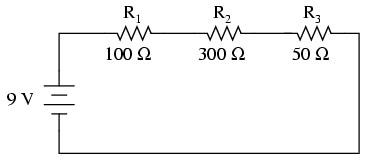
If the voltage supply for this circuit is 5 V, what is the power output of the circuit?
0.25 W
0.83 W
0.4 W
30 W
The current supplied by a battery is 0.17 amps. What would the voltage drop be across a 20 ohm resistor?
1.7 V
3.4 V
5 V
30 V
One light in the library goes out, and the entire school goes out. This would prove that the school is wired in...
series
parallel
reverse
separate circuits
In a series circuit with two resistors, which of the following does not change?
Resistance
Voltage
Current
Power
In a parallel circuit with two resistors, which of the following is the same?
Current
Resistance
Voltage
Power

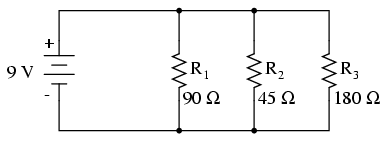
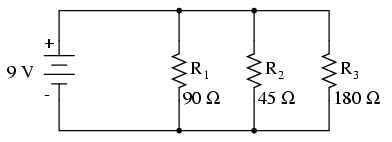
What is the total current in this circuit?
0.32 A
456 A
0.6 A
1.09 A
1.71 A

Which circuit has the smallest equivalent resistance? All resistors have a resistance of 4 ohms.
A
B
C
Which parallel resistors have the greater equivalent resistance?


If the voltage across the battery was 10 V, how much voltage does each bulb get?
10 V
5 V
20 V
0 V

If both resistors R1 and R2 are identical and have a resistance of 4 Ω, and the battery provides 12 V, then the total current coming from the battery is
6 A
1.5 A
24 A
3 A


Which lights would turn on if your closed switches 1 and 2?
red, blue, and white
red and white
red and blue
blue, white, yellow

A lamp plugged into a standard american outlet (120 V) uses 0.8 A of current. What is the power in the circuit?
0.007 W
96 W
120 W
150 W

If all of the switches were closed, how many paths can the current take?
4
6
8
10
If switch 3 and 6 were open, which device(s) would turn on?
none
A, B, C
A, C, C, E, F
all of them
What is current?
the amount of push the electrical source supplies to the circuit
how much a given device resists the flow of electric current
flow of electric charge
none of the above
What is resistance?
the amount of push the electrical source supplies to the circuit
how much a given device resists the flow of electric current
flow of electric charge
none of the above

