
 Worksheets
Oscillatory Part 2 & 3
Total questions: 17
Worksheet time: 34mins
When is the pendulum at maximum velocity
At its lowest point
At its highest point
It moves at a constant velocity
It is at rest
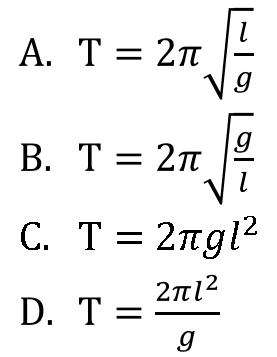
Which equation describes the pendulum’s period?
A
B
C
D
The velocity of a spring-block system vibrating along the y-axis changes with time according to the equation:
𝑣(𝑡) = - 2𝜋 sin (𝜋𝑡 + 𝜋).
What is the maximum acceleration of the object?
𝜋
2𝜋
2𝜋2
𝜋/2
Given equation of SHM,
x(t)=0.34 mm cos(3000t) where t is in second.
The frequency is:
3000 Hz
3000/2π Hz
3000/π Hz
The acceleration of a particle in SHM is:
always zero
always constant
maximum at amplitude
maximum at the equilibrium position
The velocity of a spring-block system vibrating along the y-axis changes with time according to the equation:
𝑣(𝑡) = - 2𝜋 sin (𝜋𝑡 + 𝜋).
What is the value of the velocity (in m/s) at the instant when the acceleration is zero?
2𝜋
2𝜋2
𝜋
𝜋/2

Diagram below shows an oscillating system.
Which graph shows the correct relationship between displacement and time for the oscillating system?


The equation of Simple Harmonic Motion is x(t)=A sin (2πt +ϕ)
then its phase at time t=0 is:
2πt
ϕ
2πt+ϕ
2πϕ

In a simple pendulum, which force brings the mass back to equilibrium?
Gravitational force
Elastic force
Tension
Friction
A simple harmonic motion is defined as motion where
a∝x
a∝−x
v∝x
v∝−x
A particle is executing S.H.M. if its amplitude is 2 m and periodic time 2 seconds.
Then, the maximum velocity of the particle will be:
6π
4π
2π
π
An oscillation has a function x(t)=2.0 cm sin (3.0t)
What is its angular frequency?
2.0 rad s−1
3.0 rad s−1
0.48 rad s−1
2.1 rad s−1
A simple pendulum oscillates with small amplitude, and its frequency is f.
If its length is doubled, what is the new frequency of its motion?
21f
21f
2f
2f
Which of the following is/ are characteristics of simple harmonic motion?
I. The acceleration is constant .
II. The restoring force is proportional to the displacement.
III. The frequency is independent of the amplitude.
I, II, and III
I and II only
II and III only
A block attached to an ideal spring undergoes simple harmonic motion about its equilibrium position (x = 0) with amplitude A.
What fraction of the total energy is in the form of kinetic energy when the block is at position
(x =1/2 A)?
1/3
3/8
1/2
2/3
3/4

In the graph above, the B is the characteristic of:
Underdamped
Critically Damped
Overdamped

