
 Worksheets
Unit 11 Quiz - Weather
Total questions: 48
Worksheet time: 38mins
Which of the following best describes weather?
day to day conditions of the atmosphere at a place in regards to heat, dryness, sunshine, wind, rain, etc.
long-term conditions (months/years) of the atmosphere at a place in regards to heat, dryness, sunshine, wind, rain, etc.
Which of the following best describes climate?
day to day conditions of the atmosphere at a place in regards to heat, dryness, sunshine, wind, rain, etc.
long-term conditions (months/years) of the atmosphere at a place in regards to heat, dryness, sunshine, wind, rain, etc.
The average winter temperature is 30 degrees F.
weather
climate
The high temperature today will be near 75 degrees F.
weather
climate
What is the hydrosphere?
All the water on Earth
The Ocean
A place where hydrogen and oxygen combine
A 3D rounded object made of water

Which type of cloud is tall and dark?
cumulus
cirrus
stratus
cumulonimbus
These clouds warn us that a storm is coming?
cumulus
cirrus
stratus
cumulonimbus
These clouds may bring thunder, lightning, or even a tornado.
cumulus
cirrus
stratus
cumulonimbus

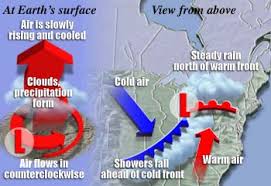
What type of weather will you see along a cold front?
Thunderstorms
Sunny skies
Gentle rain
No weather
What are tornadoes?
a storm with thunder and lighting and typically also heavy rain or hail
a storm with high winds and heavy snowfall.
a mobile, destructive vortex of violently rotating winds having the appearance of a funnel shaped cloud and beneath a large storm system.
a huge storm with strong winds and storm surges
What do hurricanes need as fuel?
warm and moist air
hot and dry air
cold and moist air
dry and warm air

A tornado occurs when
cold dry air mixes with the wet wam air
cold dry air mixes with wet cold air
dry warm air mixes with wet warm air
Mr. Sir tells it to occur
A radar tracking system that uses waves to determine the location and velocity of a storm, clouds, precipitation, etc.
Radar
Weather Channel
Dropper Radar
doppler radar
Where do MARITIME air masses form?
Over water
Over land
Where do CONTINENTAL air masses form?
Over water
Over land

What type of storm is indicated by picture?
thunderstorm
blizzard
hurricane
tornado

On the diagram below, what is the best explanation for the change in climate on the different sides of the mountain?
Mountains affect the climate of a region by creating a dry region on the leeward side of the mountain.
Mountains affect the climate of a region by creating a dry region on the windward side of the mountain.
There are land breezes on the windward side of the mountain and sea breezes on the leeward side of the mountain.
What are the names of the three climatic zones?
summer, winter, spring
polar, temperate, tropical
fauna, flora, temperate
It's extremely cold.
polar
temperate
tropical
Temperature changes according to the seasons.
polar
temperate
tropical
It has a great diversity of flora.
polar
temperate
tropical

The climate of a zone depends on the amount of _____________it receives.
sunlight
water
wind
clouds

The three main climate zones of the world are :
Polar Zone, Temperate Zone and Cold Zone.
Polar Zone,Temperate Zone and Tropical Zone.
Hot Zone,Temperate Zone and Tropical Zone.
Moderate Zone,Temperate Zone and Hot Zone.

Which Climate Zone is the arrow pointing to?
Polar
Temperate
Tropical

Which Climate Zone is the arrow pointing to?
Polar
Temperate
Tropical

Which Climate Zone is the arrow pointing to?
Polar
Temperate
Tropical

Which Climate Zone is the arrow pointing to?
Polar
Temperate
Tropical

Which Climate Zone is the arrow pointing to?
Polar
Temperate
Tropical

Which Climate Zone is the arrow pointing to?
Polar
Temperate
Tropical
How do clouds help meteorologists?
they let them know how hot it is going to be
they tell them how cold it is going to be
they help them predict the weather
they don't help them at all

