
 Worksheets
radioisotopes
Total questions: 46
Worksheet time: 31mins
Name
Class
Date
1.
Radioisotopes are chosen to have the longest half life possible.
a)
True
b)
False
2.
Water has both a positive and negative side. We call it ____.
a)
Polar
b)
Non-Polar
c)
Soluble
d)
Hydrogen Bond
3.
Inorganic Compounds do NOT contain Hydrogen and ___ together.
a)
Potassium
b)
Oxygen
c)
Carbon
d)
Nitrogen
4.
Water is ____ of your body.
a)
60-80%
b)
50%
c)
25%
d)
90-95%
5.
Water attracts molecules and forms hydration layers. It is also the best solvent in our body. This is because of water's ...
a)
Polarity
b)
Cushioning
c)
High Heat Capacity
d)
Reactivity
6.
Our cells do not instantly change temperature on a hot day. This is mostly because of water's...
a)
Polarity
b)
Cushioning
c)
High Heat Capacity
d)
Reactivity
7.
Salts are an ____ compound. They have a positive and negative atom that make them up.
a)
Ionic
b)
Covalent
c)
Hydrogen
d)
Basic
8.
____ are salts dissolved in the body that carry electrical impulses, like in the muscles and nervous system.
a)
Electrolytes
b)
Proteins
c)
Acids
d)
Monosaccharides
9.
___ increase the presence of H+ ions and are below 7 on the pH scale.
a)
Acids
b)
Bases
c)
Electrolytes
d)
Salts
10.
These chemicals help the body resist changes in pH. They are particularly useful in the blood.
a)
Buffers
b)
Acids
c)
Bases
d)
Salts
11.
Organic compounds are all bonded _____.
a)
Covalently
b)
Ionically
c)
Well
d)
with Hydrogen bonds
12.
_____ are 1-2% of your body mass.
a)
Carbs
b)
Lipids
c)
Nucleic Acids
d)
Proteins
13.
_____ are 10-30% of your body mass.
a)
Carbs
b)
Lipids
c)
Nucleic Acids
d)
Proteins
14.
Monosaccharides are use in the body as a form of...
a)
Building Block
b)
Storage
c)
Quick Energy
d)
Instructions
15.
Polysaccharides are use in the body as a form of...
a)
Building Block
b)
Storage
c)
Quick Energy
d)
Instructions
16.
In order to be used as energy, polysaccharides & disaccharides must be...
a)
Broken down
b)
Heated
c)
Put together
d)
Stored
17.
Dehydration synthesis removes water to join two simple sugars into a disaccharide. This reaction is considered to be...
a)
Anabolic
b)
Catabolic
c)
Inefficient
d)
Entropic
18.
Lipids are not soluble in water because they are ____ while water is ____.
a)
cold, hot
b)
polar, non-polar
c)
non-polar, polar
d)
hydrolyzed, cohesive
19.
Neutral fats (triglycerides) can be used for all of the following functions except...
a)
Insulation
b)
Energy Storage
c)
Quick energy
d)
Cushioning
20.
Phospholipids are...
a)
Hydrophobic
b)
Hydrophilic
c)
Both Philic & Phobic
d)
Non-polar
21.
Steroids are a type of...
a)
Protein
b)
Lipid
c)
Nucleic Acid
d)
Carbohydrate
22.
One steroid, needed to stabilize the plasma membrane, is...
a)
Cholesterol
b)
Fentenol
c)
Membranase
d)
Triglycerol
23.
You can overdose on vitamins A, D, E, and K.
a)
True
b)
False
24.
The building blocks (or monomers) of proteins are...
a)
Amino Acids
b)
Nucleic Acids
c)
Monosaccharides
d)
Glycerols
25.
The building blocks (or monomers) of Complex Carbohydrates are...
a)
Amino Acids
b)
Nucleic Acids
c)
Monosaccharides
d)
Glycerols
26.
Functional proteins are used to support or strengthen cells, like in the muscles.
a)
True
b)
False
27.
Structural Proteins are not chemically active because they help support cells.
a)
True
b)
False
28.
Enzymes are types of...
a)
Lipids
b)
Proteins
c)
Nucleic Acids
d)
Carbohydrates
29.
The ____ on the enzyme is where the chemical reaction actually occurs.
a)
Active site
b)
Substrate
c)
Chemical body
d)
Mouth
30.
Enzymes work best in temperatures above body temperature.
a)
True
b)
False
31.
Enzymes work in the body by ___ chemical reactions.
a)
Slowing down
b)
Catalyzing
c)
Simplifying
d)
Eliminating
32.
ATP is used as simple cell ____.
a)
Energy
b)
Building Blocks
c)
Enzymes
d)
Vitamins
33.
Which of the following binds to the active site of an enzyme?
a)
substrate
b)
product
c)
codon
d)
none of the above
34.
What happens when enzymes are heated to a high temperature?
a)
The enzymes die.
b)
The shapes of the enzyme are altered or denatured
c)
The enzymes' amino acid sequence changes.
d)
The enzymes remain the same
35.
Enzymes are
a)
nucleic acids
b)
proteins
c)
lipids
d)
carbohydrates
36.
Which of the following is NOT a biomolecule?
a)
Water
b)
Nucleic Acid
c)
Protein
d)
Lipid
37.
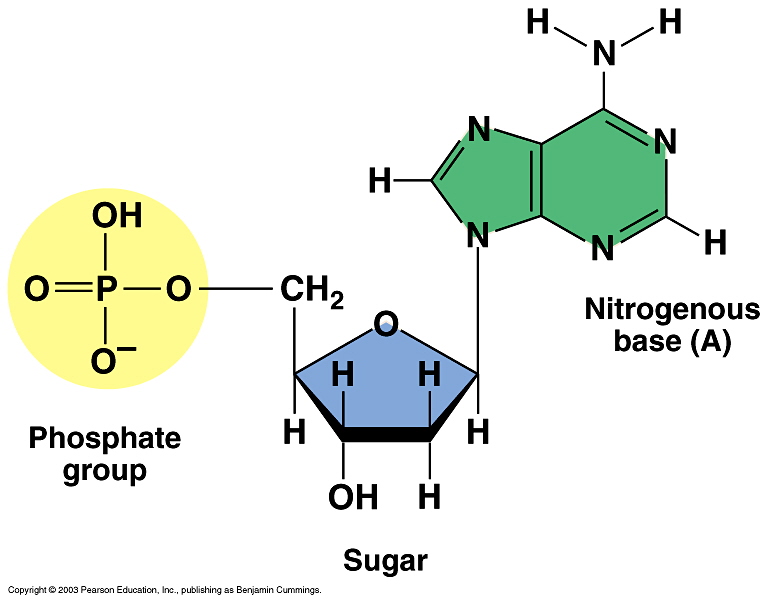
Identify the biomolecule
a)
Lipid
b)
Protein
c)
Carbohydrate
d)
Nucleic Acid
38.
Carbohydrates are more easily metabolized than lipids. However, on a gram-for-gram basis lipids provide cells with more-
a)
nitrogen
b)
proteins
c)
structure
d)
energy
39.
How do lipids function for cells?
a)
store information
b)
store energy
c)
breakdown wastes
d)
join with substrates
40.
What is the function of nucleic acids?
a)
store genetic information
b)
store energy (long-term)
c)
store energy (short-term)
d)
build skin, hair, nails, muscles
41.
Which substance plays a major role in most of the chemical reactions that occur in a living cell?
a)
water
b)
glycogen
c)
glycerol
d)
maltose
42.
What is the major component of plasma membranes?
a)
lipids
b)
carbohydrates
c)
nucleotides
d)
proteins
43.
The type of polysaccharide which serves as a strengthening tissue in the cell wall of plants is
a)
cellulose
b)
glucose
c)
lactose
d)
fructose
44.

Attractions between water molecules are called
a)
Covalent bonds
b)
Ionic bonds
c)
Polar bonds
d)
Hydrogen bonds
45.
What is the significance of nucleic acids for cells?
a)
They generate energy for the cell.
b)
They restrict what enters and leaves the cell.
c)
They support and maintain the shape of the cell.
d)
They provide all instructions for cellular activities.
46.

What is most likely being shown?
a)
amino acids
b)
chromosomes
c)
DNA
d)
RNA
100 %

