wayground logo

Free Printable Worksheets

Font size

S
M
L
XL
Worksheets

Roller Coaster Unit Study Guide

Total questions: 55

Worksheet time: 14hrs 45mins

Name
Class
Date
1.
is the energy possessed by an object because of its motion.
a)
Power
b)
Force 
c)
energy
d)
kinetic energy
2.
A ______ is a push or a pull acting upon an object
a)
Acceleration
b)
force
c)
friction
d)
energy
3.
 The two most important forms for amusement park rides are kinetic and potential _____
a)
acceleration
b)
Friction
c)
force
d)
energy
4.
Objects that are changing their speed or their direction are said to be 
a)
Energy
b)
acceleration
c)
speed
d)
unbalanced forces
5.
What force caused your cart to slow down?
a)
friction
b)
applying force
c)
gravity
d)
gravity and friction
6.
What is the relationship between kinetic energy and speed
a)
They are directly proportional
b)
There is no relationship
c)
They are indirectly proportional
d)
They are brother and sister
7.
Which would have the greatest potential energy with respect to work being done on the book?
a)
A book on a 1.2 meter table with a normal force
b)
A book on the floor with a normal force
c)
book in the hands of a 1.8 meter person with a normal force 
d)
They have the same potential energy
8.
The velocity of an object is:
a)
Acceleration
b)
Speed only
c)
Speed in a certain direction
d)
Force
9.
When measuring the force used on an object we use the unit:
a)
Meters
b)
Newtons
c)
Distance/Time
d)
None of these
10.
When you push on an object and your friend pulls on the same object and the object does not move, this is an example of:
a)
Net forces
b)
Regular forces
c)
Unbalanced forces
d)
Balanced forces
11.
Where does the most potential energy exist on a roller coaster?
a)
The top of the coaster
b)
The bottom of the coaster
c)
The middle of the coaster
d)
It is the same anywhere on the coaster
12.
Jose is stretching a rubber band so that it is tight.  Before he lets the rubber band fly, the rubber band has:
a)
Magnetic Energy
b)
Kinetic Energy
c)
Potential Energy
d)
None of these types of Energy
13.
You pushing on a chair by sitting down and the chair pushing back on you is an example of:
a)
Newton's 1st Law
b)
Newton's 2nd Law
c)
Newton's 3rd Law
d)
None of these
14.
A football player is tackled and the force of the tackle pushes the player back 5 yards is an example of:
a)
Newton's 1st Law
b)
Newton's 2nd Law
c)
Newton's 3rd Law
d)
None of these
15.
Your bike continues to accelerate as you pedal faster, this is an example of:
a)
Newton's 1st Law
b)
Newton's 2nd Law
c)
Newton's 3rd Law
d)
None of these
16.
An object set in motion by a force is an example of:
a)
an unbalanced force
b)
a balanced force
c)
neither of these
d)
both of these
17.
The force that makes a roller coaster roll is
a)
Rocket Power
b)
Gravity
c)
Motors
d)
Gears
18.
 If a drop is steeper, the roller coaster will go...
a)
Faster
b)
Crash
c)
Slower
d)
Stop
19.
When you are at the top of a hill on a roller coaster you have what type of energy?
a)
Kinetic Energy 
b)
Potential Energy
c)
Electrical Energy
d)
Chemical Energy 
20.
The faster an object moves, the ________ kinetic energy it has. 
a)
more
b)
less
c)
none of the above
d)
all of the above 
21.
Friction is a force that acts in an ___________ direction of movement.
a)
similar
b)
opposite
c)
parallel
d)
west
22.
Where is potential energy the GREATEST on a roller coaster?
a)
At the bottom of the first hill
b)
At the top of the first hill
c)
Half way down the first hill
23.
Where is kinetic energy the LEAST on a roller coaster?
a)
At the bottom of the first hill
b)
At the top of the first hill
c)
Halfway down the first hill
24.
Where is potential energy the LEAST on a roller coaster?
a)
At the top of the first hill
b)
Halfway down the first hill
c)
At the bottom of the first hill
25.
Where is kinetic energy the GREATEST on a roller coaster?
a)
At the bottom of the first hill
b)
At the top of the first hill
c)
Halfway down the first hill
26.
What is the speed of a car that traveled 56 m in 4 seconds?
a)
64 m/s
b)
34 m/s
c)
14 m/s
d)
0.0625 m/s
27.
Any object with mass has gravity.
a)
True
b)
Sometimes
c)
False
d)
Never
28.
Every object in the universe attracts every other object.
a)
True
b)
False
29.
Gravity is the force objects put on each other because of their ______.
a)
Mass
b)
Friendliness
c)
Acceleration
d)
Speed
30.
Which of the following is a unit of mass?
a)
kilogram
b)
liter
c)
meter
d)
pound
31.
What is mass?
a)
the force of an object caused by gravity
b)
the amount of space something takes up
c)
the amount of matter in an object
d)
how fast something is moving
32.
The Theory of the Conservation of Energy states -
a)
Energy can be created, just not destroyed. It changes its form from one type to another.
b)
Energy can never be created nor destroyed. It can only change its form from one type to another.
c)
The total energy in our Universe changes, as different forms of energies can be transformed from each other under certain circumstances.
d)
Energy transformations do not passively occur in our lives, rather we actively make use of energies and transform energies.
33.
Energy transformations occur when...
a)
energy is created through conduction
b)
energy changes from one form to another
c)
two forces slide together that are touching
d)
a chemical reaction takes place
34.
 A 60-kilogram student running a 3.0 meters per second has a kinetic energy of
a)
270J
b)
180 J
c)
540 J
d)
8100J
35.
When the cart started rolling the energy transformation was
a)
Potential to kinetic
b)
Kinetic to potential
c)
 No energy was transformed
d)
Totally awesome dude!!!!!! 
36.
What force pulled your cart when it slowed down going up the hill of the roller coaster?
a)
gravity
b)
applying force
c)
friction
d)
gravity and friction
37.
What force caused your cart to slow down?
a)
friction
b)
applying force
c)
gravity
d)
gravity and friction
38.
When your roller coaster cart was lifted to the top of the track...
a)
You increased potential energy, and increased kinetic energy
b)
You decreased potential energy, and increased kinetic energy
c)
You just increased potential energy
d)
You just increased kinetic energy
39.
What is the relationship between kinetic energy and speed
a)
They are directly proportional
b)
There is no relationship
c)
They are indirectly proportional
d)
They are brother and sister
40.
Where did your roller coaster cart get its total kinetic energy?
a)
potential energy gained as you lifted it to the top
b)
From the speed of the cart as it rolled down the track
c)
 From the speed of the cart as it rolled up the hill
d)
 From the potential energy gained as it rolled up the hill
41.
Which would have the greatest potential energy with respect to work being done on the book?
a)
A book on a 1.2 meter table with a normal force
b)
A book on the floor with a normal force
c)
book in the hands of a 1.8 meter person with a normal force 
d)
They have the same potential energy
42.
A roller coaster has a mass of 250 kg, and is 50 meters above the ground, what is the potential energy?
a)
122,625 Joules
b)
5,600 Joules
c)
234,799 Joules
43.
What is the Kinetic Energy of a 150 kg object that is moving with a speed of 15 m/s?
a)
10.0 J
b)
1.5 J
c)
16875 J
d)
168,750 J
44.
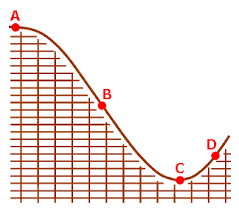
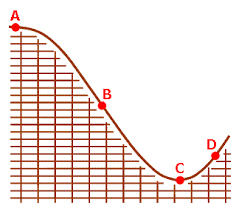
At which point(s) on the roller coaster is the gravitational potential energy at its maximum?
a)
A
b)
B
c)
C
d)
D
45.
At which point(s) on the roller coaster is the kinetic energy at its maximum?
a)
A
b)
B
c)
C
d)
D
46.
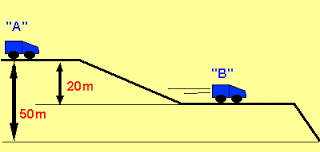
In diagram 2, if the mass of the car is 600 kg, what is the change in potential energy from point A to point B?
a)
411,600 J
b)
294,000
c)
176,400 J
d)

117,720 J

47.
What force ultimately slows the roller coaster to a stop?
a)
Applied
b)
Normal
c)
Friction
d)
Magnetic
48.
What states that "every object in the universe attracts every other object"?
a)
Law of Universal Gravitation
b)
Newton's First Law of Motion
c)
My mother
d)
Inertia & gravity
49.
Which of the following is Newton's Law on Gravitation?
a)
F=Gm1m2/r
b)
F = Gm1m2/r2
c)
F = Gm1m2/2r
d)
F = m1m2/2r
50.

Calculate the force of gravity (F) between two objects whose masses are m1 = 100 kg and m2 = 1000 kg if they are separared by a distance of d = 500 m.

a)

2.67 * 10-11 N

b)

0.4 N

c)

6.67 * 10-11 N

d)

1.3 * 10-8 N

51.

Find the distance between two objects whose masses are m1 = 4,500 kg, and m2 = 8,700 kg; if the gravitational force between them is F = 2.0 x 10⁻⁸ N.

a)

130565.25 m

b)

361.34 m

c)

0.19575 m

d)

0.783 m

52.

Calculate the gravitational force between two objects when they are 0.750m apart. Each object has a mass of 5.00kg.

a)

2.96x10⁻⁹N

b)

3.00x10⁻⁶N

c)

2.22x10⁻⁹N

d)

2.23x10⁻⁸N

53.

Calculate the force of gravity (F) between two objects whose masses are m1 = 100 kg and m2 = 1000 kg if they are separared by a distance of d = 500 m.

a)

2.67 * 10-11 N

b)

0.4 N

c)

6.67 * 10-11 N

d)

1.3 * 10-8 N

54.

Find the distance between two objects whose masses are m1 = 4,500 kg, and m2 = 8,700 kg; if the gravitational force between them is F = 2.0 x 10⁻⁸ N.

a)

130565.25 m

b)

361.34 m

c)

0.19575 m

d)

0.783 m

55.

What is the gravitational force between two identical 50,000 kg asteroids whose centers of mass are separated by 1000 m?

a)

2500 N

b)

3.3 x 10⁻¹² N

c)

1.67 x 10⁻⁴ N

d)

1.67 x 10⁻⁷ N