
 Worksheets
Muscle assessment
Total questions: 51
Worksheet time: 1hrs 24mins
Which muscle type is striated?
cardiac
skeletal
smooth
cardiac and skeletal


The connective tissue that is found on the outer covering of the muscle is called?
Fascicle
Epimysium
Perimysium
Endomysium
Which muscle tissue has intercalated discs?
Cardiac
Smooth
Skeletal
Visceral

Label the muscle type from left to right.
cardiac smooth skeletal
skeletal cardiac smooth
skeletal smooth cardiac
cardiac skeletal smooth

Name the tissue
Skeletal
Cardiac
Smooth


Which number represents the periosteum of the bone?
(a)
Which number represents the Tendon?
(a)
Which number represents the Fascia of the muscle?
(a)
Which number represents the Epimysium?
(a)
Which number represents the Perimysium?
(a)
Which number represents the Fascicle?
(a)
Which number represents the Muscle Fiber?
(a)
Which number represents the Sarcoplasmic reticulum?
(a)
Which number represents the Myofibril?
(a)
Which number represents the Filaments?
(a)
Which number represents the Endomysium?
(a)
What is the role of calcium ions in muscle contraction?
Calcium ions bind to troponin, causing a conformational change that allows myosin to bind to actin and initiate muscle contraction.
Calcium ions inhibit the binding of troponin, preventing muscle contraction
Calcium ions have no role in muscle contraction
Calcium ions cause the release of myosin, leading to muscle relaxation
During the power stroke, what happens to the actin filaments?
During the power stroke, the actin filaments detach from the myosin filaments
During the power stroke, the actin filaments shrink in size
During the power stroke, the actin filaments slide past the myosin filaments, causing muscle contraction.
During the power stroke, the actin filaments become rigid and immobile
Which molecule provides the energy for the power stroke?
Glucose
Water
Carbon dioxide
Adenosine triphosphate (ATP)
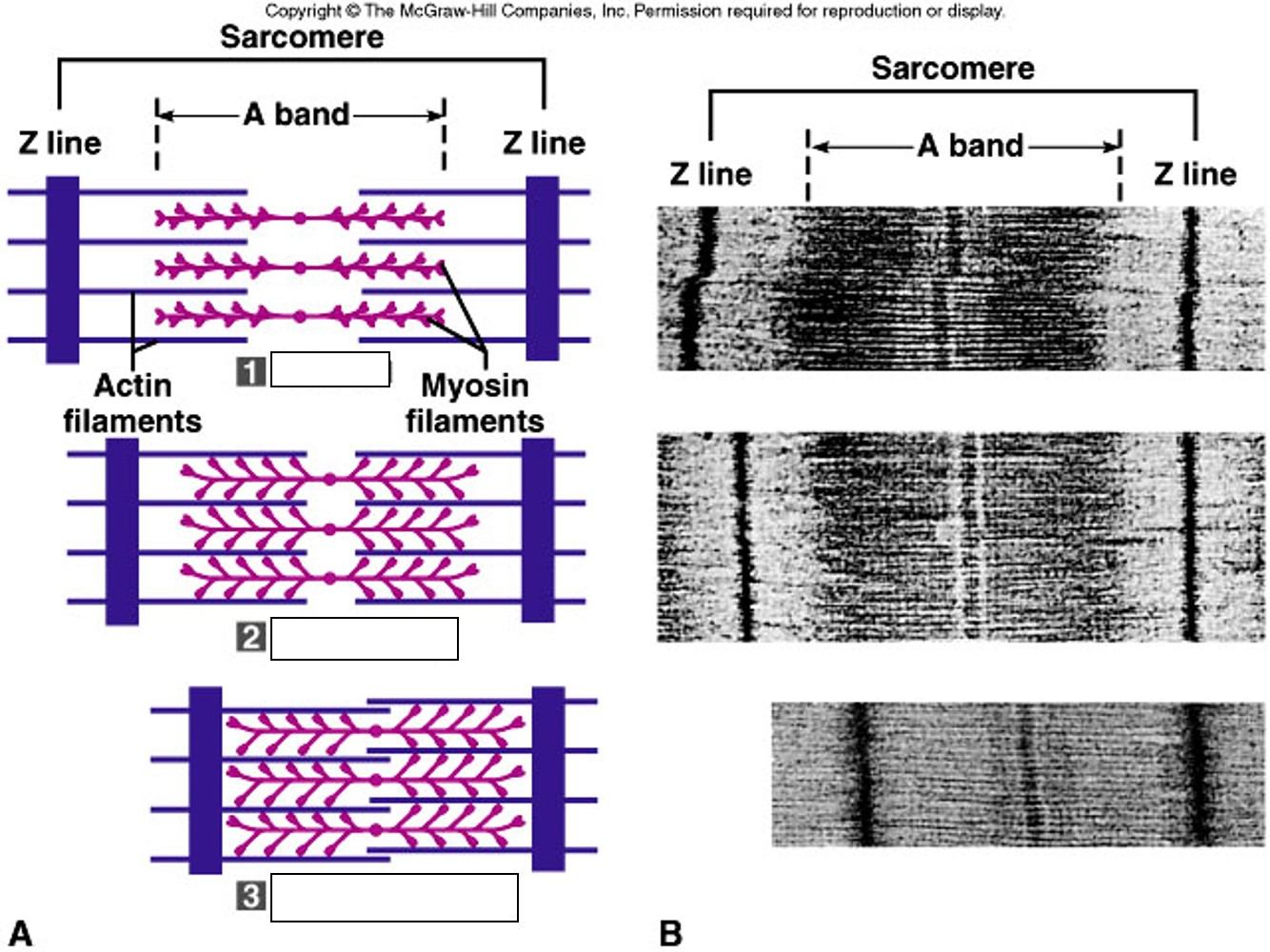
What happens to the sarcomere during muscle contraction?
The sarcomere lengthens as the actin and myosin filaments slide past each other, causing the muscle to contract.
The sarcomere shortens as the actin and myosin filaments slide past each other, causing the muscle to contract.
The sarcomere disappears as the actin and myosin filaments slide past each other, causing the muscle to contract.
The sarcomere remains the same length as the actin and myosin filaments slide past each other, causing the muscle to contract.
What is the contractile unit of the muscle?
Z disk
Sarcomere
Muscle fiber
Muscle cell
What part of the muscle fiber stores calcium ions and releases them when stimulated?
T tubule
Sarcolemma
Nucleus
Sarcoplasmic reticulum
Myofilaments are made of which 2 proteins?
Fascicles
Myosin
Myofibrils
Actin


Which number shows the M Line
8
3
2
6

What section does #6 show?
(Area of only thick myofilament)
H Zone
Z Disc
A Band
M Line

What area of the sarcomere is represented by yellow. (Area with only thin myofilament)
I Band
A Band
H Zone
M Line

Plasma membrane in muscle cell
sarcolemma
sarcoplasma
sarcoplasmic reticulum
sarcomere
actin
Which myofilament has "heads" that form cross-bridges causing muscle contraction?
(a)

Structure B is known as the thin filaments of the sarcomere, what is another name for the thin filaments?
myosin
actin
fascia
myofibril

Structure C is known as the thick filament of the sarcomere, it is also known as
myosin
actin
fascia
myofibrils

The unit between A and A is called
a sarcomere
The I band
the Z disc
fascia

Which part separate one sarcomere to the next?
M line
I band
H zone
Z line

#1 The contractile unit of muscle cells that is responsible for the striated appearance of skeletal muscle
muscle fiber
sarcomere
striation
fasicle

#7: The area that contains actin filaments only
I band
A band
H zone
M-line
#6 Area of sarcomere where actin and myosin overlap
I band
A band
H zone
M-line

The action of myosin pulling actin inward to shorten the sarcomere
ATP
Cross Bridge
Power Stroke
Acetylcholine
What is the name of the neurotransmitter released at a neuromuscular junction?
Calcium
Acetylcholine
Dopamine
Troponin


