
 Worksheets
3D Kinematic Methods
Total questions: 10
Worksheet time: 7mins
What is kinematics?
The study of motion in association to force.
The study of motion, body segment displacements and their relation to time.
The study of the science of motion.

Why do we use a sphere as a marker as opposed to a cube?
Because it is simple.
Because it is more accurate.
Because no matter what angle you look at it. It is the same shape.
Because it is more beautiful.
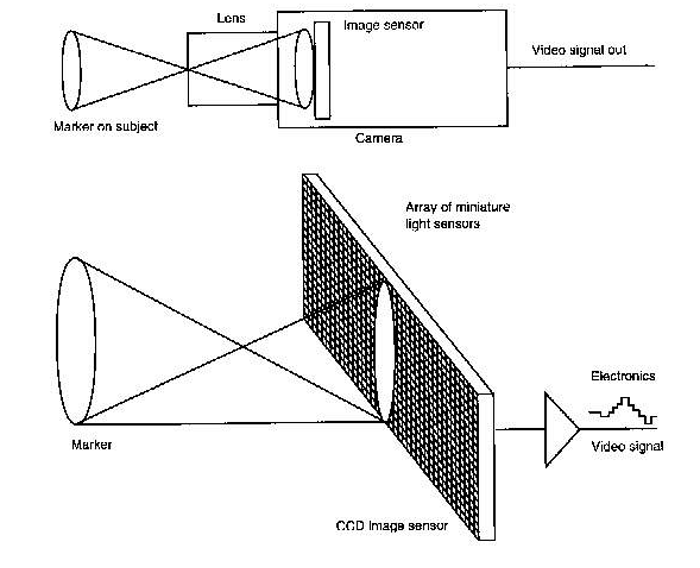
The lens and detector of the optical based camera (optoelectronic) has a crucial role in converting the video signal.
What does the lens do?
The quality of the signal will depend on these horizontal lines. The more frequent the lines on the sensor.
The infra red light is emitted from the camera. Bounces back from the small reflective markers. Upon bouncing back the light hits the lens and the image is projected onto the CCD image sensor. From there the software converts it to a video signal.
Where there has been light detected it will process as a 1 and 0 for no light.
Which is known as passive marker?
light reflecting markers
infra-red LED

What is the process when the camera systems go through to ensure quality data capture?
stereophotogrammetry
image conversion
megapixels
linearisation
The process to generate 3D images is to combine 2 or more camera’s of images and reconstruct them together to produce a 3D object.
The technical term for this is Stereophotogrammetry.
True
False
AMASS is a calculation of 3D coordinates from several cameras which uses a series of equations and coefficients to reconstruct the data.
True
False
unknown
Check all the reference system.
irrelevant reference system
absolute reference system
technical reference system
anatomical reference system
•Fixed to the body.
•Needed to describe segmental position and orientation with respect to the Absolute Reference System.
•Does not necessarily have an anatomical representation.
What reference system has the above characteristics?
absolute reference system
technical reference system
anatomical reference system
What type of reference system has markers attached to bony landmarks?
absolute reference system
technical reference system
anatomical reference system

