wayground logo

Free Printable Worksheets

Font size

S
M
L
XL
Worksheets

Economics U1 Review Questions

Total questions: 80

Worksheet time: 1hrs 12mins

Name
Class
Date
1.

Utility is synonymous with what word?

a)

Marketing

b)

Economics

c)

Value

d)

Capital

2.

Which Market type has a single seller?

a)

Monopoly

b)

oligopoly

c)

monopolistic competition

d)

pure competition

3.

Which Market type is a profit maximizer ?

a)

Monopoly

b)

oligopoly

c)

monopolistic competition

d)

pure competition

4.

Which Market type consists of a small number of firms that are relatively large firms that produce products that are similar but slightly different ?

a)

Monopoly

b)

oligopoly

c)

monopolistic competition

d)

pure competition

5.

Which Market type such that several producers sell products differentiated from each other. ?

a)

Monopoly

b)

oligopoly

c)

monopolistic competition

d)

pure competition

6.
Perfect competition involves:
a)
Sellers working together to set prices
b)
A large number of buyers & sellers
c)
Difficulty entering & exiting the market
d)
Little information is available to buyers
7.
The town of Utopia has three gas stations. The owners of these gas stations make decisions together about when to raise and lower gas prices. It would be difficult for another gas station to enter this market. Which market structure best describes the market for gas in Utopia?
a)
Perfect competition
b)
Monopolistic competition
c)
Oligopoly
d)
Monopoly
8.
If a major car company such as Ford lowers their prices, what are other car companies likely to do?
a)
Raise their prices
b)
Go out of business
c)
Maintain their current prices
d)
Lower their prices
9.
Which of the following statements is true?
a)
Monopolistic competitors have an incentive to differentiate their products so customers have choices, but monopolies do not have this incentive.
b)
Monopolistic competitors & monopolies have the same amount of influence over the price of their products.
c)
Both oligopolies & industries with monopolistic competition involve a large number of sellers.
d)
All industries fit neatly into one type of market structure.
10.
What are the advantages of economies of scale?
a)
Costs less per unit to produce an item
b)
Reduces barriers to entry in the market and increases competition
c)
Better quality products are produced
11.

What is not part of perfect competition?

a)

buyer/ seller are well informed

b)

sellers cannot enter/ exit market easily

c)

low prices

d)

few barriers of entry

12.

This tax is put on goods imported to the U.S. from other countries

a)

Income tax

b)

Medicare

c)

Tariff

d)

Import Exercise Tax

13.
Factors that make it difficult for new firms to enter a market are called
a)
Barriers to entry
b)
Factors of production
c)
Limited supply
d)
Monopolistic Outlook
14.
Why does no one firm dominate in a perfect competition?
a)
No firm wants to
b)
Each firm sells to different people
c)
Each firm produces so little of the total supply that they cannot influence prices
d)
One firm will eventually dominate and make it a monopoly
15.
Businesses can "Collude" or work together to set prices
a)
Oligopoly
b)
Monopoly
c)
Perfect Competition
16.

Which of the following industries is an example of a monopoly?

a)

utilities/water

b)

department stores

c)

auto industry

d)

commercial airlines

17.

ability of a company to control prices and total market output

a)

market power

b)

price discrimination

c)

license

d)

government monopoly

18.

In the long run equilibrium , the firm in perfect competition obtains .........

a)

Super profit

b)

Abnormal profit

c)

Loss

d)

Normal profit

19.

The equilibrium of firm is maintained where MC = MR and ................

a)

MR cuts AR from below

b)

MC cuts AC from below

c)

MR cuts AC from below

d)

MC cuts MR from below

20.

A competitive firm’s profit will be increasing as long as marginal revenue is greater than marginal cost.

a)

True

b)

False

21.

A firm operating in a perfectly competitive industry will continue to operate in the short run but earn losses if the market price is less than that firm’s average variable cost but greater than the firm’s average fixed cost.

a)

True

b)

False

22.

A firm's incentive to compare marginal revenue and marginal cost is an application of the principle that rational people think at the margin.

a)

True

b)

False

23.

What might cause economies of scale?

a)

Specialization among workers permits each worker to become better at a specific task.

b)

Coordination problems that occur in large organization

24.

Internal economies of scale are those that

a)

Result from changes in production techniques

b)

Increase due to the growth of the industry as a whole

c)

Generate lower per unit production costs

d)

Reduce production costs in the short run

25.

External economies of scale can arise from

a)

Bulk purchases of raw materials, parts and components at favorable prices by a particular business/firm

b)

Purchase and use of physical/human capital by a particular business/firm

c)

Greater availability of skilled laborers for a particular industry in a particular area

d)

A business/firm being able to obtain lower interest rates on loans

26.

The increase in output a firm can produce by adding a variable input (resources, capital) to a fixed input

a)

Marginal Output of Labor

b)

Increasing Marginal Returns

c)

Diminishing Marginal Returns

d)

Marginal Input of Labor

27.
A government might tax a good that creates negative externalities in order to try to:
a)
Increase price and consumption of the good to provide firms with extra revenue
b)
 Make the information avaliable more asymmetric
c)
Decrease demand for the good and thus increase the consumer surplus
d)
Decrease consumption of the good and thus reduce the triangle of welfare loss
28.
Getting a flu shot is an example of a ________ externality
a)
Negative
b)
Neutral
c)
Positive
29.
When a third party member is affected by the interaction of a buyer and seller, we call this
a)
An externality
b)
The tragedy of the commons
c)
consumer surplus
d)
total welfare
30.
By-products of production or consumption that impose costs on third parties are known as
a)
negative externalities
b)
rival externalities
c)
positive externalities
d)
exclusive externalities 
31.
Police protection is an example of a _ good and apples are an example of a _ good. 
a)
Public; Private
b)
Private; Public 
c)
Public; Public
d)
Private; Private 
32.
Government regulation may negatively affect businesses in the following ways by
a)
Increasing input costs
b)
Increasing profits
c)
Lowering consumer prices
d)
All of the above
33.
When the government creates a law used to protect individuals this is know as:
a)
Deregulation
b)
Regulation
c)
Positive Externality
d)
Preventing a market failure
34.
What is an example of a negative consumption externality?
a)
Increased standards of education in schools
b)
Increased research and development into cancer prevention
c)
Health impacts for society of passive tobacco smoking
d)
Environmental Pollution
35.

Under what condition is allocative efficiency achieved?

a)

Marginal private benefits = marginal social costs

b)

Marginal social benefits = marginal social costs

c)

Marginal private benefits > marginal social costs

d)

Marginal social benefits > marginal social costs

36.
Government regulations exist to
a)
Increase economic freedom
b)
Protect consumers from negative externalities
c)
Punish people who intervene in the free market
d)
Provide incentives to privatize
37.

Market failures occur when

a)

the accumulation of wealth in the free market is shared between a large group of people

b)

a command economy increases production

c)

the economy has a strong GDP and low interest rates

d)

the distribution of goods and services in the free market is not efficient and leads to loss of social wellbeing

38.

Public goods, such as defence, are not supplied by the price system because;

a)

the capital cost is too high

b)

the benefits would - ceteris paribus - not be restricted to buyers but would be available to non-buyers as well

c)

public goods are necessities and therefore cannot be left to the price system

d)

monopolies would make supernormal profits

39.

Which of the following does not apply to merit goods and services?

a)

They provide private and social benefits

b)

They are limited in supply and require a system of allocation

c)

They could be paid for by the consumer if a market system was allowed to operate

d)

They have the characteristic of non-excludability

40.

What does price ceiling create?

a)

Excess Demand

b)

Consumer Surplus

c)

Excess Supply

d)

Producer Surplus

41.

What is government intervention?

a)

taxes and subsidies

b)

is any action carried out by the government or public entity that affects the market economy

c)

when employees of the government decide to take action after contemplation whilst creating economic models to predict market economy

d)

a consequence of an industrial or commercial activity which affects other parties in turn being reflected in market prices

42.

Which sections represent the incidence of tax paid by customers?

a)

A + B + C +E

b)

D +F + G

c)

B +C

d)

D

43.
When the demand for a product or service is higher than the supply this causes what?
a)
shortage
b)
consumer
c)
surplus
d)
equilibrium
44.
The desire or willingness a consumer has to purchase a good or a service is called?
a)
shortage
b)
supply
c)
price
d)
demand
45.
The amount of goods or services available is called?
a)
supply
b)
demand
c)
producer
d)
consumer
46.
An individual or group who purchases goods.
a)
producer
b)
consumer
c)
goods
d)
services
47.
The point where supply and demand are balanced is?
a)
product
b)
demand
c)
surplus
d)
equilibrium
48.
When there is a shortage the price will usually? 
a)
rise
b)
fall
c)
remain the same
d)
equilibrium
49.
For the law of supply, as price rises, what happens to quantity supplied?
a)
it goes up
b)
it goes down
c)
it stays the same
d)
it is not effected
50.
If a price is above equilibrium price, it creates a...
a)
shortage
b)
surplus
c)
market price
d)
demand
51.
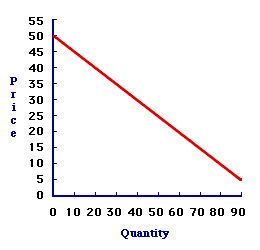
What does this curve represent?
a)
demand
b)
supply
c)
equilibrium
d)
shortage
52.
What does this curve represent?
a)
supply
b)
equilibrium
c)
demand
d)
surplus
53.
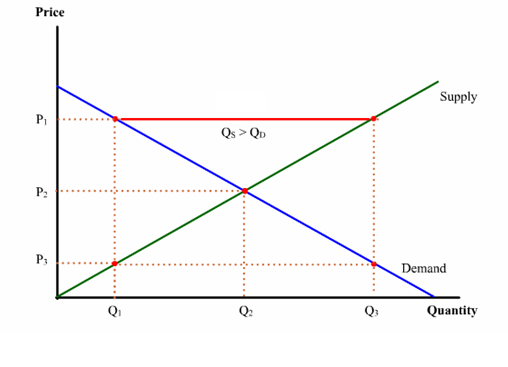
What does this graph show?
a)
Shortage
b)
Surplus
c)
Supply Table
d)
Equilibrium
54.
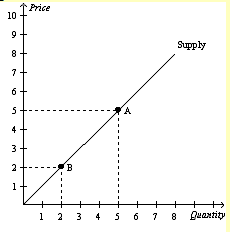
The movement from Point A to Point B represents a(n)
a)
increase in the price.
b)
decrease in the quantity supplied.
c)
shift in the supply curve.
d)
Both Orange and Blue are correct.
55.
Which of the following would not shift the supply curve for iphones?
a)
an increase in the price of iphones
b)
a decrease in the number of sellers of iphone
c)
an increase in the price of plastic, an input into the production of iphones
d)
an improvement in the technology used to produce iphones
56.

What will happen to the price of shoes if shoe producers have to pay higher wages to their workers?

a)

The price will increase

b)

The price will decrease

57.

What will happen to the price of gasoline if the price of crude oil (one of the main ingredients in gasoline) falls?

a)

The price will increase

b)

The price will decrease

58.

Definition of Marginal Utility

a)

the satisfaction from consumption

b)

to total satisfaction from consuming a product

c)

the extra satisfaction from the last unit consumed

d)

the extra consumption from last unit consumed

59.

The definition of the law of diminishing marginal utility

a)

As more units are consumed the marginal utility falls.

b)

As more units are consumed the marginal utility increases.

c)

As price decreases quantity demanded increases.

d)

As price increases consumers are willing to pay more.

60.

The total utility definition states:

a)

The usefulness, benefit or satisfaction a consumer gains from consuming a product.

b)

The satisfaction gained from consuming a quantity of an economic good, measured in utils.

c)

The added consumer satisfaction from consuming a quantity of a good.

d)

The consumer's satisfaction from consuming a quantity of a good.

61.

The relationship between demand and marginal utility is best explained as ...

a)

the marginal utility a person gets from consuming a good determines their demand for the good.

b)

the total utility a person gets from consuming a good determines their demand for the good.

c)

the marginal utility a person gets from consuming a good determines their market demand for the good.

d)

the total utility a person gets from consuming a good determines their market demand for the good.

62.

Which of the following best refers to the additional cost a person or firm incur to produce one more unit?

a)

Consumer Benefit

b)

Intersection

c)

Marginal Benefit

d)

Marginal Cost

63.

The first four dinner rolls Joan consumes have total utility of 15, 27, 37, and 45 respectively. What is the marginal utility of the 4th dinner roll?

a)

124 units of utility

b)

45 units of utility

c)

11.25 units of utility

d)

8 units of utility

64.

Harry's marginal utility for 2 bananas is ?

a)

23

b)

32

c)

25

d)

26

65.
A consumer's budget line could also be referred to as which of the following?
a)
demand curve
b)
marginal utility curve
c)
total utility curve
d)
consumption possibilities curve
66.
Utility is the
a)
benefit or satisfaction that a person gets from the consumption of a good or service
b)
measure of how useful a resource is in the production process
c)
measure of productivity associated with a good or service
d)
economic term for consumption possibilities
67.
The goal of a consumer is to
a)
acquire the largest possible quantity of goods
b)
acquire the largest possible variety of goods
c)
maximize utility
d)
save money
68.
The utility maximizing rule says that consumers must 
a)
only allocate the entire available budget
b)
only make the marginal utility per dollar spent the same for all goods
c)
both allocate the entire budget and make the marginal utility per dollar spent the same for all goods
d)
either allocate the available budget or make the marginal utility per dollar spent the same
69.
In a given time period, a person consumes more and more of a good and enjoys each additional unit less and is willing to pay less for it, because of:
a)
diminishing returns
b)
diminishing marginal product
c)
diminishing marginal utility
d)
increasing costs
70.

when we add up utility derived from consumption of all the units of the consumption, we get :

a)

total utility

b)

initial utility

c)

marginal utility

71.

In case of cardinal utility approach, utility is measured in :

a)

Rupees

b)

ranks

c)

utils

72.

cardinality means utility can be:

a)

measured

b)

ranked

c)

not measured

73.

As per ordinal utility approach:

a)

measurement of utility is not possible through money.

b)

measurement of utility is possible but it can not be ranked.

c)

measurement of utility is not possible in cardinal numbers but it can be ranked

d)

ordinal utility is the utility expressed in ranks

74.
What is the Equilibrium Price?
a)
1
b)
2
c)
3
d)
4
75.
What is the Equilibrium Quantity?
a)
50
b)
60
c)
70
d)
80
76.

Which of these demonstrates a shortage of goods?

a)
b)
c)
d)
77.
Which of the following is an example of a positive statement?
a)
Unemployment is higher this year than it has been in the last 5 years.
b)
Unemployment benefits help lift people out of poverty.
c)
Free education helps alleviate the problem of unemployment.
d)
The government should provide jobs to those who are unemployed to lower the unemployment rate.
78.
Scarcity is best illustrated in which of the following scenarios:
a)
Sunlight in the tropics.
b)
Drinking water from a renewable spring.
c)
Honey supply as bees are dying off.
d)
 Dollars from a mint (a place where currency is printed)
79.
Which of the following is represented by constant opportunity cost?
a)
Bowed out curve
b)
Bowed in curve
c)
Straight line curve
d)
Circle
80.
Which of the following economic systems answers the three economic questions with laws or force?
a)
Market
b)
Command
c)
Traditional
d)
Mixed