wayground logo

Free Printable Worksheets

Font size

S
M
L
XL
Worksheets

5th science review 2

Total questions: 140

Worksheet time: 2hrs 14mins

Name
Class
Date
1.

It was 85 degrees yesterday in Odessa.

a)

Climate

b)

Weather

2.

There is a 15 mph wind from the north today.

a)

Climate

b)

Weather

3.

The average pattern of weather for a particular region...

a)

Climate

b)

Weather

4.

Winters in Amarillo can reach temperatures below zero.

a)

Climate

b)

Weather

5.

In August, you can usually expect it to be hot and humid in Corpus Christi.

a)

Climate

b)

Weather

6.

In August, you can usually expect it to be hot and humid in Corpus Christi.

a)

Climate

b)

Weather

7.

It snowed for three days last week.

a)

Climate

b)

Weather

8.

a)

Mixture

b)

Solution

9.

a)

Mixture

b)

Solution

10.

a)

Mixture

b)

Solution

11.

a)

Mixture

b)

Solution

12.

a)

Mixture

b)

Solution

13.

a)

Mixture

b)

Solution

14.

What is the energy source for the water cycle?

a)

sun

b)

wind

c)

rain

d)

oceans

15.

On Earth, what process generates most of the water vapor?

a)

Condensation

b)

Evaporation

c)

Precipitation

d)

Transpiration

16.

What are formed when water vapor condenses?

a)

Clouds

b)

Mountains

c)

Transpiration

d)

Valleys

17.
What part of the water cycle does this picture show?
a)
condensation
b)
precipitation
c)
evaporation
18.

Which example is a form of precipitation?

a)

Dew

b)

Fog

c)

Frost

d)

Hail

19.

As a part of the water cycle, water from Earth's surface enters the clouds and finally falls back to the ground in the form of rain. What is the correct sequence of processes water undergoes?

a)

Evaporation, Condensation, Precipitation

b)

Precipitation, Condensation, Evaporation

c)

Condensation, Evaporation, Precipitation

d)

Evaporation, Precipitation, Condensation

20.

What would happen if the Sun is removed from the water cycle?

a)

The water cycle would not include precipitation but would continue with groundwater flow.

b)

The water cycle would no longer occur because the Sun provides the energy for evaporation and transpiration.

c)

The water cycle would no longer occur because the Sun provides energy for the formation of clouds.

d)

The water cycle would not include evaporation and transpiration but would continue with condensation.

21.
What is it called when plants give off water vapor as a waste product?
a)
condensation
b)
evaporation
c)
sublimation
d)
transpiration
22.

Which of the following is NOT a way water moves from the land to the air?

a)

transpiration

b)

respiration

c)

evaporation

d)

precipitation

23.

What is it called when there is TOO MUCH water vapor in the air?

a)

Humdity

b)

Condensation

c)

Evaporation

d)

Transpiration

24.

How much salt water covers the earth?

a)

55%-60%

b)

63 - 68%%

c)

71%-75%

d)

85 - 97%%

25.
Water in lakes and rivers that does not contain salt-
a)
recycled water
b)
new water
c)
salt water
d)
fresh water
26.

When water vapor s cooled and forms droplets-

a)

Condensation

b)

Evaportation

c)

Transpiration

d)

Run-off

27.
Forms of precipitation are-
a)
only sleet and snow
b)
rain, sleet, hail, and snow
c)
only dew and rain 
d)
only snow and rain
28.
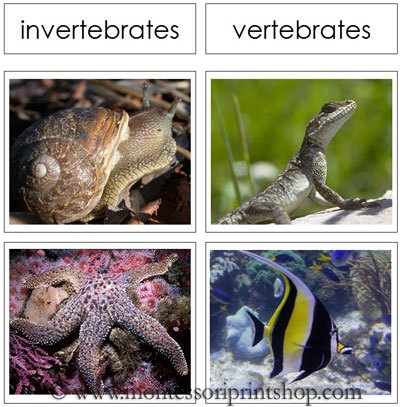
What is the major difference between vertebrates and invertebrates?
a)
Vertebrates are always smaller than invertebrates.
b)
Invertebrates always live in the water.
c)
Vertebrates have a backbone but invertebrates do not.
d)
Vertebrates and invertebrates are the same.
29.
Mammals, fish, reptiles, amphibians, and birds are all __________________.
a)
invertebrates
b)
vertebrates
c)
good pets
30.
Which of the following is not an invertebrate?
a)
spider
b)
starfish
c)
catfish
d)
crab
31.

What is a invertebrate?

a)

an animal without a backbone

b)

an animal with a backbone

32.

These animals are warm-blooded. They have hair or fur on their bodies. Their young do not hatch from eggs.

a)

amphibans

b)

reptiles

c)

mammals

d)

fish

33.

These animals are cold-blooded. They breathe with gills throughout their lives.

a)

spiders

b)

reptiles

c)

birds

d)

fish

34.

These animals are cold-blooded. They have dry, scaly skin. and breathe air through lungs.

a)

reptiles

b)

birds

c)

mammals

d)

fish

35.

These animals are cold-blooded. They breathe with gills when young, but they grow lungs when they become adults.

a)

birds

b)

reptiles

c)

amphibians

d)

mammals

36.

What climate is extremely cold all year round?

a)

Polar

b)

Mild

c)

Tropical

d)

Desert

37.

In which climate do trees lose their leaves?

a)

Desert

b)

Tropical

c)

Temperate

d)

Polar

38.

Which climate is very hot and dry?

a)

Tropical

b)

Desert

c)

Mild

d)

Temperate

39.

Which climate is hot all year round and is very wet and rainy?

a)

Desert

b)

Tropical

c)

Temperate

d)

Mild

40.

Which climate is shown here?

a)

Polar

b)

Tropical

c)

Desert

d)

Mild

41.

The pattern of weather in an area over many years is called:

a)

Weather

b)

Climate

42.

What is happening in the atmosphere outside right now is called:

a)

Weather

b)

Climate

43.

A climate with no winter is a ___________ climate.

a)

Tropical

b)

Temperate

c)

Polar

d)

Desert

44.

Whales and dolphins are

a)

Fish

b)

Mammals

c)

Reptiles

d)

Amphibians

45.

What does renewable mean?

a)

Cannot be replaced once used

b)

made new again every day

46.

Nonrenewable resources are replaced quickly.

a)

True

b)

False

47.

Trees are renewable resources.

a)

True

b)

False

48.

Water is a renewable resource.

a)

True

b)

False

49.

Water is a renewable resource.

a)

True

b)

False

50.

Gold is a renewable resource.

a)

True

b)

False

51.

Coal is a renewable resource.

a)

True

b)

False

52.

Coal is a renewable resource.

a)

True

b)

False

53.

Wind is a renewable resource.

a)

True

b)

False

54.

Sources of energy made from prehistoric plants and animals.

a)

the sun

b)

the wind

c)

fossil fuels

55.

The inner planets are:

a)

Mars, Jupiter, Saturn, Mercury

b)

Mercury, Venus, Earth, Mars

c)

Jupiter, Saturn, Uranus, Neptune

d)

Earth, Mars, Jupiter, Saturn

56.

The outer planets are:

a)

Mercury, Venus, Earth, Mars

b)

Earth, Mars, Jupiter, Saturn

c)

Jupiter, Saturn, Uranus, Neptune

d)

Mars, Jupiter, Saturn, Uranus

57.

Which term describes the composition of the outer planets?

a)

rocky

b)

solid

c)

water

d)

gaseous

58.

Which terms describe the composition of the inner planets?

a)

rocky

b)

gaseous

c)

water

d)

solid

59.

Why do the outer planets have longer years than the inner planets?

a)

The outer planets rotate faster than the inner planets.

b)

The outer planets are farther from the sun.

c)

The inner planets are denser and rotate slower.

d)

Outer planets are made of gas.

60.
Very few moons
a)
Inner planets
b)
Outer planets
c)
Both
d)
Mercury
61.
Shorter revolutions
a)
Inner planets
b)
Outer planets
c)
Both
d)
Neptune
62.
Located between the inner and outer planets.
a)
Sun
b)
Asteroid belt
c)
Uranus
d)
Moons
63.
Solar system's hottest planet
a)
Mercury
b)
Venus
c)
Earth
d)
Neptune
64.

Which type of rock is most likely to contain fossils?

a)

Sedimentary

b)

Igeneous

c)

Metamorphic

d)

All rocks

65.

Slate is a dark rock showing crystals and layers. It was formed by shale being changed by heat and pressure. What kind of rock is it?

a)

Sedimentary

b)

Extrusive igneous

c)

Intrusive igneous

d)

Metamorphic

66.

Breccia is a rock made from different sized angular particles which have collected together and been cemented. What kind of rock is it?

a)

Sedimentary

b)

Extrusive igneous

c)

Intrusive igneous

d)

Metamorphic

67.

Which of the following types of rocks is formed when extreme heat and pressure are combined?

a)

Igneous

b)

Metamorphic

c)

Sedimentary

68.

Which type of rock is formed when rocks are melted deep in the Earth and cool to form new rocks?

a)

Igneous

b)

Metamorphic

c)

Sedimentary

d)

Sandstone

69.

What is a similarity between Metamorphic and Igneous rocks?

a)

They both are formed with extreme heat.

b)

They both are formed with water.

c)

They both are formed formed by plants.

70.
When sediments are pressed together tightly, this is called ____________.
a)
Compaction
b)
Cementation
c)
Weathering
d)
Erosion
71.
The process when rocks break into smaller pieces due to exposure to natural elements is called
a)
erosion
b)
weathering
c)
sediments
72.

During evaporation, water changes from a _________ to a __________.

a)

solid, liquid

b)

gas, liquid

c)

liquid, gas

d)

liquid, solid

73.
What is precipitation?
a)
The part of the water cycle when the sun heats up water, turning it from a liquid into water vapor or steam. It rises from the ground into the air.
b)
The part of the water cycle when the water vapor in the air gets cold. The water turns back into a liquid and forms clouds.
c)
The part of the water cycle when clouds get heavy and can no longer hold the liquid water. This causes the water to fall from the sky to the earth as rain, snow, sleet, or hail.
74.
What is condensation?
a)
The part of the water cycle when the sun heats up water, turning it from a liquid into water vapor or steam. It rises from the ground into the air.
b)
The part of the water cycle when the water vapor in the air gets cold. The water turns back into a liquid and forms clouds.
c)
The part of the water cycle when clouds get heavy and can no longer hold the liquid water. This causes the water to fall from the sky to the earth as rain, snow, sleet, or hail.
75.
What is evaporation?
a)
The part of the water cycle when the sun heats up water, turning it from a liquid into water vapor or steam. It rises from the ground into the air.
b)
The part of the water cycle when the water vapor in the air gets cold. The water turns back into a liquid and forms clouds.
c)
The part of the water cycle when clouds get heavy and can no longer hold the liquid water. This causes the water to fall from the sky to the earth as rain, snow, sleet, or hail.
76.
What is water that flows in rivers and streams into the oceans and lakes?
a)
evaporating
b)
condensing
c)
precipitating
d)
runoff
77.

The process when rocks break into smaller pieces due to exposure to natural elements and ARE NOT CARRIED AWAY by water or wind.

a)

erosion

b)

weathering

c)

sediments

78.

The process when rocks break into smaller pieces due to exposure to natural elements and ARE CARRIED AWAY by water or wind.

a)

erosion

b)

weathering

c)

sediments

79.
A liquid becomes a solid when there is ___________ heat.
a)
less
b)
more
c)
equal amounts
d)
it doesn't change
80.
__________ heat causes a gas to condense to a liquid.
a)
Increasing
b)
Decreasing
81.
In the gas phase, molecules are __________ than in the solid phase.
a)
closer together
b)
farther apart
82.
Molecules have the least kinetic energy in which phase?
a)
solid
b)
liquid
c)
gas
d)
plasma
83.
Molecules have the most kinetic energy in what phase?
a)
solid
b)
liquid
c)
gas
d)
plasma
84.
The state of matter that describes a substance having no definite volume or shape - compressible
a)
solid
b)
liquid
c)
gas
d)
plasma
85.
The state of matter that describes a substance that has definite volume, but no definite shape.
a)
solid
b)
liquid
c)
gas
d)
plasma
86.
Baking a cake is a
a)
Physical change
b)
Chemical change
87.
What is the freezing point of water?
a)
00C
b)
1000C
c)
2120F
d)
00K
88.
What is the boiling point of water?
a)
00C
b)
320F
c)
1000C
d)
00K
89.
Boiling water is a
a)
Physical change
b)
Chemical change
90.
Metal is being destroyed through oxidation that we call rust.
a)
Physical change
b)
Chemical change
91.
Melting Ice is a :
a)
Physical Change
b)
Chemical Change
92.
Burning wood in a campfire is a:
a)
Physical Change
b)
Chemical Change
93.
Hammering gold into a sheet of metal is a:
a)
Physical Change
b)
Chemical Change
94.
Tearing paper in half is a:
a)
Physical Change
b)
Chemical Change
95.
Combining 2 substances and the temperature of the product increases 5 degrees is a:
a)
Physical Change
b)
Chemical Change
96.
A bicycle sits out in the rain for a year and rusts is a:
a)
Physical Change
b)
Chemical Change
97.
Adding an Alka-Seltzer to water and bubbles form is a:
a)
Physical Change
b)
Chemical Change
98.
Combining 2 clear substances and the solution created is bright yellow is a:
a)
Physical Change
b)
Chemical Change
99.
Cracking an egg is a:
a)
Physical Change
b)
Chemical Change
100.
Can be separated. 
a)
mixture
b)
solution
101.
Form new physical properties. 
a)
mixture
b)
solution
102.
Do not form new properties. 
a)
mixture
b)
solution
103.
Substances don't dissolve. 
a)
mixture
b)
solution
104.
Difficult to separate. 
a)
mixture
b)
solution
105.
Shampoo
a)
mixture
b)
solution
106.

This picture shows liquid water changing into a ______.

a)

Solid

b)

Liquid

c)

Gas

107.

This ice in this glass is ___________.

a)

Freezing

b)

Melting

c)

Evaporating

d)

Liquidizing

108.

This state of matter is turning from a solid to a ____?

a)

liquid

b)

Freezing

c)

Gas

d)

Solid

109.

A ____________ substance has a definite volume and shape.

a)

gas

b)

liquid

c)

solid

110.

A ___________ substance has a definite volume but not a definite shape.

a)

gas

b)

liquid

c)

solid

111.

A _______________ does not have a definite volume or shape.

a)

gas

b)

liquid

c)

solid

112.

True or False: Solids can easily change shape.

a)

True

b)

False

113.

The particles in a ______________ can move easily in any direction.

a)

gas

b)

solid

c)

liquid

114.

True or False: liquids take the shape of their container.

a)

True

b)

False

115.

True or False: A gas will spread out and fill its container.

a)

True

b)

False

116.

Anything that has mass and takes up space is called

a)

mass

b)

volume

c)

matter

d)

solid

117.

The amount of matter in an object is called

a)

matter

b)

mass

c)

volume

d)

density

118.
Which of the following is NOT a part of the male reproductive structures in a flower? 
a)
staMEN 
b)
anther 
c)
style 
d)
filament 
119.
What is the function of the petal on a flower? 
a)
to support the flower
b)
to carry pollen 
c)
to produce food 
d)
to attract pollinators 
120.
Which is NOT a part of the female reproductive structures in a plant? 
a)
Filament 
b)
Pistil 
c)
Ovary 
d)
Style 
121.
What is the role of root hairs? 
a)
protect the root 
b)
absorb water and nutrients
c)
store food.
122.
The female reproductive structure is called .... 
a)
stamen 
b)
style 
c)
pistil 
d)
filament 
123.
The male reproductive structure is called... 
a)
anther 
b)
filament 
c)
pistil 
d)
stamen 
124.
Which of the following are parts of the staMEN? 
a)
anther and filament 
b)
style 
c)
ovary and ovule
d)
stem 
125.

Stamens are:

a)

the female reproductive organ of a flower that produces pollen

b)

the male reproductive organ of a flower that produces nectar

c)

the male reproductive organ of a flower that produces pollen

d)

none of the above

126.

The Pistil is:

a)

the male reproductive organ of a flower that can be fertilized by pollen

b)

the female reproductive organ of a flower that can be fertilized by pollen

c)

the male reproductive organ of a flower that can be fertilized by nectar

d)

none of the above

127.

A Stem is:

a)

a plant structure that contains a young plant, food supply, and protective coating

b)

a plant organ that takes in water and nutrients from the soil

c)

the part of a plant that grows away from the roots; supports leaves and flowers

d)

none of the above

128.
The main purpose of the ____________ system is to break food particles into pieces that can be used.
a)
circulatory
b)
respiratory
c)
digestive
d)
skeletal
129.
What is responsible for delivering oxygen and removing carbon dioxide from the body?
a)
cell nucleus
b)
excretory system
c)
nervous tissue
d)
respiratory system
130.
The __________ is the main organ of the nervous system.
a)
heart
b)
lungs
c)
brain
d)
skin
131.
When tissues come together, they form ___________.
a)
cells
b)
atoms
c)
organs
d)
systems
132.
This system protects the body's organs, provides support for the body.
a)
Nervous System
b)
Skeletal System
c)
Respiratory System
133.
This system helps the body respond to signals and information from both inside and outside the body.
a)
Nervous System
b)
Muscular System
c)
Skeletal System
134.
This system includes the spinal cord, brain and nerves
a)
Nervous System
b)
Digestive System
c)
Circulatory System
135.
What body system makes your body move? 
a)
Circulatory
b)
Respiratory
c)
Skeletal
d)
Muscular
136.
What body system removes the waste from your body? 
a)
Circulatory
b)
Excretory
c)
Digestive
d)
Respiratory
137.
How many bones make up a human adult?
a)
205
b)
206
c)
207
d)
208
138.
My spinal cord helps _________ travel between my brain and the nerves in my body. 
a)
Memories
b)
Blood
c)
Waste
d)
Messages
139.
My body needs ______ from the air to live. 
a)
Oxygen
b)
Cardon Dioxide
c)
Carbon Monoxide
d)
Hydrogen Peroxide
140.
What is the body system that sends and recieves electrical signals from the brain?
a)
Skeletal System
b)
Nervous System
c)
Muscular System
d)
Digestive System