Wayground logo

Free Printable Worksheets

Font size

S
M
L
XL
Worksheets

Mitosis and Meiosis Review

Total questions: 44

Worksheet time: 1hrs 5mins

Name
Class
Date
1.

What is the acryonym used to remember the four phases of mitosis? (a)  

Choose from the below words
P, S, A, T
P, R, O, M
P, T, A, P
P, M, A, T
2.

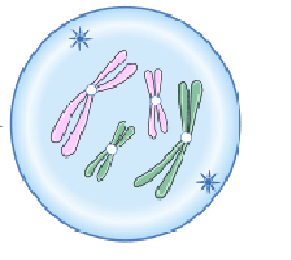
What phase is this? (a)  

Choose from the below words
Anaphase
Metaphase
Telophase
Prophase
3.

The number of chromosomes in a human sex cell is

4.

Sperm and Egg cells are produced using which process? (a)  

Choose from the below words
Mitosis
Meiosis
Binary Fission
None of these
5.

Another name for a sex cell is a: (a)  

Choose from the below words
Gamete
Embryo
Somatic cell
Muscle cell
6.
A male shark has 40 chromosomes in each of its sex cells. How many would be present in its body cells?
a)
20
b)
40
c)
80
d)
160
7.

Mitosis creates daughter cells which are genetically identical to the parent cell

a)

True

b)

False

8.
The process on the left is:
The process on the right is:
a)
Left: meiosis
Right: meiosis
b)
Left: meiosis
Right: cloning
c)
Left: mitosis
Right: meiosis
d)
Left: mitosis
Right: mitosis
9.

What is the NEXT phase of mitosis after the phase shown? (a)  

Choose from the below words
Prophase
Metaphase
Anaphase
Telophase
10.
The stages of mitosis in order
a)
Metaphase, Anaphase, Prophase, Telophase
b)
Prophase, Anaphase, Metaphase, Telophase
c)
Prophase, Metaphase, Anaphase, Telophase
d)
Anaphase, Prophase, Telophase, Metaphase
11.

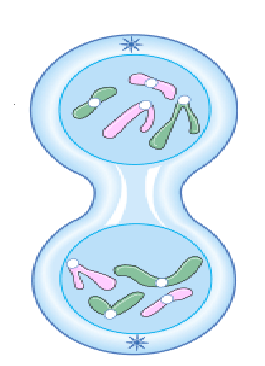
The cytoplasm is divided between the cells splitting the cell into two. Name that Stage! (a)  

Choose from the below words
Cytokinesis
Interphase
Prophase
Metaphase
12.
Genetic variety occurs in meiosis because of
a)
crossing over
b)
independent assortment
c)
both crossing over and independent assortment
d)
neither crossing over or independent assortment
13.
Cancer occurs because of a mutation in the protein that controls cell
a)
cyclin
b)
p53 gene
c)
growth
d)
differentiation
14.
Which of the following happens when a cell divides?
a)
It grows in volume
b)
It becomes more difficult for it to get rid of waste
c)
Each daughter cell gets a copy of its parent's DNA
d)
It becomes more difficult to get oxygen and nutrients
15.

What is formed at the end of meiosis? (a)  

Choose from the below words
2 diploid cells
2 haploid cells
4 diploid cells
4 haploid cells
16.
When two sister chromatids swap DNA it is called
a)
mutation
b)
crossing over
c)
replication
d)
independent assortment
17.
During Mitosis, a parent cell with 8 chromosomes will produce daughter cells with
a)
4 chromosomes
b)
8 chromosomes
c)
16 chromosomes
d)
24 chromosomes
18.

Cells that have pairs of every chromosome are called______________ while cells that have one copy of a chromosome are called____________________?

a)

complete, incomplete

b)

multiploid, monoploid

c)

diploid, haploid

d)

megaploid, uniploid

19.

In humans, which is true about the number of chromosomes after fertilization (the union of egg and sperm cells)

a)

a fertilized cell has 23 pairs of chromosomes

b)

a fertilized cell has 23 chromosomes

c)

a fertilized cell has 46 pairs of chromosomes

d)

a fertilized cell has no chromosomes

20.

Which of the following choices is true about this picture?

a)

It is a diploid cell

b)

This was produced at the end of mitosis

c)

This was produced at the end of meiosis

d)

This cell is about to go through the process of meiosis.

21.

Which type of cell division creates genetic variation in the resulting daughter cells? (a)  

Choose from the below words
A, only
B, only
both A and B
neither A or B
22.

Which type of cell division creates cells that are genetically identical to the parent (original) cell?

a)

A, only

b)

B, only

c)

both A and B

d)

neither A or B

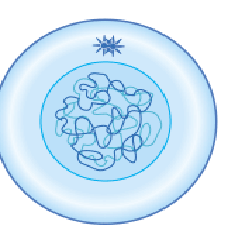
23.

What phase am I? (a)  

Choose from the below words
Interphase
Prophase
Metaphase
Anaphase
Telophase
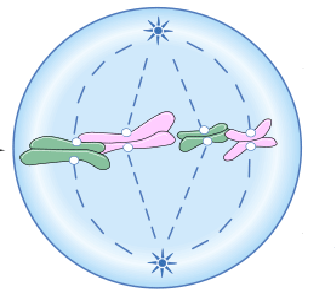
24.

What phase am I?

a)

Interphase

b)

Prophase

c)

Metaphase

d)

Anaphase

e)

Telophase

25.

What phase am I? (a)  

Choose from the below words
Interphase
Prophase
Metaphase
Anaphase
Telophase
26.

What phase am I?

a)

Interphase

b)

Prophase

c)

Metaphase

d)

Anaphase

e)

Telophase

27.

What phase is represented? (a)  

Choose from the below words
metaphase 1
metaphase 2
anaphase 1
anaphase 2
28.

Identify the phase.

a)

Metaphase I

b)

Metaphase II

c)

Prophase I

d)

Anaphase II

29.

What is this image showing?

a)

mitosis

b)

anaphase 1

c)

metaphase 1

d)

crossing over

30.

This part of meiosis makes sure there is diversity in offspring?

a)

anaphase 1

b)

crossing over

c)

replication

d)

fertilization

31.

The haploid number of an organism is 18. Its sex cells would have how many chromosomes?

a)

9

b)

18

c)

36

d)

72

32.

If an organism has 22 chromosomes in its somatic cells, how many does it have in gametes?

a)

11

b)

22

c)

44

d)

88

33.

How many times does a cell divide in mitosis?

a)

1

b)

2

c)

3

d)

4

34.

Does the DNA replicate again before meiosis 2? (a)  

Choose from the below words
yes
no
35.

When in the cell cycle does DNA replicate?

a)

G1

b)

S phase

c)

G2

d)

M phase

36.

This picture shows which process? (a)  

Choose from the below words
mitosis
meiosis
the cell cycle
37.

Which is the correct order? (a)  

Choose from the below words
C,D, B, A, F, E
D,A,F,C,E,B
B,E,C,F,A,D
C,B,D,A E,F
38.
A guinea pig cell has 64 chromosomes.  After mitosis, each daughter contains ___ chromosomes.
a)
128
b)
64
c)
32
d)
16
39.
Which process and type of resulting cells are represented?
a)
mitosis, gametes
b)
mitosis, body cells
c)
meiosis, gametes
d)
meiosis, body cells
40.
Fruit fly body cells have 8 chromosomes. After mitosis, you would expect a resulting fruit fly daughter cell to have -
a)
16 chromosomes.
b)
46 chromosomes.
c)
8 chromosomes.
d)
4 chromosomes.
41.

When does crossing over occur?

a)

prophase I of meiosis I

b)

prophase II of meiosis II

c)

metaphase I of meiosis I

d)

s phase

42.

How do mitotic cells and meiotic cells look different in prophase/prophase I?

a)

meiotic cells would have paired homologous chromosomes

b)

spindle fibers would be in the mitotic cell only

c)

there would be twice as many chromosomes in the meiotic cell

d)

there would be kinetochores in the mitotic cell only

43.

What is separated during meiosis I?

a)

homologous chromosomes

b)

sister chromatids

c)

spindle fibers

d)

crossing over

44.

What is separated during meiosis II? (a)  

Choose from the below words
sister chromatids
homologous chromosomes
spindle fibers
crossing over