
Font size
 Worksheets
B3 Breathing
Total questions: 34
Worksheet time: 1hrs 8mins
Which TWO sets of muscles are involved in breathing?
The Diaphragm
The Lungs
The Heart
The Intercostal Muscles
The main ORGAN(s) responsible for breathing is/are:
the Brain
the Lungs
the Liver
the Kidneys
The air sacs that are covered with capillaries where gas exchange takes place are called:
bronchi
lungs
oxygen
alveoli
Where does gas exchange happen in humans?
alveoli
bronchus
nose
trachea
What adaptations does the alveoli have for efficient gas exchange?
thick walls and large surface area
thin walls and large surface area
thin walls and small surface area
thick walls and small surface area

Gas exchange is needed to supply _____________ to cells and remove __________________
carbon dioxide; oxygen
oxygen; food
oxygen; carbon dioxide
carbon dioxide; water
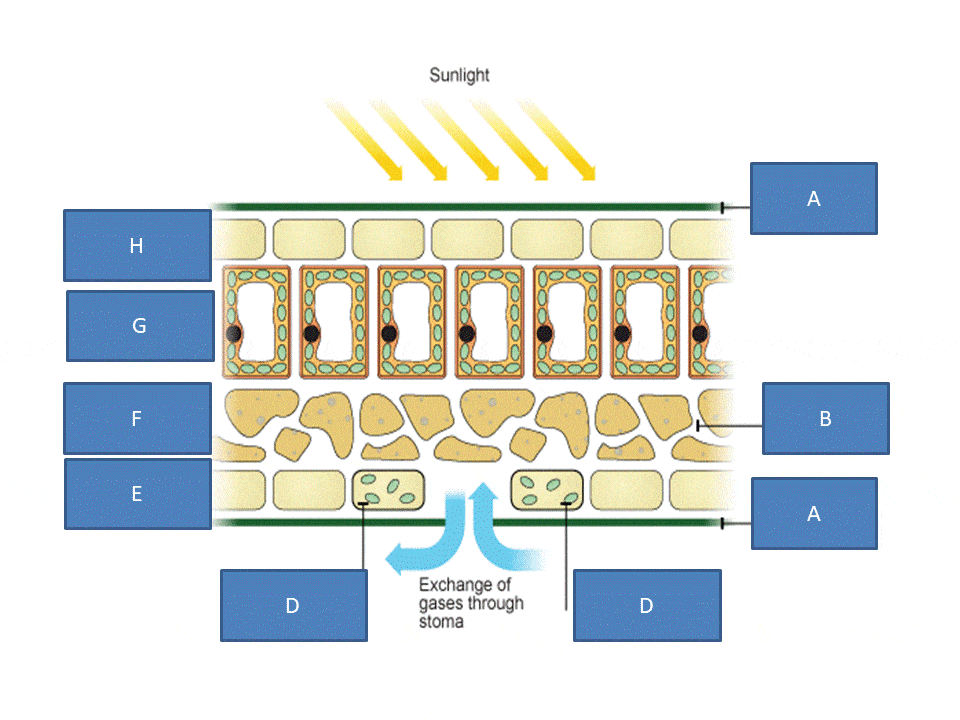
What is the name of the elongated, packed cells (part G) directly under the upper epidermis?
Palisade cells
Guard cell
Spongy layer
Lower epidermis

Which number is pointing to the stomata?
6
7
8
9
The cell organelle where photosynthesis occurs in plant cells is the
chloroplast
mitochondrion
vacuole
nucleus
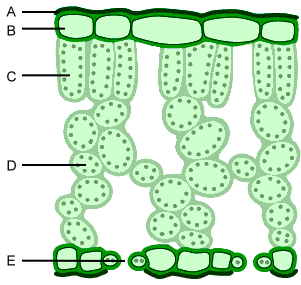
Which of the following is pointing to the "guard cell"?
B
C
D
E

Where do plants get the energy for photosynthesis?
nutrients in the soil
the sun
chlorophyll
bee pollination
Exhaled air contains:
More carbon dioxide and more oxygen than inhaled air
Less carbon dioxide and more oxygen than inhaled air
More carbon dioxide and less oxygen than inhaled air
Less carbon dioxide and less oxygen than inhaled air
Which of the following is the correct equation for PHOTOSYNTHESIS?
carbon dioxide + water --> glucose + oxygen
carbon dioxide + glucose + water --> oxygen
oxygen + water --> carbon dioxide + glucose
carbon dioxide + oxygen + water --> glucose
Which of the following is the correct equation for RESPIRATION?
carbon dioxide + water --> glucose + oxygen
carbon dioxide + glucose + water --> oxygen
glucose + oxygen --> carbon dioxide + water
carbon dioxide + oxygen + water --> glucose
Which is the order showing for air entering the lungs?
Nasal cavity/Nose and Mouth - Pharynx - Larynx - Trachea - Bronchi - Bronchioles - Alveoli
Nasal cavity/Nose and Mouth - Alveoli-Larynx -Pharynx - Trachea - Bronchi - Bronchioles
Nasal cavity/Nose and Mouth - Pharynx - Larynx - Alveoli - Bronchi - Bronchioles - trachea
Pharynx - Larynx - Trachea - Bronchi - Bronchioles - Alveoli - Nasal cavity/Nose and Mouth

What are the name of the label A, B and C?
Alveoli, Pharynx, Diaphragm
Pharynx, Larynx, Alveoli
Larynx, Pharynx, Mouth
Pharynx, Alveoli, Diaphragm

Trachea and Bronchi labeled by ... and ..
A and C
A and B
A and D
F and D
Many chemicals in cigarettes are considered carcinogenic because they cause what?
Emphysema
Cancer
Heart disease
Liver Failure
What is tar?
A plant used to make cigarettes
A toxic metal found in rechargeable batteries
A chemical released by the body in exciting situations
A sticky substance formed by cigarette smoke
The chemical in tobacco smoke that causes addiction is __________________.
arsenic
carbon monoxide
tar
nicotine
Diffusion is the natural movement of molecules from:
Areas of low concentration to areas of high concentration
Areas of high concentration to areas of low concentration
Cold to hot environments
Gaseous to liquid environments
Why is diffusion so important in biology?
It's the basic power source for most types of cells
It allows substances to move across cell membranes
It prevents toxins from entering our bodies
Without diffusion, cell division could not take place
Which gases move into and out of blood in the lungs by diffusion?
Nitrogen and Oxygen
Oxygen and Carbon Dioxide
Nitrogen and Carbon Dioxide
Argon and Nitrogen
Leaves are wide and flat
to absorb light energy for photosynthesis.
to create a large surface area and to absorb
as much light as possible.
for efficient gas exchange.
to allow gases to move in and out.
Leaf cells contain chlorophyll in chloroplasts
to absorb light energy for photosynthesis.
to create a large surface area and to absorb
as much light as possible.
for efficient gas exchange.
to allow gases to move in and out.
Air spaces inside the leaf give the cells a large surface area to volume ratio
to absorb light energy for photosynthesis.
to create a large surface area and to absorb
as much light as possible.
for efficient gas exchange.
to allow gases to move in and out.
Leaves have holes, called stomata, on their underside
to absorb light energy for photosynthesis.
to create a large surface area and to absorb
as much light as possible.
for efficient gas exchange.
to allow gases to move in and out.

