Wayground logo

Free Printable Worksheets

Font size

S
M
L
XL
Worksheets

REVIEW QUIZ: Human Population and the Environment

Total questions: 42

Worksheet time: 27mins
Name
Class
Date
1.
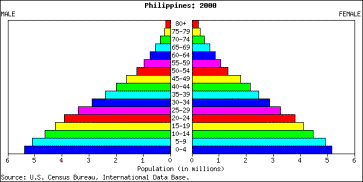
According to the population pyramid of this country, its population is most likely...
a)
growing slowly.
b)
growing rapidly.
c)
decreasing.
d)
not changing.
2.
Which has NOT been a major cause of the population explosion?
a)
modern preventive medicine
b)
increase in life expectancy
c)
improved sanitation
d)
increase in birth rates
3.
Which of the following is likely to be affected by a population of 7 billion?
a)
amount of land for agriculture
b)
amount of clean water
c)
number of people who are unemployed
d)
all of the above
4.
Which region of the world has the fastest growing population?
a)
Southeast Asia
b)
Eastern Europe
c)
Sub-Saharan Africa
d)
Latin America
5.
The number of live births per 1000 people is called the...
a)
growth rate.
b)
infant rate.
c)
baby total.
d)
birth rate.
6.
All of the following are demographic figures used in determining the total population of a country EXCEPT...
a)
immigration.
b)
birth rate.
c)
death rate.
d)
marriage rate.
7.
Deserts are usually....
a)
densely populated.
b)
sparsely populated.
c)
evenly populated.
d)
None of the above
8.
If a country has a death rate of 30 and a birth rate of 45 the natural rate of increase would show the population is ______.
a)
Increasing
b)
Decreasing
c)
Staying the same
d)
Fluctuating too much
9.
The maximum population size of a species that the environment can sustain indefinitely, given the food, habitat, water and other necessities available in the environment.
a)
sparse population
b)
environmental
c)
carrying capacity
d)
dense population
10.
The average number of people living in a square kilometer is called...
a)
urbanization. 
b)
internal migration. 
c)
population density. 
d)
pull factors. 
11.
One reason for a rapid population growth is...
a)
an increase in pull factors.
b)
declining death rates. 
c)
a sparse population density. 
d)
internal migration.
12.
Moving from place to place in the same country 
a)
Urbanization 
b)
Internal Migration 
c)
Pull Factor 
d)
Declining death rates
13.
What is a population pyramid?
a)
A type of graph showing the number of males and females in different age groups.
b)
A type of graph showing the number of males in different age groups.
c)
A type of graph showing the number of females  in different age groups.
d)
A type of graph showing the number of males and females in only one age group.
14.
Areas close to rivers tend to be...
a)
Densely populated
b)
Sparsely populated
c)
Fairly populated.
d)
None of the above
15.

If a population grows larger than its environmental carrying capacity, then

a)

death rate may rise.

b)

death rate may fall significantly.

c)

birth rate may rise significantly.

d)

immigration rate may increase.

16.

Which correctly describes the term demographic transition?

a)

The transition from low birth rates and death rates to high birth rates and death rates as a country develops.

b)

The transition from high birth rates and death rates to low birth rates and death rates as a country develops.

c)

The transition from high birth rates to low death rates as a country develops.

d)

The transition from low birth rates to high death rates as a country develops.

17.

VOCAB: The average number of children a female member of a population has during her lifetime

a)

total fertility rate

b)

replacement fertility rate

c)

growth rate

d)

death rate

18.
VOCAB: describes the relative numbers of organisms of each age within a population and is often represented by a graph
a)
age structure diagram
b)
population growth rate
c)
demographic transition
d)
fertility rate
19.
Countries with high growth rates usually have an age structure that has
a)
an even distribution over all ages
b)
more older people than young people
c)
more younger people than older people.
d)
more middle-aged people than younger people.
20.

Which of the following leads to a decrease in birthrates among women?

a)

Higher Education

b)

High Infant Mortality Rate

c)

No Prenatal Care

d)

No contraceptives

21.
Which of the following makes it difficult to reduce population growth?
a)
High literacy rates result in women wanting to have more children
b)
Population sizes will not decline until some people start having to do without food and other necessities of life
c)
Many people live in cities, where large families are an advantage
d)
Many people have low literacy and limited access to healthcare
22.

Which problem today is primarily the result of the Industrial Revolution?

a)

extensive air and water pollution

b)

increased transmission of disease between people living in close proximity

c)

decline in quality of agricultural soil

d)

erosion from deforestation as more fuel wood is harvested

23.
Population growth and fertility rates are lowest in
a)
upper-income countries
b)
upper- and middle-income countries
c)
middle- and low-income countries
d)
lower-income countries
24.
The most populous country in the world
a)
China
b)
India
c)
US
d)
Brazil
25.
The number of babies out of 1,000 that die during their first year of life is called
a)
infant mortality
b)
growth rate
c)
demography
26.

According to this graph, Which stage of the demographic transition has the highest level of population growth?

a)

pre-industrial

b)

transitional

c)

industrial

d)

post-industrial

27.

What can you conclude from the fact that the human population is so much larger today than it was 200 years ago?

a)

a. Most people chose not have children 200 years ago

b)

b. People 200 years ago killed one another frequently

c)

c. People 200 years ago had better medicine than we do today

d)

d. People today live longer, healthier lives than 200 years ago

28.

How can population growth lead to more pollution?

a)

a. Too many people breathing causes too much carbon dioxide to enter the atmosphere

b)

b. The body heat generated by billions of people leads to an increase in global warming

c)

c. More people being born means more paper is needed to print birth certificates

d)

d. All people produce waste, so more people equals more waste

29.

Which of the following would be a good step to take to reduce the waste you produce?

a)

a. Ask your parents to buy you your own car

b)

b. Try to reduce your consumption of electricity and fuel

c)

c. Use only electric appliances in your home

d)

d. Only buy products with vacuum-sealed plastic packaging

30.

If the world population keeps growing at its current rate, how many people might be alive in 10 years?

a)

a. 14 million

b)

b. 22 billion

c)

c. Between 7 and 8 billion

d)

d. 1.5 trillion

31.

What might happen if the earth exceeds its carrying capacity?

a)

a. There might not be room for people to move around.

b)

b. There might not be enough food and water for everyone.

c)

c . The continents might sink into the oceans.

d)

d. Most of the people on the planet would starve.

32.
Wastes produced by agriculture, households, industry, mining, and other human activities can end up in ______________.
a)
groundwater
b)
streams and rivers
c)
oceans
d)
All of these choices
33.
About 97% of the water on Earth is ___________________.
a)
fresh water
b)
groundwater
c)
salt water
d)
ice
34.
Which of the following historical events most likely triggered the largest increase in the human population? 
a)
the Black Death plague, which occurred in the mid-1300s
b)
the domestication of wheat crops, which began around 8000 B.C
c)
the fall of the Roman Empire, which occurred around A.D. 800
d)
the Industrial Revolution, which began in the late 1700s
35.
What are some reasons deforestation occurs?
a)
clearing land for agriculture, ranching, and mining
b)
just wanting to destroy things
c)
Population moving from rural areas to cities
d)
to make room for infrastructure
36.
The natural resources used by society are limited by various factors. Why is coal considered a nonrenewable resource?
a)
Once coal is used up, it can never be replaced.
b)
Coal is a nonrenewable resource, because it comes from the impact of meteors with the Earth
c)
Coal was a renewable resource, until it was mismanaged by humans
d)
Coal is considered a nonrenewable resource, because it takes millions of years to form
37.

Which of the following is NOT a potential limiting factor of human population growth?

famine medicine war disease

a)

disease

b)

war

c)

medicine

d)

famine

38.

After the demographic transition is complete, a population

grows rapidly. grows slowly. begins a period of rapid decline. stays about the same size as time passes.

a)

grows rapidly

b)

grows slowly

c)

begins a period of rapid decline

d)

stays about the same size as time passes.

39.

Name the type of pyramid in the picture.

a)

slow growth

b)

rapid growth

c)

zero growth

d)

negative growth

40.
Why has the world population dramatically increased?
a)
Better medicine
b)
Better sanitation
c)
Better technology
d)
All of the above
41.
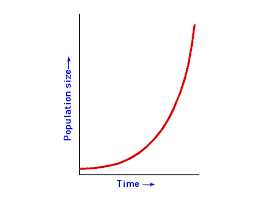
What type of growth is shown in the diagram?
a)
exponential growth
b)
logistic growth 
c)
predator-prey cycle
d)
boom-bust curve
42.
What three factors can affect ANY population's growth rate?
a)
Birthrate, death rate, migration
b)
disease, predation, migration
c)
medicine, agriculture, industry
d)
life expectancy, sanitation, vaccines