Wayground logo

Free Printable Worksheets

Font size

S
M
L
XL
Worksheets

Biology Review

Total questions: 55

Worksheet time: 32mins

Name
Class
Date
1.
What is the total magnification of a microscope with two lenses when one lens has a magnification of 10x, and the other lens has a magnification of 30x?
a)
15x
b)
30x
c)
40x
d)
300x
2.
Hold the slide in place on the stage
a)
Stage
b)
Stage Clips
c)
Aperature
d)
Light Source
3.
Regulates the amount of light on the specimen
a)
Diaphragm
b)
Aperature
c)
Ocular Lens
d)
Objective Lenses
4.
When carrying the microscope, hold the _____ and ______.  
a)
stage and arm
b)
base and arm
c)
light and base
d)
diaphragm and base
5.
The ________ supports the microscope.
a)
stage
b)
body tube
c)
base
d)
arm
6.
The ___________ holds the low and high power objective lenses and allows the lenses to rotate. 
a)
arm
b)
diaphragm
c)
eyepiece
d)
nosepiece
7.
The ___________ allows us to see very small objects not visible to the naked eye. 
a)
resolution
b)
light source
c)
microscope
d)
diaphragm
8.
This connects the eyepiece and the nosepiece.
a)
stage
b)
body tube
c)
stage
d)
arm
9.
This is what you look through, has a magnification of 10x
a)
body tube
b)
diaphragm
c)
eyepiece
d)
base
10.
What is the total magnification if you are using an objective that is 40x?
a)
4x
b)
40x
c)
400x
d)
4000x
11.
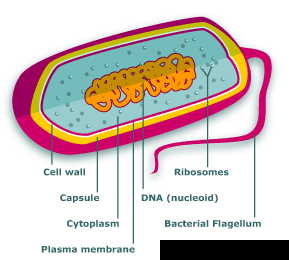
DNA is free floating, not in a nucleus
a)
Prokaryote
b)
Eukaryote
12.
DNA is free floating, not in a nucleus
a)
Prokaryote
b)
Eukaryote
13.
Include kingdoms: Protist, Animal, Fungi, and Plant
a)
Prokaryote
b)
Eukaryote
14.
Include kingdoms: Bacteria and Archaea
a)
Prokaryote
b)
Eukaryote
15.

Only Unicellular

a)

Prokaryote

b)

Eukaryote

16.

Which of the following has DNA?

a)

prokaryotes

b)

eukaryotes

c)

prokaryotes and eukaryotes

17.

Bacteria are an example of __________.

a)

prokaryotes

b)

eukaryotes

18.
Which type of cell?
a)
Prokaryote
b)
Eukaryote
19.
Has cytoplasm
a)
Prokaryote
b)
Eukaryote
c)
both
20.

Who was the first person to view and name "cells" when he observed cork cells?

a)

Hooke

b)

Virchow

c)

Schleiden

21.

Which is NOT part of Kingdom Eukarya?

a)

Animals

b)

Plants

c)

Archaea

d)

Protists

22.

The _______ is the smallest structural and functional unit of a living thing.

a)

cell

b)

metabolism

c)

nutrition

d)

defense

23.
Which statement is a part of the cell theory?
a)
all cells come from preexisting cells
b)
bacteria are prokaryotic cells
c)
eukaryotic cells are complex
d)
humans are multicellular
24.

Cell theory states that...

a)

cells are the basic building block of life

b)

cells are cool

c)

cells are microscopic

d)

cells cannot be destroyed

25.
All organisms are made of:
a)
organelles
b)
cytoplasm
c)
DNA
d)
cells
26.
All existing cells are produced by other
a)
living cells
b)
dead cells
c)
atom cells
d)
animal cells
27.

Autotrophs

a)

Make their own food

b)

Get their food from others

c)

are Fungi

d)

are none of the above

28.

Heterotrophs

a)

make their own food

b)

get their food from others

c)

are fungi

d)

none of the above

29.

Mutlicellular decomposers are in which kingdom

a)

Fungi

b)

Protist

c)

Plantae

d)

Animalia

30.

Mulitcellular organism have

a)

one cell

b)

many cells

c)

no cells

d)

both one cell and many cells

31.

I have no nucleus and live in extreme hot liquids. Which Kingdom am I in?

a)

Fungi

b)

Protist

c)

Eubacteria

d)

Archaebacteria

32.

Plant cells and animal cells have similar characteristics. What characteristic do they share that classifies them both into the Eukarya domain?

a)

They are both multicellular

b)

They both have a cell wall

c)

They both have a nucleus in the cells

d)

They both produce their own food

33.

Coral are classified as animals because they cannot —

a)

move from place to place

b)

make their own food

c)

catch their own food

d)

get rid of waste products

34.

Which list of characteristics describes organisms classified as animals?

a)

Unicellular, prokaryotic, autotrophic

b)

Multicellular, eukaryotic, heterotrophic

c)

Unicellular, eukaryotic, heterotrophic

d)

Multicellular, eukaryotic, autotrophic

35.

How many kingdoms are home to organisms that are eukaryotes?

a)

2

b)

4

c)

6

d)

1

36.

Where do autotrophs obtain their energy from?

a)

The Sun

b)

Other Organisms

c)

The Moon

d)

Earth's Inner Core

37.

The two (2) kingdoms that make up Prokaryotes are...

a)

Animals & Plants

b)

Protists & Fungi

c)

Archaea & Bacteria

d)

Fungi & Plants

38.

What kingdom's organisms often live in harsh environments?

a)

archaea

b)

bacteria

c)

animalia

d)

protista

39.

What are the three (3) domains in Taxonomy?

a)

Species, Bacteria, Protista

b)

Fungi, Archaea, Animalia

c)

Archaea, Bacteria, Eukarya

d)

Archaea, Bacteria, Prokaryote

40.

How many groups are in the Domain level?

a)

1

b)

2

c)

3

d)

4

41.
Temperature, light, air, water, and soil are all  _____  parts of the environment
a)
alive
b)
biotic 
c)
abiotic
d)
living
42.
Is a deer an abiotic or biotic factor? 
a)
abiotic
b)
biotic
43.
Is a weather an abiotic or biotic factor? 
a)
abiotic
b)
biotic
44.
Is sunlight an abiotic or biotic factor? 
a)
abiotic
b)
biotic
45.
Which of the following is not an abiotic factor?
a)
sun
b)
temperature
c)
soil
d)
grass
46.
Which of the following is not a biotic factor?
a)
mushroom
b)
air
c)
elephant
d)
coyote
47.
A nonliving element in an ecosystem is an 
a)
animal
b)
abiotic factor
c)
biotic factor
d)
organism
48.

A community comprising all the biotic and abiotic factors in an area and all the interactions among them

a)

ecosystem

b)

population

c)

species

d)

Environmental interaction

49.

A group of interacting individuals of the same species located in the same area

a)

population

b)

species

c)

interaction

d)

reproduction

50.
Which of the fallowing has only abiotic factors?
a)
Sunlight, algae, and temperature
b)
Guppy, crab, oxygen
c)
Sunlight, soil, and weather
d)
Algae, temperature, and dog
51.
The following picture is an example of...
a)
population
b)
community
c)
microorganism
d)
predator
52.

An individual living things,such as animals or a plants,is called an

a)

Animal

b)

plant

c)

Organism

d)

Nutrition

53.
Which of the following is an example of an interaction between a living and nonliving organism?
a)
a snake using a mouse for food
b)
a worm using the soil as shelter
c)
a bird using an insect for food
54.

A group of living things that live together and interact in an environment are called a/an ________.

a)

community

b)

habitat

c)

population

d)

ecosystem

55.

A rock

a)

Biotic (living)

b)

Abiotic (non-living)