wayground logo

Free Printable Worksheets

Font size

S
M
L
XL
Worksheets

Algebra I Review for Final

Total questions: 110

Worksheet time: 6hrs 31mins

Name
Class
Date
1.
Find the y-intercept of f(x) = 2x- 2x + 1
a)
2
b)
-2
c)
1
d)
-1
2.
What is the vertex of the quadratic function:
y = x2 - 6x + 11?
a)
(3,2)
b)
(-3,-2)
c)
(-3,2)
d)
(3,-2)
3.
Determine the vertex of the parabola:
y = 5x- 20x + 13
a)
(5, -7)
b)
(-2, -7)
c)
(2, -7)
d)
(-7, -2)
4.
Identify the 'a' value: y = 16x2 -8x -24
a)
16
b)
8
c)
-8
d)
-24
5.

Identify the 'b' value: y = 16x2 -8x -24

a)

16

b)

-8

c)

8

d)

-24

6.
What is the axis of symmetry of:y=2x2-4x+9
a)
x = 1
b)
x = -1
c)
x = -2
d)
x = 4
7.
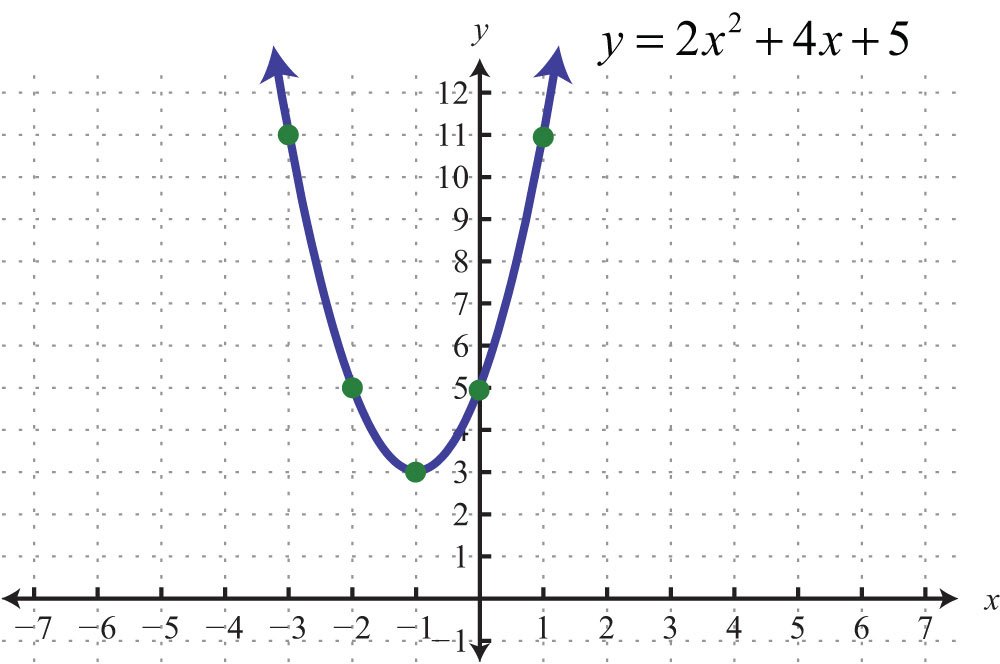
What is the vertex?
a)
(5,2)
b)
(2,5)
c)
(-2,5)
d)
(-5,2)
8.
What is the y-intercept of this parabola?
a)
(−1, 3)
b)
(−3, 11)
c)
(−2, 5)
d)
(0, 5)
9.
Which answer choice describes  y = -3x2 +7x - 2 accurately?
a)
opens up with a maximum
b)
opens up with a minimum
c)
opens down with a maximum
d)
opens down with a minimum 
10.
Does the following quadratic equation have a maximum or minimum value? How can you tell?
y=x
²+2x-3
a)
Minimum value, because the a value is positive
b)
Maximum value, because the b value is positive
c)
Maximum value, because the a value is positive
d)
Minimum value, because the c value is negative
11.
What is the arrow pointing at? How can you use this value?
a)
The arrow is pointing at the y-intercept. The x-value is the axis of symmetry and the y-value of this point is equivalent to the maximum/minimum 
b)
The arrow is pointing at the vertex. The x value of this point is equivalent to the maximum/minimum and the y-value is the axis of symmetry
c)
The arrow is pointing at the solution. The y value of this point is equivalent to the maximum and the x value is equivalent to the minimum
d)
The arrow is pointing at the vertex. The x-value is the axis of symmetry and the y-value is equivalent to the minimum/maximum
12.
Factor completely
k2 -2k - 24
a)
(k+4)(k-6)
b)
(k+4)(k+6)
c)
(k+6)(k-1)
d)
(k-4)(k+6)
13.
Factor completely
k2+7x+10
a)
(k+2)(k+5)
b)
(k-2)(k-5)
c)
(k+10)(k+4)
d)
(k+2)(k-5)
14.
Factor completely
n2 + 16n + 63
a)
(n-7)(n+4)
b)
(n+7)(n-9)
c)
(n-3)(n-10)
d)
(n+7)(n+9)
15.
Solve  by factoring
x2 + 13x + 12 = 0
a)
x = -12, -1
b)
x = 12, 1
c)
x = 13, 1
d)
x = -13, -1
16.
Factor: x2 – 5x – 24
a)
(x - 5)(x + 19)
b)
(x - 8)(x + 3)
c)
(x - 3)(x + 8)
d)
(x - 19)(x + 5)
17.
Factor: x2 + 2x – 3
a)
(x - 2)(x + 1)
b)
(x + 1)(x - 3)
c)
(x + 2)(x - 1)
d)
(x - 1)(x + 3)
18.
Which of the following is equivalent to (x - 9)2 ?
a)
x2 + 81
b)
x2 - 81
c)
x2 + 18x - 81
d)
x2 -18x + 81
19.
x- 25
a)
( x + 5 ) ( x - 5 ) 
b)
( x - 5 ) ( x - 5 ) 
c)
( x + 5 ) ( x + 5 ) 
d)
Prime
20.
What is the first question you ask yourself when factoring a polynomial? 
a)
How many terms does it have? 
b)
Is there a GCF? 
c)
What strategy should I use? 
d)
Why do I have to learn this?!?!?!
21.

Factor completely.
 4x2494x^2-49  

a)

(2x + 7)(2x + 7)

b)

(2x + 7)(2x - 7)

c)

(2x - 7)(2x - 7)

d)

(4x + 7)(4x - 7)

22.
Determine the values of
a, b, and c for
the quadratic equation: 
4x2 – 8x = 3
a)
a = 4, b = -8, c = 3
b)
a = 4, b =-8, c =-3
c)
a = 4, b = 8, c = 3
d)
a = 4, b = 8, c = -3
23.
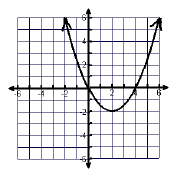
What are the zeros?
a)
x= 0 and x= -4
b)
x= 0 and x= 4
c)
y= 0
d)
x= 2
24.
What is another word for zeros?
a)
y-intercepts
b)
roots
c)
vertex
d)
axis of symmetry
25.
True or false:
The solutions, roots, x-intercepts, and zeros of a quadratic equation are all the same thing.
a)
True
b)
False, because the solution and root are the same but the x-intercept and zero are different
c)
False, because the x-intercept and root are the same but the zero and solution are different
d)
False, they are all different
26.
a)
A
b)
B
c)
C
d)
D
27.
a)
A
b)
B
c)
C
d)
D
28.
a)
A
b)
B
c)
C
d)
D
29.
a)
A
b)
B
c)
C
d)
D
30.
a)
A
b)
B
c)
C
d)
D
31.
a)
A
b)
B
c)
C
d)
D
32.
a)
A
b)
B
c)
C
d)
D
33.
a)
A
b)
B
c)
C
d)
D
34.
a)
A
b)
B
c)
C
d)
D
35.
Simplify:
a)
2√12
b)
4√12
c)
4√3
d)
16√3
36.
Simplify:  √28
a)
7√2
b)
2√7
c)
4√7
d)
2√14
37.
Simplify:
a)
3√10
b)
√10
c)
9√10
d)
√30
38.
Simplify:
a)
A
b)
B
c)
C
d)
D
39.
Simplify:
a)
A
b)
B
c)
C
d)
D
40.
Simplify:
a)
√5
b)
(√14)/2
c)
√7
d)
Cannot be simplified
41.

What is this called?

a)

Radical

b)

Radicand

c)

Index

d)

Root Symbol or Radical Symbol

42.

What is this called?

a)

Radical

b)

Radicand

c)

Index

d)

Root Symbol

43.

What is

 ama^m  called?

a)

Radical

b)

Radicand

c)

Index

d)

Root Symbol

44.

What is

 4\sqrt{4}  ?

a)

-2, 2

b)

-4, 4

c)

-8, 8

d)

 14,14-\frac{1}{4},\frac{1}{4}  

45.

What is the 3rd root of 125?

a)

25

b)

5

c)

10

d)

3

46.

Simplify.

a)
b)
c)
d)
47.

Simplify:

a)
b)
c)
d)
48.

Simplify.

a)
b)
c)
d)
49.

Simplify.

a)
b)
c)
d)
50.
(x²+11x+24)/(x²+4x-32)
a)
A.(x+7)/(x+4)
b)
B.3/4
c)
C.(x+3)/(x+4)
d)
D.(x+3)/(x-4)
51.
20x³/(5x+10)
a)
A.4x³/(x+2)
b)
B.4x³/(x+10)
c)
C.2x³/(5x+1)
d)
D. 2x³/(x+5)
52.
(-x-5)/(x²+12x+35)
a)
A. 1/(x+7)
b)
B. 1/(x-7)
c)
C. -1/(x+7)
d)
D. -1/(x+6)
53.
Simplify by cancelling
a)
1
b)
-1
c)
Can't be simplified
54.
Which of the following is equivalent?
(7-m)
a)
(m-7)
b)
-(m+7)
c)
-(7+m)
d)
-(m-7)
55.
Simplify
a)
(x-9)/(x+9)
b)
1/(x-9)
c)
(x+9)
d)
1/(x+9)
56.
Simplify.
a)
A.
b)
B.
c)
C.
d)
D.
57.
Simplify
(x2-49)/(x2+9x+14)
a)
(x-7)/(x+2)
b)
(x+7)/(x+2)
c)
(x-7)/(x-2)
d)
(x+7)/(x+2)
58.
Simplify
(x2+6x+8)/(x2-x-6)
a)
(x+2)/(x-3)
b)
(x+4)/(x+2)
c)
(x+4)/(x-3)
d)
(x+2)/(x+2)
59.
(4 - x2) / (x2 - x - 2)
a)
4 / (-x - 2)
b)
-2 / (-X - 1)
c)
-1(x + 2) / (x + 1)
60.
(5x2 + 21x + 4) / (25x + 100)
a)
(x2 + 21x + 1) / (5x + 25)
b)
5x2 + 4 / 4x + 25
c)
(5x + 1) / 25
61.
Which value of x makes the expression undefined?
a)
-2
b)
2
c)
-6
d)
-3
62.
a)
A
b)
B
c)
C
d)
D
63.
a)
A
b)
B
c)
C
d)
D
64.
a)
A
b)
B
c)
C
d)
D
65.
a)
A
b)
B
c)
C
d)
D
66.
a)
A
b)
B
c)
C
d)
D
67.
a)
A
b)
B
c)
C
d)
D
68.
a)
A
b)
B
c)
C
d)
D
69.
a)
A
b)
B
c)
C
d)
D
70.
a)
A
b)
B
c)
C
d)
D
71.
a)
A
b)
B
c)
C
d)
D
72.
Which would be better to use here?
a)
Long division
b)
Synthetic division
73.
For synthetic division, what would be the number in the left hand box?
a)
0
b)
1
c)
2
d)
3
74.

Divide using synthetic division

(2x³ + 4x² - 5) by (x + 3).

a)

2x² + 2x - 4 - 12/(x + 3)

b)

2x² - 2x + 6 - 23/(x + 3)

c)

2x² - 2x + 8 - 20/(x + 3)

d)

2x² - 4x + 1

75.

The area of a rectangular pool table is: x2 + 14x +40.

The length is x + 4. What is the width?

a)

x + 8

b)

x + 14

c)

x + 10

d)

x +4

76.

 2x3+7x26x8x+4\frac{2x^3+7x^2-6x-8}{x+4}  

a)

 2x2x22x^2-x-2  

b)

 2x3x22x2x^3-x^2-2x  

c)

 2x2+15x+54+208x+42x^2+15x+54+\frac{208}{x+4}  

d)

 2x3+15x2+54x+2082x^3+15x^2+54x+208  

77.

 2x35x24x25x4\frac{2x^3-5x^2-4x-25}{x-4}  

a)

 2x2+3x+857x42x^2+3x+8-\frac{57}{x-4}  

b)

 2x213x562x^2-13x-56  

c)

 2x2+3x+8+7x42x^2+3x+8+\frac{7}{x-4}  

d)

 2x23x1689x42x^2-3x-16-\frac{89}{x-4}  

78.

Factor by using polynomial division: p(x)=x3+3x218x40p\left(x\right)=x^3+3x^2-18x-40  
A known factor of the polynomial is (x+2)

a)

 p(x)=(x+2)(x3)(x+10)p\left(x\right)=\left(x+2\right)\left(x-3\right)\left(x+10\right)  

b)

 p(x)=(x+2)(x+5)(x4)p\left(x\right)=\left(x+2\right)\left(x+5\right)\left(x-4\right)  

c)

 p(x)=(x+2)(x5)(x+7)p\left(x\right)=\left(x+2\right)\left(x-5\right)\left(x+7\right)  

d)

 p(x)=(x3)(x+4)(x+6)p\left(x\right)=\left(x-3\right)\left(x+4\right)\left(x+6\right)  

79.

 x2+7x+7x+3\frac{x^2+7x+7}{x+3}  

a)

 (x+4)(x+3)\left(x+4\right)\left(x+3\right)  

b)

 x+5x+5  

c)

 x+4+5x+3x+4+\frac{5}{x+3}  

d)

 x+45x+3x+4-\frac{5}{x+3}  

80.

 x38x2+6x+41x4\frac{x^3-8x^2+6x+41}{x-4}  

a)

 x24x7+2x4x^2-4x-7+\frac{2}{x-4}  

b)

 x24x11+1x4x^2-4x-11+\frac{1}{x-4}  

c)

 x22x12+3x4x^2-2x-12+\frac{3}{x-4}  

d)

 x24x10+1x4x^2-4x-10+\frac{1}{x-4}  

81.
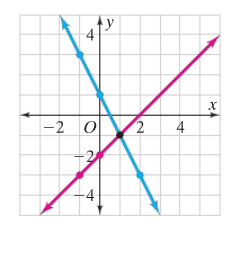
What is the solution?
a)
(1, -1)
b)
(-1, 1)
c)
(0, -2)
d)
(0, 1)
82.
If a system of equations has no solution, what does the graph look like? 
a)
intersecting lines
b)
parallel lines
c)
skew lines
d)
intersecting lines
83.

Solve the following systems of equations using substitution:


x = 6

y = 2x - 3

a)

(6, 6)

b)

(6, 9)

c)

(9, 6)

d)

(9, 9)

84.

Solve the following systems of equations using substitution:


y = 3 - x

3y + x = 5

a)

No solution

b)

(1, 2)

c)

(3, 0)

d)

(2, 1)

85.
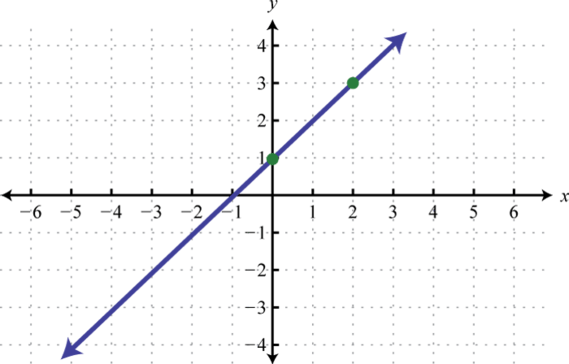
What is the y-intercept of this graph?
a)
(0,1)
b)
(0,-2)
c)
(0,0)
d)
(0,3)
86.
What is the y-intercept of the line?
a)
y = 1/2
b)
y = 1
c)
y = -1/2
d)
y = -1
87.
What does 'b" represent in y=mx=b
a)
y-intercept
b)
macaroni
c)
nothing
d)
slope
88.
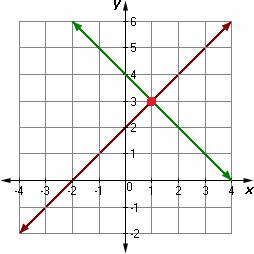
What is the solution to the system?
a)
(0, 3)
b)
(1, -1)
c)
(-3, 1)
d)
(1, 3)
89.
What is the solution to the system of equations? 
y = 3x - 8
y = 4 - x
a)
(3,1)
b)
(1,3)
c)
(-3,1)
d)
(3,-1)
90.
What is the value of the y-coordinate of the solution to the system of equations 
x-2y=1
x+4y=7 
a)
1
b)
-1
c)
3
d)
4
91.
Solve for x and y
y = 2x + 1
y = 4x - 1
a)
(1,3)
b)
(-1,-3)
c)
(-1,3)
d)
(3,1)
92.
Solve for x and y
3x + 2y = 16
7x + y = 19
a)
(-2,5)
b)
(-2,-5)
c)
(2,-5)
d)
(2,5)
93.
Solve for x and y.
y = 2/3x - 2
y = -x + 3
a)
(0,3)
b)
(0,-3)
c)
(3,0)
d)
(-3,0)
94.

Show your work:

a)
b)
95.

Solve the equation.

a)

x = 12

b)

x = 5

96.
8v - 4(v + 8) = 8
a)
2
b)
10
c)
4
d)
-4 
97.
2x - 3 + 4x = 27
a)
12
b)
4
c)
5
d)
15
98.
3x + 2(4x - 4) = 3
a)
4
b)
3
c)
2
d)
1
99.

Solve

a)

y < 6

b)

y < 16

c)

3y < 16

d)

y < -6

100.

Solve

a)

h > -8

b)

h < 8

c)

h < -5

d)

h > -10

101.

Which point is a solution to the system of inequalities?

a)

(-8,2)

b)

(-2,-5)

c)

(0,6)

d)

(4, 3)

102.
Which point below is NOT part of the solution set?
a)
(0, 0)
b)
(5, 1)
c)
(-1, -3)
d)
(20, -5)
103.
Which inequality is shown in the graph?
a)
y < 2x + 1
b)
y < -2x + 1
c)
y ≤ 2x + 1
d)
y ≤ -2x + 1
104.
The graph shows which inequality?
a)
y ≤ 3
b)
y ≥ 3
c)
y > 3
d)
x > 3
105.
Which system of inequalities is shown?
a)
y ≥ -x - 1
y < x + 4
b)
y < -x - 1
 y ≥ x + 4
c)
y > -x - 1
y ≥ x + 4
d)
y > -x - 1
y ≥ x + 3
106.
Match
a)
y < x−2 
y < 3
b)
y > -x+2
y > 3
c)
y < -x+2
y < 3
d)
y < -x+2
y > 3
107.
Select the correct graph for each inequality.
a)
A
b)
B
c)
C
d)
D
108.
Write an inequality represented by the graph.
a)
x < - 3
b)
y < - 3
c)
x > - 3
d)
x ≥ - 3
109.

Solve the system of inequalities by graphing.

a)
b)
c)
d)
110.

Solve the system of inequalities by graphing.

a)
b)
c)
d)