wayground logo

Free Printable Worksheets

Font size

S
M
L
XL
Worksheets

Muscular System Comprehensive Review

Total questions: 42

Worksheet time: 25mins

Name
Class
Date
1.
What is the name of the thin filaments in the muscle cell?
a)
Actin
b)
Myosin
c)
Myoglobin
d)
Titan
2.
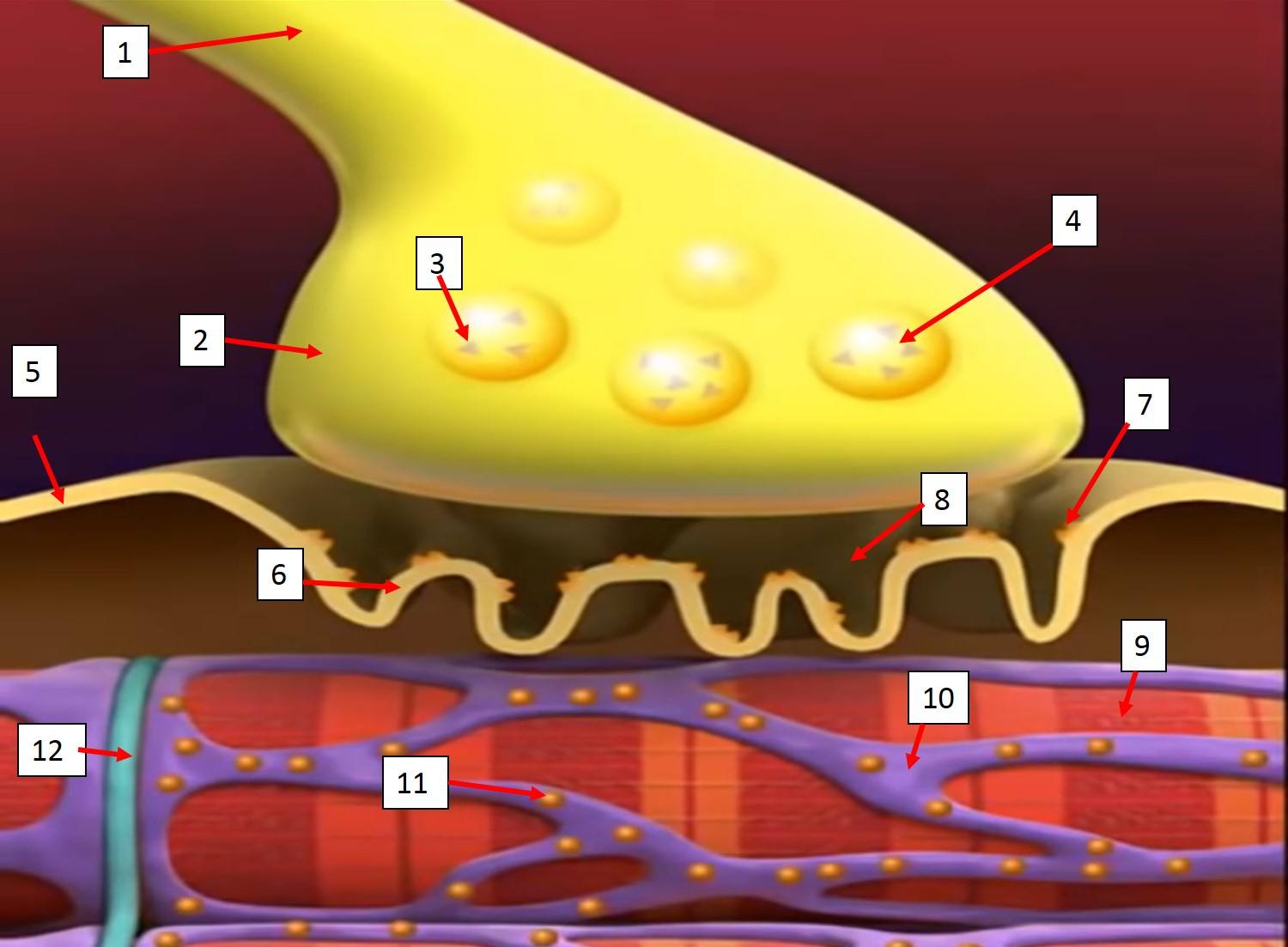
Region where a motor neuron comes in close contact with a muscle cell.
a)
neurotransmitter
b)
muscular dystrophy
c)
muscle tension
d)
neuromuscular junction
3.
The Ions that are responsible for removing Troponin from Tropomyosin.
a)
Sodium
b)
Calcium
c)
Potassium
d)
Magnesium
4.
Skeletal Muscle contraction is initiated when the ________ sends a message to the muscle cell.  
a)
Muscle cell
b)
Neuron
c)
Gland
d)
None of the above
5.
Z represents
a)
Dendrite
b)
Axon Terminal
c)
Neurotransmitters
d)
Synapse
6.
The receptors are represented by
a)
8
b)
9
c)
10
d)
11
7.

These muscles are found in your organs, like your stomach, bladder, and intestines.

a)

Skeletal muscle

b)

Smooth muscle

c)

Rough muscle

d)

Cardiac muscle

8.

This type of muscle is only found in your heart.

a)

Skeletal muscle

b)

Smooth muscle

c)

Rough muscle

d)

Cardiac muscle

9.
Movements that you choose to control
a)
Cramp
b)
Voluntary
c)
Strain
d)
Involuntary
10.
Identify the muscle.
a)
Quadriceps
b)
Bicep
c)
Pectorals
d)
Gastrocnemius
11.
Identify the muscle.
a)
Hamstring
b)
Pectorals
c)
Abdominals
d)
Quadriceps
12.
Identify the muscle.
a)
Hamstring
b)
Gastrocnemius
c)
Deltoid
d)
Latissimus Dorsi
13.
Identify the muscle.
a)
Bicep
b)
Tricep
c)
Deltoid
d)
Trapezius
14.
Identify the muscle.
a)
Gluteus Maximus
b)
Quadriceps
c)
Hamstrings
d)
Deltoids
15.
Identify the muscle.
a)
Obliques
b)
Trapezius
c)
Gluteus Maximus
d)
Latissimus Dorsi
16.
Identify the muscle.
a)
Deltoids
b)
Quadriceps
c)
Triceps
d)
Trapezius
17.

The movement shown is a person moving his leg outward. This movement is known as:

a)

abduction

b)

adduction

c)

rotation

d)

flexion

18.

The lateral motion TOWARDS the midline is called ______.

a)

adduction

b)

abduction

c)

circumduction

d)

opposition

19.
What movement is occurring here?
a)
Eversion
b)
Flexion
c)
Dorsiflexion
d)
Plantarflexion
20.
Identify the joint action being performed.
a)
Circumduction
b)
Lateral Rotation
c)
Medial Rotation
d)
Eversion
21.
Identify the joint action being performed.
a)
Inversion
b)
Eversion
c)
Plantarflexion
d)
Dorsiflexion
22.

Name this movement

a)

adduction

b)

abduction

c)

flexion

d)

extension

23.

Name this movement

a)

extension

b)

flexion

c)

adduction

d)

abduction

24.

Name this movement (moving palm face up)

a)

ulnar deviation

b)

supination

c)

pronation

d)

radial deviation

25.

One neuron and all the skeletal muscle cells it stimulates is the ____ ___.

a)

Neurotransmitter

b)

Neuromuscular junction

c)

Motor unit

d)

Synaptic cleft

26.

The gap between the nerve cell and sarcolemma is the ____ ___.

a)

Synaptic cleft

b)

Neurotransmitter

c)

Motor unit

d)

Neuromuscular junction

27.

What is the specific neurotransmitter that stimulates the movement of skeletal muscles?

a)

GABA

b)

Acetylcholine

c)

Serotonin

d)

Dopamine

28.

A bundle of myofibrils best describes a

a)

muscle

b)

muscle fiber

c)

myofilaments

d)

muscle fiber bundle

29.

The organelle that stores ACh in the axon is identified as #4

a)

Vacuole

b)

Sarcoplasm

c)

Sarcolemma

d)

Vesicle

30.
Muscles are attached to bones by _____.
a)
Ligaments
b)
Tendons
c)
Cartilage
d)
Axons
31.

Another name for a muscle cell.

a)

Fiber

b)

Sarcolemma

c)

Sarcomere

d)

Fascicle

32.

Thick filaments in a myofibril are

a)

Muscle fiber

b)

Sarcoplasmic reticulum

c)

Actin

d)

Myosin

33.
Thin filaments in a myofibril are
a)
Sarcomeres
b)
Sarcoplasm
c)
Actin
d)
Myosin
34.

The cell membrane of a skeletal muscle cell is called the:

a)
sarcomere
b)
myofilament
c)
sarcolemma
d)
sarcoplasm
35.
___ and ___ are regulatory proteins bound to actin. 
a)
Troponin and tropomyosin
b)
Myosin and actin
c)
Calcium and Oxygen
d)
Glycogen and hemoglobin
36.
What is a crossbridge?
a)
Where myosin binds to actin
b)
Where the calcium crosses into the cytoplasm
c)
Where calcium binds with troponin
d)
None of the answers are correct.
37.

How many Muscles are in the human body?

a)

~500

b)

~600

c)

~300

d)

~200

38.
How many types of Muscles are there in the body?
a)
2
b)
4
c)
3
d)
1
39.
When a muscle contracts, it _______
a)
gets longer
b)
gets shorter
c)
gets thinner
d)
grows hair
40.

What muscle is the arrow pointing to?

a)

Biceps

b)

Triceps

c)

Lats

d)

Quads

41.

a)

Rectus abdominis

b)

External Oblique

c)

Pectoralis major

d)

Trapezius

42.

a)

Hamstring

b)

Quadriceps

c)

Biceps femoris

d)

Sartorius