Wayground logo

Free Printable Worksheets

Font size

S
M
L
XL
Worksheets

CGTC Biol2113 Review for Chapters 1-4

Total questions: 175

Worksheet time: 5hrs 24mins

Name
Class
Date
1.

Which of these is NOT required for life?

a)

water

b)

food

c)

blood

d)

oxygen

e)

pressure

2.

What is the basic unit of structure and function of all LIVING organisms?

a)

organism

b)

species

c)

cell

d)

tissue

e)

organ system

3.

Which of these is NOT a characteristic of life?

a)

movement

b)

growth

c)

excretion

d)

sleeping

e)

reproduction

4.

Homeostasis refers to:

a)

changing internal conditions

b)

stable external conditions

c)

stable internal conditions

d)

changing external conditions

e)

none of these is correct

5.

Small structures within cells that carry on specific functions are:

a)

organelles

b)

tissues

c)

molecules

d)

parasites

e)

hormones

6.

The sum of all chemical reactions in the body is called

a)

metabolism

b)

assimilation

c)

growth

d)

digestion

7.

Which of the following is the most complex level of organization?

a)

cell

b)

organ

c)

organ system

d)

organelle

8.
The study of structure is called ___________.
a)
homeostasis
b)
anatomy
c)
physiology
d)
interrelation
9.

What is formed when cells of the same type join to perform a common task?

a)

cell

b)

tissue

c)

organ

d)

system

10.

Measuring an organ's size would relate more closely to the science of ...

a)

anatomy

b)

physiology

c)

both anatomy and physiology

11.

Measuring the acid content of the stomach would relate more closely to the science of ...

a)

anatomy

b)

physiology

c)

both anatomy and physiology

12.
Dissection would relate more closely to the science of ...
a)
anatomy
b)
physiology
13.

The branch of biology that deals with the normal functions of living organisms and their parts. is...

a)

anatomy

b)

physiology

c)

both anatomy and physiology

14.

Physics (the study of matter, energy and motion) of the human body would relate more closely to the science of ...

a)

anatomy

b)

physiology

c)

both anatomy and physiology

15.

Which character of life describes the process of getting oxygen?

a)

Absorption

b)

Growth

c)

Respiration

d)

Responsiveness

16.
Towards the Front. 
[The eyes are _______ to the brain].
a)
Inferior
b)
Deep
c)
Lateral
d)
Anterior
17.
Away from midline
a)
Lateral
b)
Distal
c)
Superior
d)
Transverse
18.
Divides body into top and bottom portions (superior-head; inferior-feat)
a)
Medial Plane
b)
Sagittal
c)
Proximal 
d)
Transverse Plane
19.
A body part is above another part, or is closer to the head
a)
Superficial
b)
Lateral
c)
Superior
d)
Deep
20.
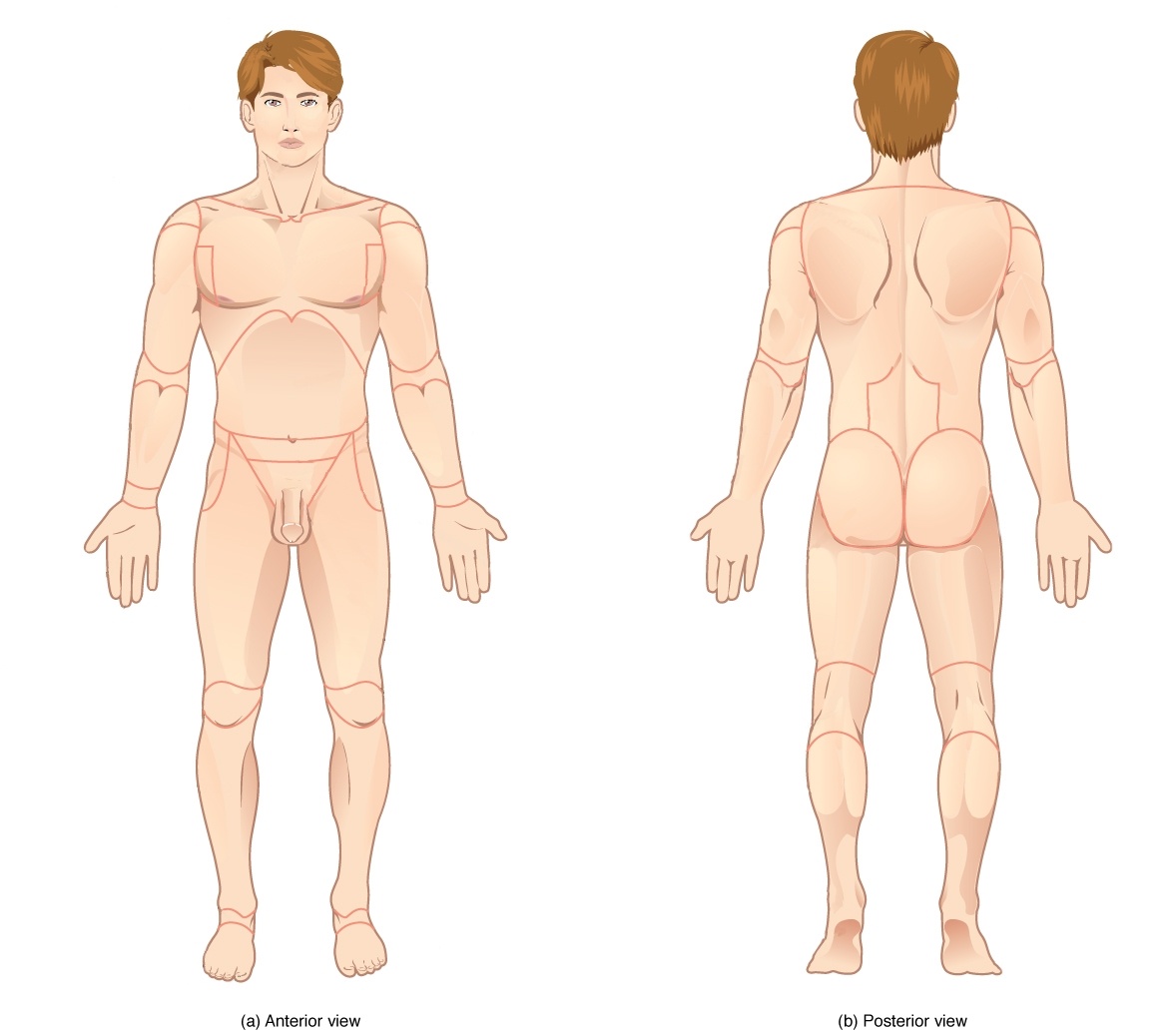
Body is standing straight, facing forward, upper limbs at side and palms facing forward. 
*right and left refer to "right" and "left" of the body in position.
a)
Sagittal
b)
Anatomical Position
c)
Anterior Position
d)
Anatomical Plane
21.
Away from the origin or trunk
a)
Deep
b)
Distal
c)
Proximal
d)
Posterior
22.
The knee is _______ to the ankle.
a)
proximal
b)
lateral
c)
distal
d)
medial
23.
The head is ______ to the chest.
a)
superior
b)
dorsal
c)
inferior
d)
ventral
24.
The bone is _____ to the skin.
a)
inferior
b)
superficial
c)
deep
d)
posterior
25.
Which is the correct structural order?
a)
tissue-cells-organ-organ system
b)
cells-tissue-organ system-organ
c)
tissue-cells-organ system-organs
d)
cells-tissue-organ-organ system
26.
Which body cavity is surrounded by the pelvic bones?
a)
abdominal
b)
pelvic
c)
thoracic
27.
The cranial cavity and the spinal (vertebral) cavity are both contained within the _______ cavity.
a)
dorsal
b)
ventral
c)
abdominal
d)
throacic
28.
The thoracic cavity and the abdominopelvic cavity are both contained within the _______ cavity.
a)
dorsal
b)
ventral
c)
cranial
d)
spinal
29.
Which body cavity is located above the diaphragm and is surrounded by the rib cage?
a)
abdominal
b)
pelvic
c)
thoracic
d)
diaphragm
30.
Abdominal region
a)
Region between the thorax and pelvis
b)
The ribs
c)
The area between the pod and the pelvis
d)
What even?
31.
Where is the femoral region located?
a)
The thigh 
b)
Lumbar region
c)
Orbital
d)
The chest
32.
What is the region called between the thigh and abdomen, where the legs connect to the trunk of the body?
a)
Inguinal region
b)
Otic
c)
Pedal
d)
Popliteal
33.
This plane divides the body into the right and left sides
a)
transverse plan
b)
midsagittal plane
c)
frontal or coronal plane
d)
ventral plane
34.
This plane divides the body into upper and lower portions
a)
transverse plane
b)
midsagittal plane
c)
frontal or coronal
d)
dorsal plane
35.
This plane divides the body into front and back sections.
a)
transverse
b)
midsagittal
c)
frontal or coronal
d)
mediastinum plane
36.
Which system absorbs oxygen and releases carbon dioxide?
a)
respiratory
b)
urinary
c)
endocrine
d)
lymphatic
37.
Which system acts as a barrier against infection and UV radiation and helps regulate body temperature?
a)
integumentary
b)
muscular
c)
digestive
d)
cardiovascular
38.
Which system eliminates waste products and helps maintain homeostasis?
a)
urinary
b)
respiratory
c)
cardiovascular
d)
digestive
39.

Which system helps with voluntary and involuntary movement; helps circulate blood and move food through the digestive tract?

a)

muscular

b)

skeletal

c)

lymphatic

d)

urinary

40.
This system fights pathogens (germs) and produces and stores white blood cells.
a)
lymphatic
b)
muscular
c)
endocrine
d)
integumentary
41.
This system supports and protects vital organs, stores minerals, and produces red blood cells.
a)
skeletal
b)
muscular
c)
cardiovascular
d)
nervous
42.
This system sends chemical messages (hormones) that regulate growth, development, and metabolism.
a)
endocrine
b)
nervous
c)
lymphatic
d)
skeletal
43.
Which system sends electrical messages that helps control the body's responses to internal and external changes?
a)
nervous
b)
endocrine
c)
reproductive
d)
integumentary
44.
True or False Blood clotting and uterine contractions are good examples of negative feedback.
a)
True
b)
False
45.
Which of the following is an example of positive feedback to indirectly maintain homeostasis?
a)
the chemical reactions involved in blood clotting
b)
your blood vessels dilate and you begin to sweat in response to elevated body temperature
c)
your blood vessels constrict and you begin to shiver in response to low body temperature
d)
your coach compliments you on your performance in practice
46.
Which of the following descriptions are involved in negative feedback?
a)
deviation from a set point
b)
causes changes to compensate for deviation in order to maintain homeostasis
c)
constantly monitors conditions
d)
All of these are involved in negative feedback
47.
Humans have ___ for body temperature, blood glucose concentrations, electrolyte concentrations, pH levels, tendon tension and variables.
a)
positive feedback mechanisms
b)
set points
c)
a wide internal range
d)
no regulation
48.
Homeostasis in the human body is often maintained by a: 
a)
neutral feedback loop 
b)
solar feedback loop
c)
positive feedback loop
d)
negative feedback loop
49.
Positive feedback is when the change caused by the stimulus is
a)
decreased
b)
non existant
c)
increased
d)
changes constantly
50.
As you get dehydrated, your blood becomes thicker and harder to pump. Your kidneys will respond by stopping urine production, sending the water from urine into your bloodstream to thin your blood back to normal level.
a)
Positive Feedback Response
b)
Negative Feedback Loop 
51.
When you are cold, you shiver and your blood vessels contract, which warms you up. When you are hot, you sweat and your blood vessels expand, which cools you down.  
a)
Positive Feedback Response
b)
Negative Feedback Loop 
52.
Quandrant 2
a)
LUQ
b)
RUQ
c)
LLQ
d)
RLQ
53.
Region 4
a)
Left Lumbar
b)
Right Lumbar
c)
Umblical
d)
Right Hypochondriac
54.
Region 9
a)
Epigastric
b)
Left Hypochondriac
c)
Left Iliac
d)
Right Iliac
55.
Region 1
a)
Left Lumbar
b)
Epigastric
c)
Hypogastric
d)
Right Hypochondraic
56.
Region 1
a)
Left Lumbar
b)
Epigastric
c)
Hypogastric
d)
Right Hypochondraic
57.
4
a)
LLQ
b)
RUQ
c)
LUQ
d)
RLQ
58.
A group of tissues that perform a similar function is called_____. (Examples include the heart, lungs or stomach)
a)
cells
b)
tissues
c)
organs
d)
organ systems
59.
What is the correct order for the levels of organization (least complex to most complex)?
a)
cell, tissue, atom, molecule, macromolecule, organelle, organ, organism, organ system
b)
atom, molecule, macromolecule, organ, organelle, cell, tissue, organ system, organism
c)
atom, molecule, macromolecule, organelle, cell, tissue, organ, organ system, organism
d)
molecule, atom, macromolecule, organelle, cell, tissue, organ, organ system, organism
60.

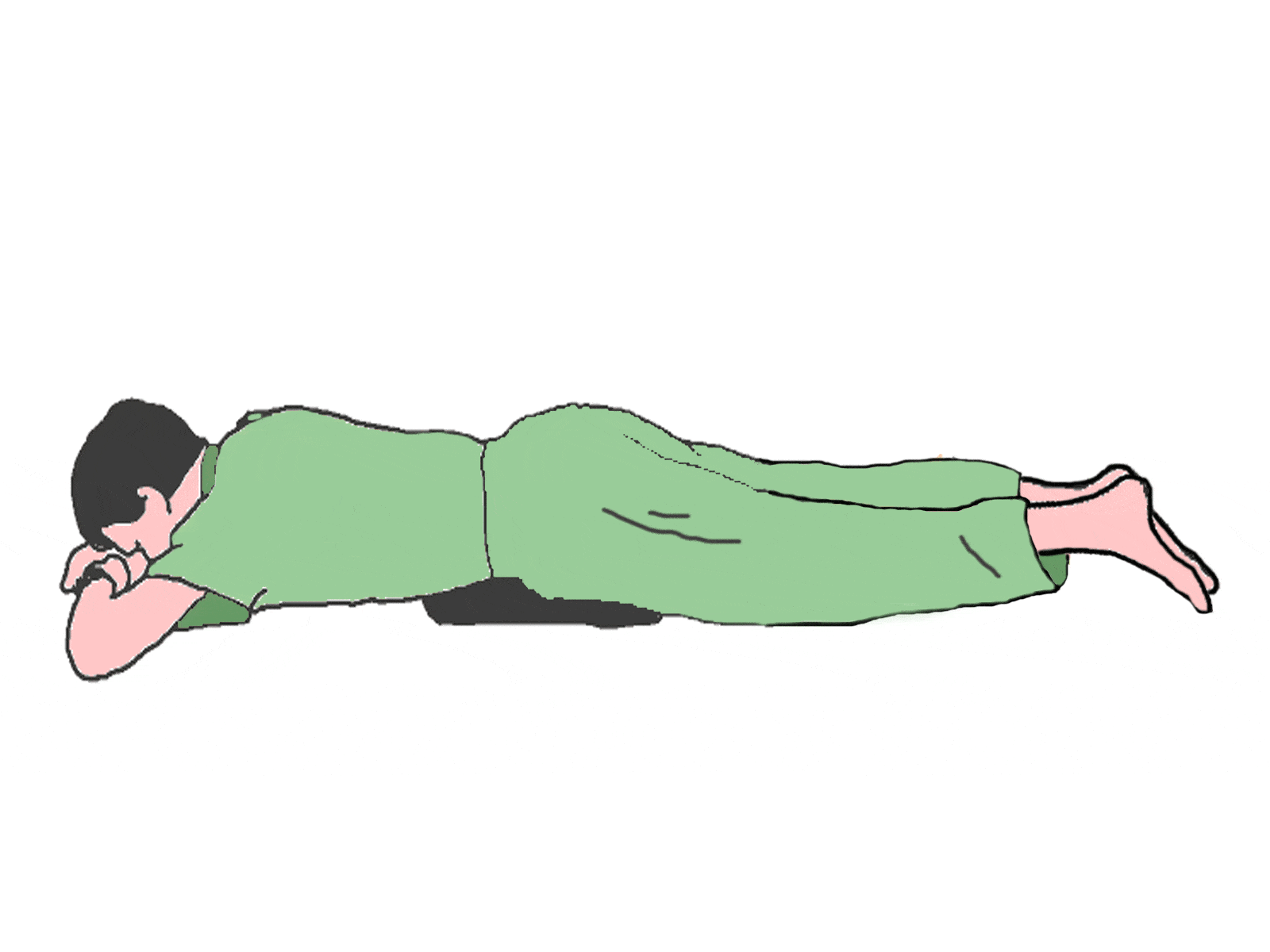
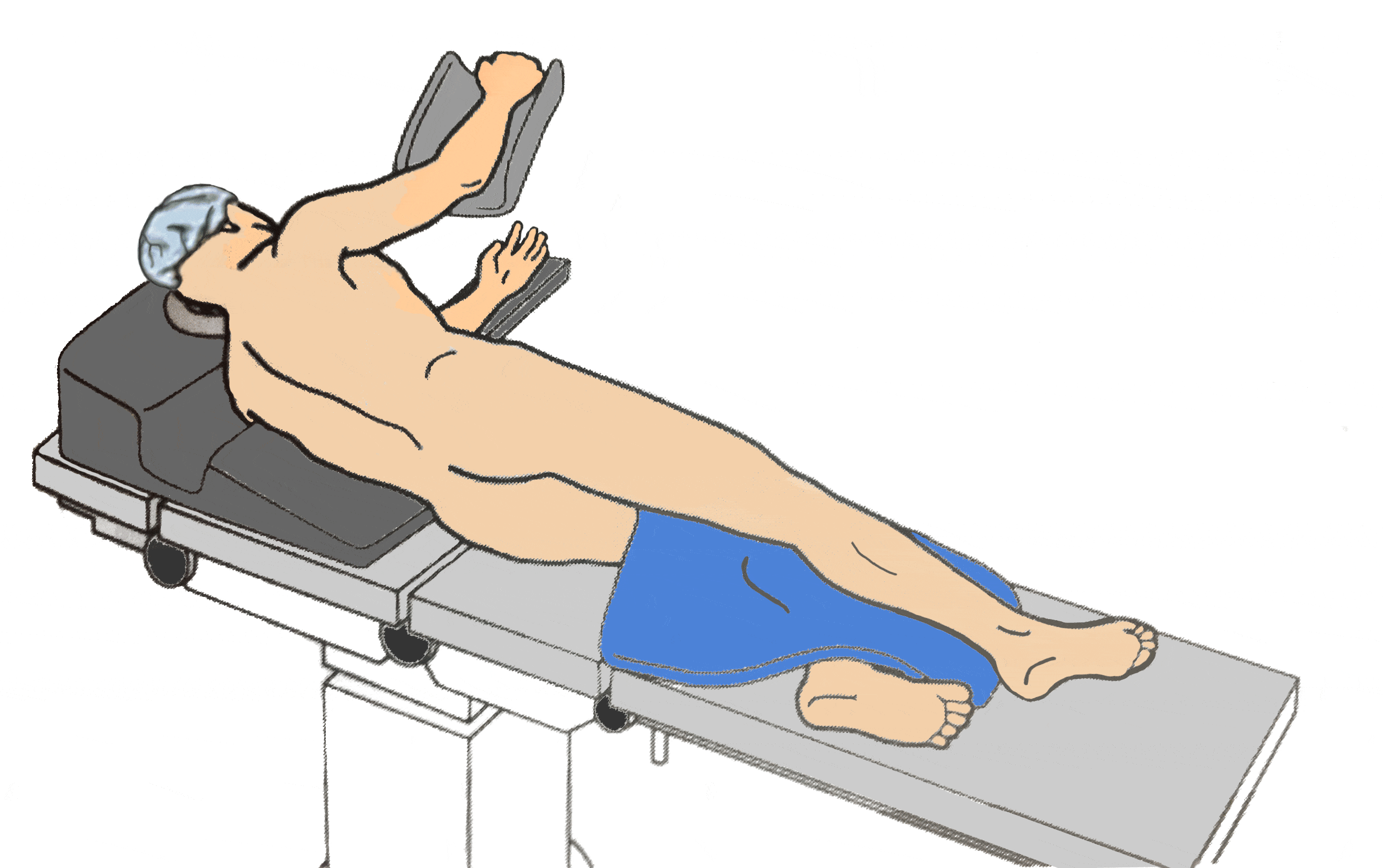
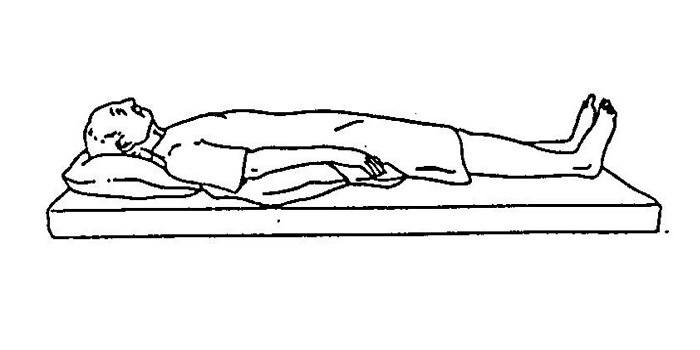
What is anatomical position?

a)
b)
c)
d)
61.

Rotation of hands so that palms are up

a)

Flexion

b)

Eversion

c)

Supination

d)

Pronation

62.

This term refers to the arm

a)

Brachial

b)

Carpal

c)

Clavicular

d)

Bilateral

63.

This term refers to the stomach region

a)

acromial

b)

abdominal

c)

ocular

d)

thoracic

64.

This term refers to the front of the elbow

a)

brachial

b)

cubital

c)

palmar

d)

acromial

65.

This term refers to the neck region

a)

geniculate

b)

carpal

c)

cervical

d)

unilateral

66.

This term refers to the wrist

a)

palmar

b)

carpal

c)

brachial

d)

cubital

67.

This term pertains to the sole of the foot

a)

plantar

b)

pubic

c)

femoral

d)

unilateral

68.

This term refers to the thigh region

a)

pelvic

b)

pubic

c)

plantar

d)

femoral

69.

This term pertains to the palm of the hand

a)

pedal

b)

plantar

c)

palmar

d)

pelvic

70.
Front of the knee
a)
Popiteal
b)
Patellar
c)
Plantar
d)
Cervical
71.
Heel Area
a)
Plantar
b)
Popiteal
c)
Patellar
d)
Calcaneal
72.
Head Region
a)
Acrominal
b)
Cephalic
c)
Cervical
d)
Occipital
73.
Area behind the knee
a)
Patellar
b)
Popiteal
c)
Cephalic
d)
Cervical
74.
Point of the shoulder
a)
Cephalic
b)
Calcaneal
c)
Deltoid
d)
Acrominal
75.
Lower posterior region of the head
a)
Cervical
b)
Occipital
c)
Popiteal
d)
Cephalic
76.
Ankle Area
a)
Plantar
b)
Tarsal
c)
Patellar
d)
Calcaneal
77.
Armpit
a)
Brachial
b)
Axillary
c)
Deltoid
d)
Acromila
78.
a)
Cephalic
b)
Oral
c)
Popiteal
d)
Axillary
79.

Thumb

a)

Carpal

b)

Pollex

c)

Digital

d)

Brachial

80.

Which of the following particles is described as the basic building block of matter?

a)

atoms

b)

compounds

c)

mixtures

d)

pure substances

e)

protons, neutrons, and electrons

81.

Which of the following subatomic particles are located in the nucleus of the atom?

a)

protons and neutrons

b)

protons only

c)

neutrons only

d)

electrons only

e)

protons, neutrons, and electrons

82.

Which of the following BEST describes the location of electrons within the atom?

a)

in an electron cloud around the nucleus

b)

in orbits around the nucleus

c)

outside of the nucleus

d)

in the nucleus

83.

The atomic number of iron (Fe) is 26. What does this tell you about an atom of iron?

a)

An atom of iron has 26 protons.

b)

The sum of protons and neutrons in an atom of iron is 26.

c)

An atom of iron has 26 neutrons.

d)

The sum of protons, neutrons, and electrons in an atom of iron is 26.

84.

Which of the following statements about the masses of subatomic particles is true?

a)

Electrons have very little mass compared to protons and neutrons.

b)

Protons, neutrons, and electrons all have about the same mass.

c)

Electrons have no mass.

d)

Neutrons have very little mass compared to electrons and protons.

e)

Protons and neutrons have very little mass compared to electrons.

85.

Which of the following subatomic particles is electrically neutral?

a)

neutrons

b)

protons

c)

electrons

86.

Which of the following subatomic particles is negatively charged?

a)

electrons

b)

protons

c)

neutrons

87.

if the first and second energy levels of an atom are full, then what would be the total number of electrons in the atom?

a)

6

b)

8

c)

10

d)

18

88.

Look at this picture of Argon off the periodic table. Which of the following is true for this element?

a)

18 protons

b)

40 protons

c)

22 protons

d)

21.9 protons

89.

Look at this picture of Argon off the periodic table. Which of the following is true for this element?

a)

18 neutrons

b)

40 neutrons

c)

22 neutrons

d)

21.9 neutrons

90.

Which part of an atom is used to identify it?

a)

number of protons

b)

number of neutrons

c)

number of electrons

91.

When you two atoms with different masses, Carbon-12 and Carbon-13 for example, what type of atom do you have?

a)

Neutral atom

b)

Ion

c)

Isotope

92.

When you two isotopes of an atom, Carbon-12 and Carbon-13 for example, what has changed in the atomic structure?

a)

Number of protons

b)

Number of neutrons

c)

Number of electrons

93.

The atomic mass of an atom is equal to

a)

number of protons plus number of neutrons

b)

number of protons plus number of electrons

c)

number of electrons plus the number of neutrons

94.

A substance that is formed as the result of a chemical reaction is a __________________

a)

Product

b)

Reactant

c)

Starters

d)

Enders

95.

What type of reaction involves the breaking down of a substance into simpler substances?

a)

Single Displacement Reaction

b)

Double Displacement Reaction

c)

Synthesis Reaction

d)

Decomposition Reaction

96.

What type of reaction involves 2 substances combining to form 1 new compound?

a)

Decomposition Reaction

b)

Single Displacement Reaction

c)

Double Displacement Reaction

d)

Synthesis Reaction

97.
Acids react with
a)
water to produce bases and salts
b)
salts to produce bases and water
c)
neither bases, salts nor water
d)
bases to produce salts and water
98.

A substance is found to have the following characteristics:


Very bitter taste

Feels slippery to the touch

Produces OH- ions when dissolved in water


In what category would the substance be classified?

a)

acid

b)

base

c)

enzyme

d)

fatty acid

99.
Releases hydrogen in an aqueous solution.
a)
base
b)
strong base
c)
acid
d)
weak base
100.
Which has a pH below 7?
a)
Acid
b)
Base
101.
Which of the following is most likely to be basic:
a)
Lemon juice
b)
Vinegar
c)
Laundry detergent
d)
Coke
102.
Tastes Sour
a)
Acids
b)
Bases
c)
Salts
d)
All
103.
Human blood has a pH between 7.35 and 7.45. Which of the following best describes human blood?
a)
strongly acidic
b)
slightly acidic
c)
strongly basic
d)
slightly basic
104.
Which of these pH values would indicate that a solution is a weak base?
a)
4
b)
5.6
c)
8
d)
13
105.
Water is the most abundant molecule found in living organisms.  Most mammals, in fact are approximately 70% water by weight.  About two-thirds of this water is present inside cells.  The other one-third is present outside cells (e.g., in blood plasma or other body fluids).  Why is water so important to cells?
a)
Water is stored in the cells to be used when the organism gets thirsty.
b)
Almost all the chemical reactions in life processes occur in solutions with water.
c)
Water determines which proteins are translated from the cellular DNA.
d)
The main structural component found in plasma membranes and cell walls is water.
106.
Nucleic acids are one of the four major macromolecules.  The main functions of nucleic acids are to
a)
store and transport energy and structural components in the cell.
b)
act as enzymes, cell signals, and structural support for the cell.
c)
carry genetic material and create structures inside the cell.
d)
aid in development, the immune system, and blood clotting.
107.
Protein molecules are composed of long chains of __________ .
a)
ribosomes
b)
RNA
c)
amino acids
d)
DNA
108.
Organic macromolecules called __________ are insoluble in water, are often found in biological membranes and other waterproof coverings, and have the ability to store energy for extended periods of time.
a)
carbohydrates
b)
lipids
c)
proteins
d)
nucleic acids
109.
Which reaction is responsible for the production of lipids, when glycerol is joined to three fatty acids?
a)
dehydration
b)
hydrolysis
c)
hydrophilic
d)
hydrophobic
110.
Examine the diagram of the enzyme:
How does the structure of this enzyme help with its function?
a)
The enzyme's shape complements the substrate's shape, so it only catalyzes specific reactions.
b)
The enzyme's active site is amorphous and can change its shape to fit any substrate.
c)
Since the enzyme's shape matches the substrate's shape, it catalyzes only reverse reactions.
d)
Since the enzyme is larger than the substrate, catalytic reactions can occur within the enzyme itself.
111.
Any factor that changes the shape of an enzyme can affect the enzyme's activity.  Which of the following two factors affect an enzyme's operation the most?
a)
blood glucose level and pH
b)
temperature and pH
c)
amount of light and temperature
d)
amount of light and pressure
112.
The attraction between hydrogen and oxygen atoms in different water molecules is known as a(n)
a)
ionic bond.
b)
hydrogen bond.
c)
covalent bond.
d)
dispersion force.
113.

What are the most common elements in the human body?

a)

Carbon

b)

Nitrogen

c)

Water

d)

Oxygen

e)

Hydrogen

114.
Proteins are made of monomers called ___________
a)
Nucleotides
b)
Monosaccharides
c)
Amino Acids
d)
Glycerol and fatty acids
115.
DNA and RNA are examples of 
a)
Carbohydrates
b)
Lipids
c)
Proteins
d)
Nucleic Acids
116.
DNA and RNA are examples of 
a)
Carbohydrates
b)
Lipids
c)
Proteins
d)
Nucleic Acids
117.
Nucleotides are monomers of
a)
Carbohydrates
b)
Lipids
c)
Proteins
d)
Nucleic Acids
118.
Monosaccharides are monomers of
a)
Carbohydrates
b)
Lipids
c)
Proteins
d)
Nucleic Acids
119.
Waxes, oils and fats are examples of
a)
Carbohydrates
b)
Lipids
c)
Proteins
d)
Nucleic Acids
120.
Which of the following organic compounds is the main source of energy for living things?
a)
carbohydrates
b)
lipids
c)
nucleic acids
d)
proteins
121.
Which macromolecule stores energy, insulates us, and makes up the cell membrane?
a)
lipids
b)
proteins
c)
carbohydrates
d)
nucleic acids
122.
Lipids can be digested into what smaller subunits?
a)
nucleic acids
b)
amino acids
c)
fatty acids
d)
glucose
123.
All polymers are made up of...
a)
monosaccharides
b)
monomers
c)
proteins
d)
None of these
124.
All organic compounds contain the element
a)
carbon
b)
nitrogen
c)
phosphorus
d)
sulfur
125.
Building blocks of the body, hair , muscles etc.
a)
protein
b)
nucleic acid
c)
lipids
d)
carbohydrates
126.
Enzymes are..
a)
nucleic acids 
b)
carbohydrates 
c)
lipids 
d)
proteins 
127.
How many sugar units make up polysaccharides?
a)
one
b)
two
c)
more than two
d)
zero
128.
Cell organelles that are responsible for digesting food, worn out organelles and other cellular wastes are called ___________________.
a)
Mitochondria
b)
Vacuoles
c)
Lysosomes
d)
Chlororplasts
129.
All cells need energy to function.  Which cell organelle is responsible for producing energy in the cell?
a)
chloroplasts
b)
mitochondria
c)
nucleus
d)
vacuoles
130.
What type of cell has a nucleus? 
a)
eukaryotic
b)
prokaryotic 
131.
control, read, and direct the cell using DNA instructions
a)
nucleus
b)
mitochondria
c)
endoplasmic reticulum
d)
lysosome
132.
Controls what enters/leaves a cell
a)
cell membrane
b)
Nuclear membrane
c)
cell wall
d)
cytoplasm
133.
Amino acids link together to form proteins. In which organelle would this process occur?
a)
Lysosome
b)
Ribosome
c)
Centriole
d)
Mitochondria
134.
packages proteins for delivery
a)
Endoplasmic reticulum
b)
ribosomes
c)
golgi apparatus
d)
lysosomes
135.
jello-like material, fills the space between cell organelles, is where many chemical reactions occur
a)
cytoplasm
b)
chromatin
c)
chloroplast
d)
cell membrane
136.
Transportation network for the cell, moves materials around in the cell
a)
Lysosome
b)
Nuclear Membrane
c)
Endoplasmic Reticulum
d)
Centriole
137.

Diffusion is the movement of particles from

a)

an area of equilibrium to an area of high concentration.

b)

an area of low concentration to an area of high concentration.

c)

an area of high concentration to an area of low concentration.

d)

all of the answers describe what occurs in diffusion.

138.

Osmosis is the movement of ________ across a semi-permeable membrane.

a)

food

b)

energy (ATP)

c)

oxygen

d)

water

139.

Which is an example of osmosis?

a)

water moving into the root cells of a plant

b)

carbon dioxide moving into the leaf of a plant cell

c)

oxygen moving into the bloodstream from the lungs

d)

potassium ions moving in and out of an animal cell

140.

In a nerve cell, ATP energy is used to pump sodium (Na) out of the cell and potassium (K) into the cell. This is an example of...

a)

Diffusion

b)

Active Transport

c)

Osmosis

141.

Active Transport uses energy in the form of-

a)

Glucose

b)

ATP

c)

Sodium

d)

DNA

142.
Osmosis is the movement of _____ across a membrane.
a)
food
b)
energy
c)
oxygen
d)
water
143.
 If a cell containing 5% salt is placed into a glass of water with 20% salt, the water is _______ compared to the cell.
a)
hypertonic
b)
hypotonic
c)
isotonic
144.
 An animal cell placed in a hypertonic (salty) solution will
a)
Stay the same
b)
Shrink- get smaller
c)
Swell- get bigger
145.
In this given scenario, corn syrup is hypertonic to an egg with a dissolved shell. What will happen to the egg when it is place in corn syrup?
a)
It will stay the same.
b)
It will swell- get bigger.
c)
It will shrink- get smaller.
146.
Vegetables are often sprayed with water in grocery stores.
What will happen to the cells? They will -
a)
undergo plasmolysis
b)
increase in turgor pressure
c)
crenate
d)
become hypotonic
147.

Passive Transport uses ____ energy

a)

no

b)

a lot of

c)

a little bit of

d)

some

148.

In which part of Interphase are the chromosomes replicated?

a)

G0

b)

G1

c)

S

d)

G2

149.

During which stage of the cell cycle does the nucleus divide?

a)

interphase

b)

mitosis

c)

endocytosis

d)

cytokinesis

150.

In which stage of the cell cycle does the cell split into two?

a)

Mitosis

b)

G1

c)

Cytokinesis

d)

S

151.

_____ is the uncontrolled growth of cells, often resulting in a tumor or mass of abnormal cells

a)

Cancer

b)

Apoptosis

c)

Radiation

152.

Apoptosis is

a)

programmed cell death

b)

mysterious cell death

c)

programmed cellular mutation

d)

mysterious cellular mutation

153.
Put the following actions in order: DNA replicates, cell grows, cell divides, cell prepares for mitosis. 
a)
DNA replicates, cell grows, cell prepares for mitosis, cell divides
b)
cell grows, cell prepares for mitosis, DNA replicates, cell divides
c)
cell grows, DNA replicates, cell prepares for mitosis, cell divides
d)
DNA replicates, cell prepares for mitosis, cell grows, cell divides
154.
What is the cell cycle?
a)
The gradual development of something, especially from a simple to a more complex form.
b)
The study of heredity and the variation of inherited characteristics.
c)
The branch of biology that deals with the relations of organisms to one another and to their physical surroundings.
d)
The series of events that take place in a cell leading to its division and duplication of its DNA to produce two daughter cells.
155.
Which part of the Cell Cycle takes the longest?
a)
Interphase
b)
Mitosis
c)
Prophase
d)
Cytokinesis
156.
What happens in the first part of Interphase?
a)
Mitosis
b)
Cell Growth
c)
DNA Replication
d)
Anaphase
157.
What does DNA Replication mean?
a)
DNA is made.
b)
DNA makes new cells. 
c)
DNA copies itself.
d)
DNA starts the cell cycle.
158.
What phase is this cell in?
a)
Cytokinesis
b)
Mitosis
c)
Prophase
d)
Metaphase
159.
What phase is this cell in?
a)
Mitosis
b)
Interphase
c)
Anaphase
d)
Telophase
160.
What phase is this cell in?
a)
Mitosis
b)
Cytokinesis
c)
Prophase
d)
Telophase
161.
What phase is this cell in?
a)
Mitosis
b)
Interphase
c)
Prophase
d)
Telophase
162.
What part of the cell cycle is this cell in?
a)
Mitosis
b)
Interphase
c)
Telophase
d)
Cytokinesis
163.

Which molecules act as gatekeepers for each checkpoint of the cell cycle?

a)

p53 gene

b)

cyclins and cycline-dependent kinases

c)

thyroid hormones

164.

What is the purpose the the cell cycle checkpoints?

a)

To repair damaged cells before they enter cell division.

b)

To remove damaged cells from an organism.

165.

The type of metabolic pathway where polymers are built and requires energy is

a)

an enzymatic response

b)

anabolic

c)

catabolic

d)

catatonic

166.

The reaction where glucose is broken down and used by cells that require oxygen is called

a)

photosynthesis

b)

respiration

c)

fermentation

d)

lactic acid

167.
What are the reactants of cellular respiration?
a)
glucose & carbon dioxide
b)
glucose & oxygen
c)
water & oxygen
d)
water & carbon dioxide
168.
The purpose of cellular respiration is to 
a)
make water
b)
make ATP
c)
make glucose
d)
make  oxygen
169.
What is the correct equation for cellular respiration?
a)
6O2 + C6H12O6 -> 6CO2 + 6H2O + Energy
b)
6O2 + C6H12O6 + Energy -> 6CO2 + 6H2O
c)
6CO2 + 6H2O -> 6O2 + C6H12O6 + Energy
d)
6CO2 + 6H2O + Energy -> 6O2 + C6H12O6
170.
If oxygen is not present what process will occur in yeast cells?
a)
Alcoholic fermentation
b)
Respiration
c)
Photosynthesis
d)
Lactic acid fermentation
171.
What does metabolism mean?
a)
Converting energy into food
b)
Making light reactions happen
c)
Converting food into energy
172.

Which of these is a product of cellular respiration?

a)

ATP

b)

Carbon dioxide

c)

Water

d)

All of these are a product of cellular respiration

173.
In cellular respiration, the electron transport chain takes place in
a)
the membrane of the mitochondrion
b)
the folds of the mitochondrion
c)
the cytoplasm
d)
the cell nucleus
174.
When glycolysis occurs,
a)
a molecule of glucose is split
b)
two pyruvate are made
c)
some ATP is produced
d)
all of these
175.
Cells produce ATP most efficiently in the presence of
a)
water
b)
carbon dioxide
c)
oxygen
d)
radiant energy