wayground logo

Free Printable Worksheets

NEW

Font size

S
M
L
XL
Worksheets

Science Year 5 Food Chain and Food Web Revision

Total questions: 57

Worksheet time: 54mins

Name
Class
Date
1.
What is a producer? 
a)
Organism that creates their own food.
b)
Organism that eat other organisms for energy
c)
Organism that eat other dead organisms
2.
What is a consumer? 
a)
Organism that creates their own food.
b)
Organism that eat other organisms for energy
c)
Organism that eat other dead organisms
3.
What do Omnivores eat? 
a)
Plants ONLY 
b)
Animals ONLY
c)
Plants AND Animals
4.
What do Herbivores eat? 
a)
Plants ONLY 
b)
Animals ONLY
c)
Plants AND Animals
5.
What do Carnivores eat? 
a)
Plants ONLY 
b)
Animals ONLY
c)
Plants AND Animals
6.
What animal is on the top of the food chain? 
*Remember Humans are on the top of all food chains because we do not get hunted. 
a)
Grass
b)
Grasshopper
c)
Mouse
d)
Owl
7.
Who does the owl get energy from? 
a)
Grass
b)
Grasshopper
c)
Mouse
d)
Ow
8.
Who does the owl get energy from? 
a)
Grass
b)
Grasshopper
c)
Mouse
d)
Ow
9.
Who is the producer in this food chain? 
a)
Grass
b)
Grasshopper
c)
Mouse
d)
Ow
10.
Who does the grasshopper get energy from? 
a)
Grass
b)
Grasshopper
c)
Mouse
d)
Ow
11.

Producers are:

a)

animals

b)

rocks

c)

plants

12.

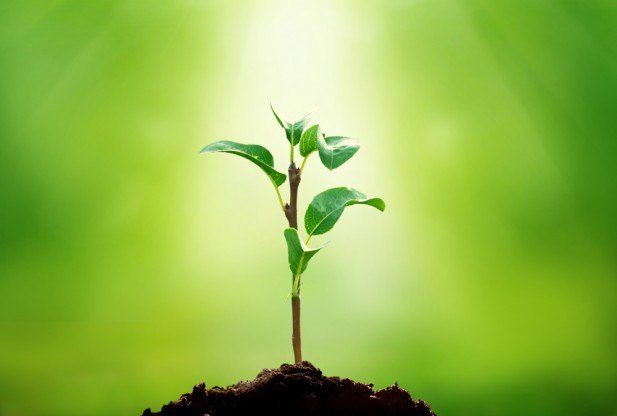
Plants are called producers because they can produce their own:

a)

music

b)

food

c)

air

13.
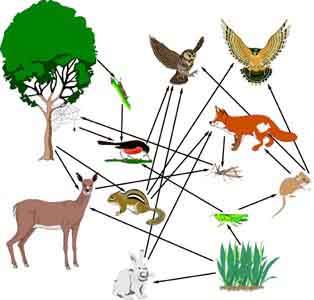
What is this called?
a)
Food Web
b)
Food Chain
c)
Abiotic Factors
14.
An organism that lives by breaking apart dead organic matter into simpler parts is...
a)
scavenger
b)
consumer
c)
decomposer
d)
carnivore
15.
An animal that eats other animals is a....
a)
carnivore
b)
omnivore
c)
herbivore
d)
decomposer
16.
All energy transformations in an ecosystem begin with
a)
a scavenger
b)
the sun
c)
a decomposer
d)
a herbivore
17.
a deer population has significantly increased, the best hypothesis is 
a)
the deer's main predator has been eliminated
b)
competition increased
c)
decreased water levels of local ponds
d)
organisms that rely on similar food sources migrated to the area
18.
Which event is the best example of competition between species in a pond?
a)
dragonflies landing on lily pads
b)
lizards and snakes lying in the sun
c)
hawks eating mice
d)
frogs and toads eating flies
19.

Birds eat insects off the skin of cows. If the relationship is a type of mutualism, then the organisms that will benefit are

a)

only the cattle

b)

neither the birds or the cattle

c)

both the birds and the cattle

d)

only the birds

20.
What does every food chain start with?
a)
producers
b)
sun
c)
consumer
d)
decomposers
21.
Consumer that eats plants
a)
heterotroph
b)
herbivore
c)
producer
d)
community
22.
Energy increases as you move up the food pyramid (from bottom to top).
a)
True 
b)
False
23.
A connection of food chains with many food energy paths in an ecosystem is a ____________
a)
ecosystem
b)
food web
c)
environment
24.

A web showing connections between food chains in a ecosystem -

a)

food chain

b)

food web

c)

habitat

d)

ecosystem

25.

Makes food from dead organisms -

a)

decomposer

b)

producer

c)

consumer

d)

herbivore

26.

A chain that connects how the energy of organisms is transferred when eaten -

a)

food chain

b)

food web

c)

ecosystem

d)

energy movement

27.
The arrows in a food chain or web represents what?
a)
They point to the organism that is being eaten.
b)
It shows how sunlight flows within an ecosystem.
c)
They show what direction the energy is flowing between organisms. 
d)
They represent how water is transferred within a habitat.
28.
What does a food web represent?
a)
All connections of energy flow throughout all organisms in a habitat.
b)
The specific ways that mutualism is carried out.
c)
A single pathway or energy flow between organisms. 
d)
How carnivores get their food. 
29.
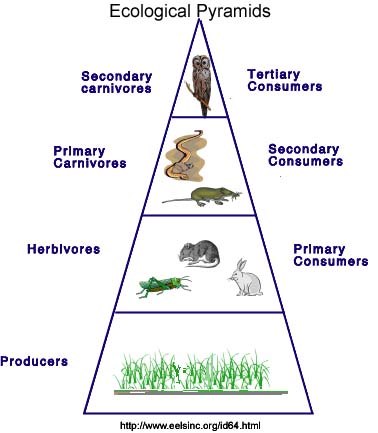
An energy pyramid represents what?
a)
How much sunlight is available for the ecosystem to use. 
b)
How much energy a particular organism needs. 
c)
How much energy is needed to build a pyramid. 
d)
The amount of energy available to the next 'feeder' in a food web.
30.
The largest group of organisms found in a food web would be:
a)
Primary Consumers
b)
Producers
c)
Decomposers
d)
Tertiary Consumers
31.
Which of the following animals are herbivores?
Antara haiwan yang berikut, yang manakah adalah herbivor?

I Goat
  Kambing

II Bear
   Beruang

III Lion
    Singa

IV Squirrel
    Tupai
a)
I and II
I dan II
b)
I and IV
I dan IV
c)
II and III
II dan III
d)
III and IV
III dan IV
32.
Which of the following animals can be used to represent P?
Antara haiwan yang berikut, yang manakah boleh digunakan untuk mewakili P?

   
I Frog
  Katak

II Bird
   Burung

III Goat
    Kambing

IV Rabbit
     Arnab
a)
I and II
I dan II
b)
I and III
I dan III
c)
II and IV
d)
III and IV
III dan IV
33.
Which statement is true about omnivores?
Pernyataan manakah yang benar tentang omnivor?
a)
Animals that only eat one specific type of animals
Haiwan yang hanya memakan sejenis haiwan tertentu sahaja
b)
Animals that only eat one specific type of plants
Haiwan yang hanya memakan sejenis tumbuhan tertentu sahaja
c)
Animals that eat both plants and animals
Haiwan yang memakan kedua-dua tumbuhan dan haiwan
d)
Animals that only eat other animals
Haiwan yang hanya memakan haiwan lain sahaja
34.
Which of the following animals are carnivores?
Antara haiwan yang berikut, yang manakah adalah karnivor?

   
I Tiger
  Harimau

 II Eagle
    Helang

 III Rabbit
     Arnab

 IV Chicken
      Ayam
a)
I and II
I dan II
b)
I and IV
I dan IV
c)
II and III
II dan III
d)
III and IV
III dan IV
35.
Which of the following will happen to the food chain if the number of frog increases excessively?
Antara yang berikut, yang manakah akan berlaku kepada rantai makanan jika bilangan katak bertambah dengan banyaknya?

   I The number of caterpillar increases
     Bilangan beluncas meningkat

 II The number of snake increases
    Bilangan ular meningkat

 III The number of grass increases
     Bilangan rumput meningkat

 IV The number of grass decreases
     Bilangan rumput menurun
a)
I and II
I dan II
b)
I and IV
I dan IV
c)
II and III
II dan III
d)
III and IV
III dan IV
36.
Which of the following is the herbivore?
Antara yang berikut, yang manakah ialah herbivor?
a)
P
b)
Q
c)
R
d)
S
37.
Which of the following is a correct food chains?
Antara yang berikut, yang manakah ialah rantai makanan yang betul?
a)
Q → P R S
b)
Q → S P R
c)
R → P Q S
d)
S → Q R P
38.
Which of the following animals are herbivores?
Antara haiwan yang berikut, yang manakah adalah herbivor?

   
I Crocodile
  Buaya

II Duck
   Itik

 
III Elephant
    Gajah

IV Rabbit
    Arnab
a)
I and II
I dan II
b)
I and III
I dan III
c)
II and IV
II dan IV
d)
III and IV
III dan IV
39.
Which of the following arrangement is the correct food chain?
Antara susunan yang berikut, yang manakah ialah rantai makanan yang betul?
a)
R → P Q S
b)
Q → R P S
c)
P → Q R S
d)
Q → P R S
40.
All energy on Earth ultimately comes from what source?
a)
Water
b)
Sun
c)
Consumers
d)
Oxygen
41.
What does a food chain represent?
a)
How all living organisms within a habitat are connected.
b)
All of the things that a particular animal eats.
c)
How plants create their own food.
d)
A single path of energy transfer within a habitat.
42.
What does a food web represent?
a)
All connections of energy flow throughout all organisms in a habitat.
b)
The specific ways that mutualism is carried out.
c)
A single pathway or energy flow between organisms. 
d)
How carnivores get their food. 
43.

Why might an organism have more than one arrow coming from them in a food web?

a)

More than one organism may eat them.

b)

They may eat more than one other organism.

c)

This organism gets its energy from multiple sources.

44.
The largest group of organisms found in a food web would be:
a)
Primary Consumers
b)
Producers
c)
Decomposers
d)
Tertiary Consumers
45.
The shrew provides energy for the _______?
a)
cricket
b)
grasshopper
c)
frog
d)
snake
46.
What is this called?
a)
Food Web
b)
Food Chain
c)
Abiotic Factors
47.
If a frog is the prey, what could be the predator?
a)
Grass
b)
Insect
c)
Snake
d)
Snail
48.
Where does the energy start in this food chain?
a)
Plant
b)
Sun
c)
Deer
d)
Wolf
49.
An animal that eats other animals is a....
a)
carnivore
b)
omnivore
c)
herbivore
d)
decomposer
50.
What is missing from this food chain?
Grass > Grasshopper > Bird > Snake
a)
Producer
b)
Primary Consumer
c)
Secondary Consumer
d)
Decomposer
51.
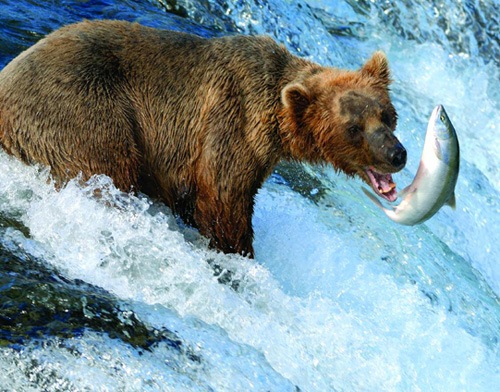
Bears eat fish, insects, plants, seeds, nuts and young elk. They are called __________.
a)
Franivore
b)
Carnivore
c)
Herbivore
d)
Omnivore
52.
Which organism recieves the least amount of energy from the producer?
a)
Owl
b)
Grasshopper
c)
Lilypad
d)
Mouse
53.
An organism that needs to eat other organisms to obtain energy is known as a:
a)
Autotroph
b)
Producer
c)
Consumer
d)
Mutualist
54.
An organism that uses sunlight to create its own food is known as a:
a)
Producer
b)
Heterotroph
c)
Consumer
d)
Decomposer
55.
Which of the following would be the most likely effect, if there were a sudden increase in the cricket population?
a)
There would be a decrease in the small bird population.
b)
There would be a decrease in the grass/flowers population.
c)
There would be a decrease in the mice population.
d)
There would be an increase in the grass/flowers population.
56.
How many carnivores are shown in this food web?
a)
6
b)
4
c)
5
d)
3
57.

In the food web shown, who is the secondary consumer?

a)

grass

b)

mouse

c)

rabbit

d)

fox