
 Worksheets
Quadratic Formula Practice
Total questions: 40
Worksheet time: 58mins
y = x2 +5x +7, match each leading coefficient with its correct letter
If the discriminant equals zero, the quadratic has how many solutions?
2 real
2 complex
1 real
1 complex
0 real
If the discriminant equals +35, the quadratic has how many solutions?
2 real
2 complex
1 real
1 complex
0 real
If the discriminant equals -72, the quadratic has how many solutions?
2 real
2 complex
1 real
1 complex
0 real

For the function above, is the discriminant positive, negative, or zero?

Which graph has a discriminant > 0?
None of them
Red
Blue
Green

For the function above, is the discriminant positive, negative, or zero?
Solve by the Quadratic Formula:
−12q2+3q+7=0
24−3±345
−243±345
243±345
243±i39
a, b, and c for
the quadratic equation:
4x2 – 8x = 3
*remember right side should =0
2p2 - 2p - 55 = 5
x2 + 6x - 13 = 3
For the function below, is the discriminant positive, negative, or zero?
___________
y = x² + 4x + 4
Positive
Negative
Zero
Not Sure
What is the discriminant of -2x2 − x − 1 = 0
76
-7
9
none of these
What is the discriminant of 6x2 − 2x − 3 = 0
76
29
68
none of these
x2 + 7x + 13
Remember: b2 - 4ac
What is the discriminant of this equation?
3x2 + 8x = 0
64
52
9
0
1 What does the discriminant tell us?
The maximum or minimum
The y-intercept
The number and type of solutions
The axis of symmetry
What is the discriminant of 6x2 − 2x − 3 = 0
76
29
68
none of these


a, b, and c for
the quadratic equation:
4x2 – 8x = 3
Which of the following is Standard Form?
y=ax2+bx+c
y=a(x−p)(x−q)
y=a(x−h)2+k
Which of the following is Vertex Form?
y=ax2+bx+c
y=a(x−p)(x−q)
y=a(x−h)2+k
What is an equation of a parabola with the vertex of (−2,−4) ?
y=−(x+2)2−4
y=23(x−2)2+4
y=23(x−2)2−4
y=(x+2)2+4
What is an equation of a parabola with the vertex of (4,9) ?
y=−54(x+4)2−9
y=43(x−4)2+9
y=−25(x−4)2−9
y=(x+4)2+9
What is an equation of a parabola with the vertex of (3,−4) ?
y=−21(x+3)2−4
y=2(x−3)2+4
y=23(x−3)2−4
y=(x+3)2+4
y=8(x−2)(x+3) What are the zeros (x-intercepts) of the equation
(2,0) and (3,0)
(−2,0) and (3,0)
(2,0) and (−3,0)
(−2,0) and (−3,0)
y=41(x+5)(x−6) What are the zeros (x-intercepts) of the equation
(5,0) and (6,0)
(−5,0) and (6,0)
(5,0) and (−6,0)
(−5,0) and (−6,0)

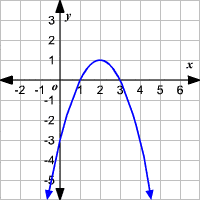
How many solutions are there?
0
1
2
Cannot be determined
What is the axis of symmetry?
x= 4
x=3
x=-3
Cannot be determined

What is the axis of symmetry?
x=0
x=1
x=2
x=3

