wayground logo

Free Printable Worksheets

Font size

S
M
L
XL
Worksheets

Unit 6: All about genes

Total questions: 72

Worksheet time: 4hrs 24mins
Name
Class
Date
1.
Most gene regulation happens at which step along the way?
a)
translation
b)
transcription
c)
signal transduction
d)
DNA replication
2.
what does a promoter do?
a)
it allows a gene to be transcribed
b)
it creates a DNA segment
c)
it is another word for ribosomes
d)
it is another word for RNA
3.
A protein that binds to the operator and blocks the RNA polymerase
a)
regulator
b)
repressor
c)
activator
d)
corepressor
4.
In the lac operon model the genes within the operon will be expressed if:
a)
lactose is absent in the cell
b)
glucose is present in the cell
c)
lactose is present in the cell
5.
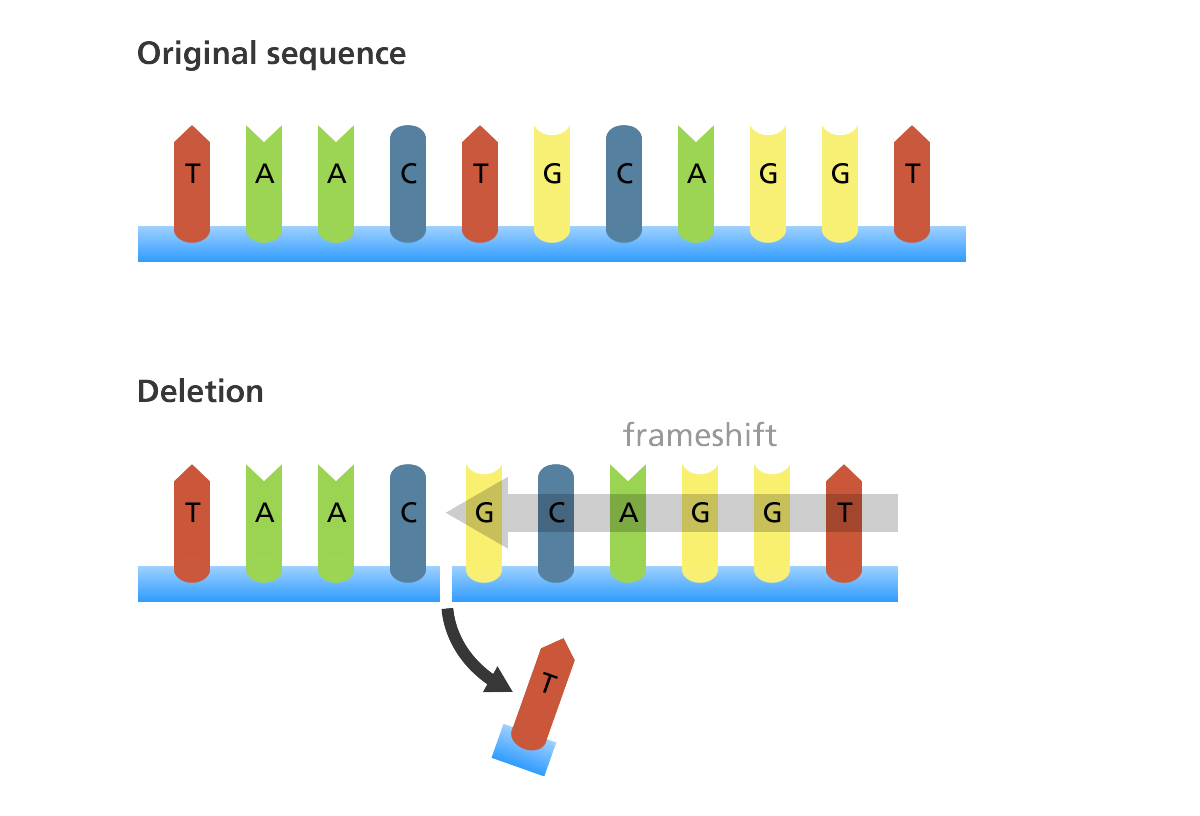
Why are insertion and deletion mutations so harmful?
a)
They change all of the codons from the mutation on down the line, which changes the amino acid sequence
b)
They insert things that an organism doesn't need.
c)
They often delete things that organisms need.
d)
Insertion and deletions are not any more harmful than substitution mutations.
6.
Identify the SUBSTITUTION mutation from the following DNA sequence: 
ATG CCA AAT
a)
ATG TCA AAT
b)
ATG CCT AAA T
c)
ATC CA  AT
d)
ATG CCA AAT
7.
In eukaryotes, proteins that help the RNA polymerase bind to the regulatory region for transcription are called ____________.
a)
transcription factors
b)
topoisomerase
c)
regulatory genes
d)
activators
8.
What is the name given to part of a DNA molecule that codes for a protein?
a)
Glucose
b)
Chromosome
c)
Gene
d)
Phosphate
9.
What does the lactose do to the Operon? 
a)
Blocks transcription because of the energy it provides
b)
Allows the repressor to be unbind from the Operator.
c)
The lactose binds the lactose and stops transcription
d)
Allows for the transcription to speed
10.
Which of the following statements regarding mRNA is correct?
a)
Exons are included in the protein sequence, while introns are left out
b)
Introns are included in the protein sequence, while exons are left out
c)
Exons and Introns can both be included or left out depending on the protein
d)
Exons and Introns are both part of the mRNA sequence, but only exons are part of the rRNA and tRNA
11.
How can a person's muscle cells have the same exact DNA sequences as their nerve cells even though the look and perform completely different?
a)
The two different cells become mutated
b)
The proteins expressed in each cell are different
c)
They actually have different DNA in the two types of cells.
d)
The genome of the different cells changes
12.
What is the role of operons in prokaryote gene expression?
a)
It makes the genes prokaryotes be turned on
b)
It accounts for the regulation of gene activity in response to the needs of the cells
c)
To make DNA for the gene
d)
To make the gene turn of and off
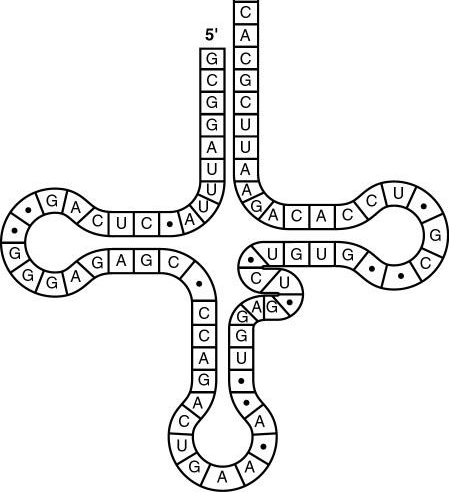
13.
What structure of this molecule binds with the mRNA molecule?
a)
Amino Acid
b)
tRNA
c)
Anticodon
d)
Codon
14.

The "on/off" switch for an operon is called the

a)

promoter

b)

enhancer

c)

operator

d)

gene

15.
A small molecule that binds to the repressor and makes it inactive is
a)
corepressor
b)
inducer
c)
promoter
d)
operator
16.

The tryptophan operon is

a)

permanently turned on.

b)

turned on when tryptophan is present in the growth medium.

c)

turned off only when glucose is present in the growth medium.

d)

turned off when tryptophan is added to the growth medium.

17.

The lac operon is referred to as a(n) __________ operon.

a)

inducible

b)

repressible

c)

audible

d)

inaudible

18.
Viruses are...
a)
prokaryotic
b)
eukaryotic
c)
non-living
d)
endospores
19.
Needs host cell to reproduce.
a)
Virus
b)
Bacteria
c)
Fungus
d)
Protozoan
20.
How does a virus cause a person to develop the common cold?
a)
invades the host cell to reproduce
b)
removes energy from the host cell
c)
produces toxins in the host cell
d)
protects the host cell from bacteria
21.
When a virus invades a living cell, its _______
takes over the cell's functions.
a)
outer coat
b)
genetic material
c)
core
d)
cytoplasm
22.
One reason that viruses are considered to be nonliving is that they are not made of ______.
a)
protein
b)
viruses
c)
bacteria
d)
cells
23.
What do viruses have in common with living cells? They both...
a)
store genetic information
b)
have chloroplasts
c)
use glucose for cellular respiration
d)
have endoplasmic reticulum
24.
What part of the phage is the DNA?
a)
A
b)
B
c)
C
d)
D
25.
What do viruses need to reproduce?
a)
they need genetic material
b)
They need a host cell
c)
They need  bacteria
d)
They need insulin
26.
Antibiotics kill viruses
a)
True
b)
False
27.
How could you describe the size of a virus?
a)
Smaller than bacteria
b)
Larger than a parasite
c)
About the size of a dime
d)
Smaller than a proton
28.
What part of the virus is number 2?
a)
Capsid
b)
DNA
c)
Surface Markers
d)
Envelope
29.
What part of the virus is number 1?
a)
Capsid
b)
DNA
c)
Surface Markers
d)
Envelope
30.
What part of the virus is number 4?
a)
Capsid
b)
DNA
c)
Surface Markers
d)
Envelope
31.
What part of the virus is number 3?
a)
Capsid
b)
DNA
c)
Surface Markers
d)
Envelope
32.
If an mRNA molecule has introns and exons in it, where is it?
a)
At a ribosome
b)
In the nucleus
c)
In a prokaryotic cell
d)
could be in the nucleus or the ribosome
33.
_______ is to transcription as ________ is to translation.
a)
mRNA / Amino Acid Chain
b)
Amino Acid Chain / mRNA
c)
Ribosome / Nucleus
d)
mRNA / tRNA
34.

Operons are found in which of the following organisms?

a)

Bacteria(prokaryotes)

b)

plants and animals(eukaryotes)

c)

only animals

d)

virsuses

35.

The lac operon genes only become expressed if:

a)

lactose binds to repressor

b)

glucose binds to repressor

c)

repressor binds to operator

d)

lactose binds to operator

36.

Regulatory proteins (transcription factors) may

a)

encourage transcription

b)

prevent transcription

c)

stop transcription once its started

d)

either encourage or prevent transcription

37.

What is 1 in the diagram?

a)

RNA polymerase

b)

Inducer

c)

Repressor

d)

Operator

38.

What is 2 in the diagram?

a)

RNA polymerase

b)

Inducer

c)

Repressor

d)

Operator

39.

In the top picture the operon is

a)

on

b)

off

40.

What type of operon is the trp (tryptophan) operon?

a)

inducible

b)

repressible

c)

positive control

d)

promotor

41.
The central dogma of biology states that information flows in one direction from 
a)
nuclei to RNA to cytoplasm
b)
ribosomes to proteins to DNA
c)
genes to nuclei to ribosomes
d)
DNA to RNA to proteins
42.
Choose the nucleotide sequence of the RNA strand that would be complementary to the following strand: 
GTAGTCA
a)
UATUAGA
b)
ACGACTG
c)
CAUCAGU
d)
CATCAGT
43.
The main function of tRNA is to...
a)
carry a message that, when translated, forms proteins
b)
form a portion of ribosomes
c)
string together complementary RNA and DNA strands
d)
bring amino acids from the cytoplasm to the ribosomes
44.
Which of the following events occurs directly after RNA polymerase recognizes a gene?
a)
The polymerase strings amino acids into a polypeptide
b)
Free-floating nucleotides pair up with exposed DNA bases
c)
A complementary RNA strand detaches itself from the DNA
d)
The DNA strand begins to unwind, separating the two strands
45.
What is the term for a three-nucleotide sequence that codes for an amino acid?
a)
base
b)
codon
c)
amine
d)
serine
46.
Which phrase best describes translation?
a)
converts mRNA into a polypeptide
b)
catalyzes bonds between amino acids
c)
produces RNA from DNA molecules
d)
recycles tRNA molecules for reuse
47.
Which of the following is the site of transcription?
a)
vacuole
b)
lysosome
c)
nucleus
d)
ribosome
48.
Which of the following is the site of translation?
a)
vacuole
b)
lysosome
c)
nucleus
d)
ribosome
49.
Which of the following is created in the nucleus and carries the genetic code to the cytoplasm?
a)
DNA
b)
tRNA
c)
mRNA
d)
rRNA
50.
What would happen if we did not have start codons?
a)
Polypeptide chains would continue to grow
b)
Amino acids would bind to tRNA
c)
Protein synthesis wouldn't occur
d)
mRNA would form a double strand
51.

Which of the following are differences in the structure between RNA and DNA

a)

DNA uses deoxyribose sugar, RNA uses sugar ribose

b)

DNA pairs Adenine with Uracil, RNA pairs Adenine with Thymine

c)

DNA is a double helix, RNA is a single helix

d)

DNA pairs Adenine with Thymine, RNA pairs Adenine with Uracil

52.

When these bond together, they form a protein

a)

Amino Acids

b)

Peptide Bonds

c)

Ribose

d)

Nucleotides

53.

During translation, this type of ribonucleic acid is responsible for delivering amino acids to help make a protein.

a)

mRNA

b)

rRNA

c)

tRNA

d)

dRNA

54.

There are a total of ____ different amino acids

a)

20

b)

1

c)

4

d)

unlimited

55.
This is the triplet of bases on the end of a tRNA molecule
a)
Anticodon
b)
Codon
c)
Protein
56.
Which of these nitrogenous bases is NOT in RNA?
a)
Uracil
b)
Thymine
c)
Cytosine
d)
Guanine
57.
In RNA, Uracil pairs with ______. 
a)
cytosine
b)
adenine
c)
guanine
d)
thymine
58.

This laboratory procedure is known as

a)

CLONING

b)

gel electrophoresis

c)

chromatography

d)

use of a dichotomous key

59.

In preparation for an electrophoresis procedure, enzymes are added to DNA in order to

a)

convert the DNA into gel

b)

cut the DNA into fragments

c)

change the color of the DNA

d)

produce longer sections of DNA

60.

The parents of a new baby believe they brought the wrong child home from the hospital. Gel electrophoresis was performed using DNA samples from the parents and the child. A section of the gel

electrophoresis results is shown below. Which conclusion is valid based on the gel electrophoresis results?

a)

They have the correct child, because her genetic information is identical to that of the father.


b)

They have the wrong child, because her genetic information does not match that of either parent.

c)

They have the correct child, because her genetic information came from both parents.


d)

They have the wrong child, because her genetic information matches only that of the mother.

61.

Base your answer to the following question on the diagram below, which represents a portion of a type of organic molecule present in the cells of organisms. This laboratory technique is known as

a)

gel electrophoresis

b)

DNA replication

c)

protein synthesis

d)

genetic recombination

62.

What is this technique an example of?

a)

chromatography

b)

gel electrophoresis

c)

direct harvesting

d)

genetic engineering

63.

A student performed a gel electrophoresis experiment. The results are represented in the diagram

below. Compared to the fragments at the top of the gel, the fragments at the lower end are

a)

larger, and move slower

b)

larger, and move faster

c)

smaller, and move faster

d)

smaller, and move slower

64.

Which chemicals are used to cut DNA into fragments for a gel electrophoresis procedure?

a)

enzymes

b)

molecular bases

c)

hormones

d)

ATP molecules

65.

Sample 1: ATTCCGGTAATCCCGTAATGCCGGATAATACTCCGGTAATATC

Sample 2: ATTCCGGTAATCCCGTAATGCCGGATAATACTCCGGTAATATCThe results of DNA analysis are often used to help determine

a)

the number of DNA molecules in an organism

b)

if two species are closely related


c)

the number of mRNA molecules in DNA


d)

if two organisms contain carbohydrate molecules

66.

A product of genetic engineering technology is represented below . Which substance was needed to join the insulin gene to the bacterial DNA as shown?

a)

a specific carbohydrate

b)

a specific enzyme

c)

hormones

d)

antibodies

67.

Which set of terms correctly identifies the procedure

shown in the diagram below and a substance

produced by this procedure?

a)

selective breeding-growth hormone

b)

cloning-antibiotics


c)

genetic engineering-insulin


d)

replicating-glucose

68.

The arrows in the diagram below indicate the development of four different varieties of vegetable plants from wild mustard.Each of these varieties was most likely produced as a result of

a)

asexual reproduction in the wild for many years

b)

changes in light availability

c)

competition between plants

d)

selective breeding over many generations

69.
Which two bear species are most closely related?
a)
Bear 1 and Bear 2
b)
Bear 1 and Bear 3
c)
Bear 2 and Bear 3
d)
There’s no way to tell
70.
Which man is the father of this baby?
a)
Father 1
b)
Father 2
c)
Father 3
d)
None of them
71.
Which suspect is likely guilty?
a)
Suspect #1
b)
Suspect #2
c)
Suspect #3
72.

Genetically modified food (or GM food) is food produced from plants or animals whose DNA has been altered through genetic engineering.

a)

True

b)

False