
 Worksheets
Motion Unit Review
Total questions: 75
Worksheet time: 42mins


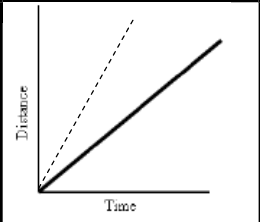
What does this graph represent?
Constant Speed
Acceleration
Not moving


Sam runs a 50 meter dash in 25 seconds. What is his speed?
2 m/s2
25 m/s
2 m/s
25 s/m
What are the two axis labels for an acceleration graph?
speed and time
time and distance
left and right
speed and distance
Motion is defined as...
being in one place and then being in another.
skipping happily.
a change in position using a reference point.
a physics term only physicists need to know.
The best definition for speed is
how fast something moves
how zippy my dog runs
rate of change in position
Lightning McQueen
Speed that does not vary is called
boring
instantaneous speed
variable speed
constant speed
What is the equation for calculating speed?
V = distance / speed
V = distance / time
Speed = time / distance
Speed = distance / acceleration
When creating a graph of speed, what variable will be on the Y axis?
Time
Distance
Velocity
Acceleration
When creating an acceleration graph, what will be the variable on the Y axis?
Distance
Speed
Acceleration
Time
An object travels 100 km in 12 seconds. What is its speed?
8.3 m/s
1200 km
8.3 km/s
1200 km/s

What does this graph tell you about the speed of the object?
It is increasing over time.
It is decreasing over time.
It is constant.
The object has stopped.
Jerome is riding his bike and sees a stop sign ahead. He slows down and then stops. Which graph below shows this?


What is the speed of a jet plane that travels 528 meters in 4 seconds?
2112 m/s
132 m/s
Really fast.
0.024 m/s
A football field is 100 m long. A person takes about 20 seconds to walk its length. What speed was the person walking?
200 m/s
2000 m/s
5 m/s
50 m/s
Velocity describes both ...
speed and time
time and distance
distance and acceleration
speed and direction
Acceleration is happening when which of the following occur?
An increase in speed
A decrease in speed
A change in direction
All of the above
When graphing acceleration, what variable is on the X axis?
time
speed
distance
velocity
When a car slows down at a traffic light, it is...
accelerating
honking its horn
changing direction
traveling at constant velocity
A swimmer swims 20 m in 40 s. What is the swimmer's speed?
0.25 m/s
2 m/s
800 m/s
0.5 m/s
A car goes from 20 mph to 80 mph in 0.5 hours. What is the car's acceleration?
30 miles/hour2
-120 miles/hour2
120 miles/hour2
45 miles / hour2
T or F? Assume there are two lines on a distance-time graph. The line with the steeper slope means greater speed.
T
F

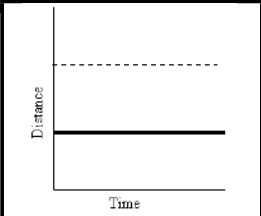
How would you describe the speed of this object?
Constant
None - it's stopped
Hard to say without more data
Which runner started out the slowest?
Albert
Bob
Charlie
Which runner started out the fastest?
Albert
Bob
Charlie
What happened during A to B point?
not moving
increasing speed at a constant rate
moving at a constant speed
moving at 0 m/s2 acceleration
What happened during D to E point?
not moving
increasing speed at a constant rate
moving at a constant speed
moving at 0 m/s2 acceleration
What was the acceleration of the car between points B-C?
3.33 m/s
3.33 m/s^(2)
-3.33 m/s
-3.33 m/s^(2)
What was the acceleration of the car between points D-E?
1 m/s
1 m/s^(2)
-1 m/s
-1 m/s^(2)
What does it mean if the value for acceleration is a negative number?
Object speed increased
Object speed decreased
Object speed didn't change
What does it mean if the value for acceleration is a positive number?
Object speed increased
Object speed decreased
Object speed didn't change
What does the A stand for in the formula for acceleration
Acceleration
Initial Velocity
Final Velocity
Time
What does the t stand for in the formula for acceleration
Acceleration
Initial Velocity
Final Velocity
Time
What does the Vf stand for in the formula for acceleration
Acceleration
Initial Velocity
Final Velocity
Time
What does the Vi stand for in the formula for acceleration
Acceleration
Initial Velocity
Final Velocity
Time
How far would you run at a speed of 1.5 m/s if you run for 10 min (600s )?
15 m
900 m
15 m/s
900 m/s
What is the velocity of a eastbound train that travels 350 km in 1.75 hours?
612.5 km/hr
612.5 km/hr West
200 km East
200 km/hr East
What is the displacement of an airplane with a velocity of 200 km/hr West after 5 hours?
40 km West
1,000 km West
40 km East
1,000 km East
What is the average speed of a car that travels 500 m in 100 seconds?
5 m/s South
50,000 m/s
5 m/s
0.2 m/s
How long would it take for you to run 400 m dash if your speed was 20 m/s?
8,000 s
20 s
0.05 s
20 min
Which of the following is a scaler?
Distance
Displacement
Velocity
Acceleration
Which one is a vector?
Distance
Speed
Position
Acceleration
A quantity that has magnitude and direction.
Displacement
Position
Scaler
Vector
The total length of the route traveled by an object.
Motion
Reference Point
Distance
Displacement
A quantity that has magnitude (size) only.
Displacement
Position
Scaler
Vector
An object change in position relative to a reference point.
Motion
Reference Point
Distance
Displacement
The location of an object compared to a reference point
Displacement
Position
Scaler
Vector
An unmoving place or object used for comparison to determine an objects motion.
Motion
Reference Point
Distance
Displacement
The distance and direction of an objects change in position from the starting point.
Displacement
Position
Scaler
Vector
Jack ran 100 m
Scaler
Vector
My Ferrari does 200 mph; I no longer can drive due to losing my license.
Scaler
Vector
I turned right and walked 20 yards
Scaler
Vector
After the run, Ms Kelly was 5 miles west of the school.
Scaler
Vector
If you run 5 laps around the school track (400 meters). How far will you run?
2000 m
80 m
0.0125 m
20,000 m
If you run 5 laps around the school track (400 meters). What will your displacement be?
2000 m
80 m
0 m
20,000 m
The distance and object travels per unit of time.
Constant Speed
Average Speed
Speed
Velocity
The total distance travelled divided by the total time it takes to travel that distance.
Constant Speed
Average Speed
Speed
Velocity
The speed of an object at any one moment in time.
Constant Speed
Average Speed
Speed
Instantaneous Speed
The speed and direction of an objects travel.
Constant Speed
Velocity
Slope of a line
Instantaneous Speed
Rise over run
Constant Speed
Velocity
Slope of a line
Instantaneous Speed
Speed that stays the same and does not change.
Constant Speed
Velocity
Average Speed
Instantaneous Speed

