
NEW
Font size
S
M
L
XL
 Worksheets
GEO In Class M (5/3)
Total questions: 36
Worksheet time: 3hrs 0mins
Name
Class
Date
1.
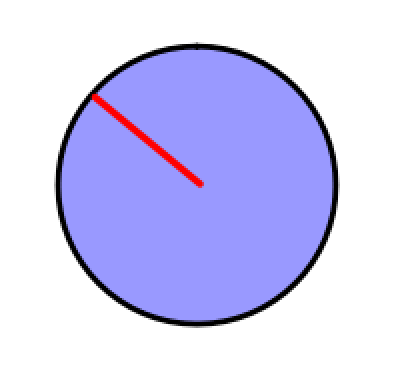
Is the red line a radius or diameter of the circle?
a)
Radius
b)
Diameter
2.
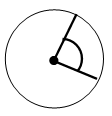
This is a picture of ___________.
a)
Major Arc
b)
Minor Arc
c)
Central Angle
d)
Inscribed Angle
3.
The _____________ of a circle is two times the radius.
a)
chord
b)
diameter
c)
circumference
4.

What do we call the red line?
a)
Chord
b)
Arc
c)
Diameter
d)
Segment
5.

What is C?
a)
diameter
b)
center
c)
circumference
d)
radius
6.

What type of angle is shown?
a)
Acute Angle
b)
Obtuse Angle
c)
Right Angle
d)
Straight Angle
7.

Classify the triangle by its angles.
a)
Acute Triangle
b)
Obtuse Triangle
c)
Right Triangle
d)
Equilateral Triangle
8.

What is the value of x?
a)
40o
b)
65o
c)
180o
d)
55o
9.

If ∢3 is 35o, what is ∢4?
a)
35o
b)
51o
c)
45o
d)
23o
10.

Classify the pair of angles.
a)
Complementary Angles
b)
Supplementary Angles
c)
Vertical Angles
d)
Obtuse Angles
11.

Classify the triangle by its angles and sides.
a)
Obtuse Right Triangle
b)
Acute Scalene Triangle
c)
Acute Isosceles Triangle
d)
Obtuse Scalene Triangle
12.

Find the value of x.
a)
180o
b)
126o
c)
42o
d)
90o
13.

Classify the pair of angles.
a)
Complementary Angles
b)
Supplementary Angles
c)
Neither
14.

What is the area of the triangle?
a)
252 cm2
b)
120 cm2
c)
240 cm2
d)
126 cm2
15.

What is the area of the shape?
a)
35 units2
b)
70 units2
c)
56 units2
d)
28 units2
16.

Classify the triangle by its angles.
a)
Right Triangle
b)
Obtuse Triangle
c)
Acute Triangle
d)
Equilateral Triangle
17.

Find the area of the circle.
a)
314 m2
b)
1256 m2
c)
62.8 m2
d)
23.1 m2
18.
Find the area of the circle.
a)
314 m2
b)
1256 m2
c)
62.8 m2
d)
23.1 m2
19.

Find the volume of the prism.
a)
120 in3
b)
60 in3
c)
15 in3
d)
130 in3
20.

Find the volume of figure.
a)
180 cm3
b)
90 cm3
c)
160 cm3
d)
80 cm3
21.

What is the volume of the pyramid?
a)
336 in3
b)
112 in3
c)
56 in3
22.
What is a line?
a)
A straight line
b)
A straight, continuos, infinite collection of points
c)
chocolate chips
d)
A dot
23.
What is a ray?
a)
The shared end point of the sides of an angle
b)
A tool used to measure an angle
c)
Part of a line with an endpoint
d)
The shared end point of the sides of an angle
24.
What is an obtuse angle?
a)
Angles whose measures add up to 180º
b)
Angles that measures add up to 90º
c)
Angle with a measure between 90º and 180º
d)
Is the "if" part of the conditional statement
25.
What is a line segment?
a)
A geometric figure
b)
Part of a line with two endpoint
c)
A shared end point of the sides of a angle
d)
Two angles that are opposite of each other
26.
What is a vertex?
a)
Angle with a measure between 90º and 180º
b)
A statement that can be accepted without proof
c)
A statement that can be proven and that can also be used in later proof
d)
The shared end point of the sides of an angle
27.
What is a midpoint?
a)
IDEK
b)
A thing
c)
The middle point of an angle
d)
help
28.
What is a theorem?
a)
A statement that can be accepted without proof
b)
A statement that can be proven and that can also be used in later proof
c)
all of the above
d)
other
29.
What is perpendicular's meaning?
a)
not sure
b)
Two angles that intersect and form a right angle
c)
An upside down T
d)
Life
30.
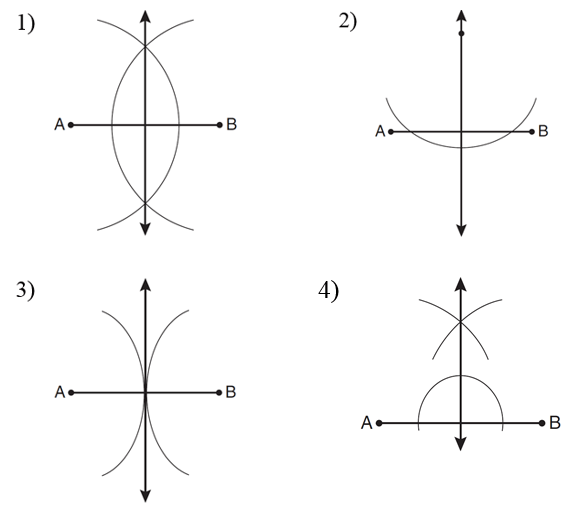
Which one is the correct construction for a perpendicular bisector?
a)
1
b)
2
c)
3
d)
4
31.

Select the best answer choice.
a)
A
b)
B
c)
C
d)
D
32.
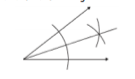
Which of the following constructions is illustrated?
a)
An angle is congruent to a given angle
b)
The bisector of a given angle
c)
The bisector of a given segment
d)
The perpendicular bisector of a given segment.
33.

The picture represents a compass and straightedge construction of _________?
a)
Copy an angle
b)
Bisect an angle
c)
Copy a line segment
d)
Bisect a line segment
34.

Given: B is the midpoint of AC. What should you conclude?
a)
AB + BC = AC
b)
AB = BC
c)
A is the segment bisector of BC
d)
ABC is a straight angle
35.

Given: OR ⊥ QP. What should you conclude by definition of perpendicular?
a)
<ORP is a right angle
b)
QR + RP = QP
c)
<ORQ and <ORP are complementary
d)
<QRP = 180 °
36.

Given: <1 and <3 are vertical angles. What should you conclude by the vertical angles theorem?
a)
<1 and <2 are a linear pair
b)
<1 and <3 are right angles
c)
<2 and <4 are vertical angles
d)
<1≅<3
Reset

