
 Worksheets
Reaction Rates and Energy diagrams
Total questions: 31
Worksheet time: 38mins
Why does a higher concentration increase the rate of reaction?
it increases the amount of reactants
it lowers the activation energy
it increases the energy of particle collisions
it increases the frequency of particle collisions
Why does a higher temperature increase the rate of a reaction?
it increases both the frequency and energy of particle collisions
it only increases the frequency of particle collisions
it only increases the energy of particle collisions
it reduces the activation energy of the reaction
Grinding a effervescent tablet into powder increases the rate of reaction due to increased
concentration
surface area
temperature
reactants
Increasing the temperature gives particles more __________.
Time
Energy
Space
Frequency
As the frequency of ______________ increases, the rate of reaction increases.
Time
Reactions
Collisions
Reactants
Adding a catalyst ___________ the activation energy.
Raises
Lowers
Doesn't affect
The minimum amount of energy needed for colliding particles to react is called
Chemical Energy
Kinetic Energy
Activation Energy
Potential Energy
Substance that changes the rate of a chemical reaction without being consumed in the reaction
bonding
catalyst
chemical reaction
activation energy
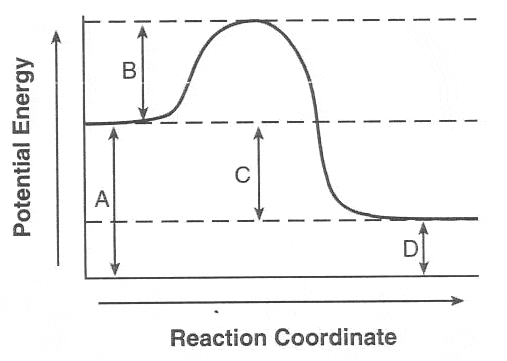
In an exothermic reaction, the heat/energy is on the __ side of the chemical equation.
reactant
product
In a chemical reaction, if the reactants are heated, the reaction usually happens
Faster
Slower
At the same rate

What letter represents the energy of the products?
A
B
C
D
E

What letter represents ΔH?
A
B
C
D
E

The following graph shows two different reaction pathways for the same overall reaction at the same temperature. Which pathway is the result of adding a catalyst and why?
Red, because the activation energy is larger
Blue, because the activation energy is lower
neither one represents the pathway of a catalyst
In an endothermic reaction, heat is
absorbed
released
Crushing a solid chunk,exposing more particles for collisions is an increase in
concentration
surface area
temperature
catalyst
This slows down or even stops a chemical reaction by poisoning the catalyst.
de-activator
terminator
enzyme
inhibitor
Why don't all collisions between particles cause a reaction?
(Choose all that apply)
not all particles collide with a catalyst
not all the particles collide with enough energy
not all collisions are in the correct orientation
not all particles collide with each other twice
Which four factors that affects the rate of a reaction?
temperature
concentration
surface area
volume
catalysts
What is the rate of reaction?
How fast reactants are becoming products.
How high the temperature gets
How loud a reaction is
How fast the reactants are being mixed

What is the name given to a catalyst in the human body?
Biology
Catalyst
Chemical
Enzyme
True or False: If the reactant particles collide with less energy than the activation energy, the particles will be rebound, and no reaction will occur.
True
False
More collisions correspond to a:
Faster reaction rate
Slower reaction rate
Constant reaction rate
Increasing the temperature gives particles more __________.
time
energy
space
frequency

What type of reaction does this diagram represent?
exothermic
endothermic
True or False: Increasing the pressure on a reaction involving gases, increases the reaction rate because it causes a greater collision frequency.
True
False
What letter represents the transition state?
A
B
C
D
E
What letter represents the reactants?
A
B
C
D
E

