Wayground logo

Free Printable Worksheets

Font size

S
M
L
XL
Worksheets

Newton's Laws and Forces

Total questions: 26

Worksheet time: 2hrs 48mins

Name
Class
Date
1.

A lamp sitting on a table is demonstrating Newton's ___ Law.

a)

1st

b)

2nd

c)

3rd

d)

4th

2.

Newton's 3rd Law states that for ever action there is an equal and opposite ________.

a)

reaction

b)

satisfaction

c)

fraction

d)

transaction

3.

A ______ is a push or pull on an object.

a)

force

b)

speed

c)

acceleration

d)

velocity

4.

Newton's 2nd Law says the acceleration of an object depends on its _______ and ______. (Choose two answers)

a)

force or applied force

b)

weight

c)

gravity

d)

mass

5.

if an object stays still or continues moving at the same speed and in the same direction, it is a _______ force.

a)

weak

b)

strong

c)

balanced

d)

unbalanced

6.

Net force is a combination of all ________ acting on an object.

a)

forces

b)

speeds

c)

accelerations

d)

velocities

7.

Sitting at the top of a steep hill on a roller coaster (not moving), is an example of:

a)

Acceleration

b)

Inertia

c)

Speed

d)

Velocity

8.
A magician pulls a tablecloth out from under dishes and glasses on a table without disturbing them.
a)
Newton's 1st Law
b)
Newton's 2nd Law
c)
Newton's 3rd Law
d)
None of them
9.
A picture is hanging on a wall and does not move.
a)
Newton's 1st Law
b)
Newton's 2nd Law
c)
Newton's 3rd Law
d)
None of them
10.
Pushing a child on a swing is easier than pushing an adult on the same swing, because the adult has more inertia.
a)
Newton's 1st Law
b)
Newton's 2nd Law
c)
Newton's 3rd Law
d)
None of them
11.
This law is often called "the law of inertia."
a)
Newton's 1st Law
b)
Newton's 2nd Law
c)
Newton's 3rd Law
d)
None of them
12.
A soccer ball accelerates more than a bowling ball when thrown with the same force.
a)
Newton's 1st Law
b)
Newton's 2nd Law
c)
Newton's 3rd Law
d)
None of them
13.
A student leaves a pencil on a desk and the pencil stays in the same spot until another student picks it up.
a)
Newton's 1st Law
b)
Newton's 2nd Law
c)
Newton's 3rd Law
d)
None of them
14.
For every action there is an equal and opposite reaction.
a)
Newton's 1st Law
b)
Newton's 2nd Law
c)
Newton's 3rd Law
d)
None of them
15.

Henry sees a basketball and decides to put in motion. What kind of force does Henry use to move the ball?

a)

small

b)

balanced

c)

equal

d)

unbalanced

16.
Force = Mass x Acceleration
a)
Newton's 1st Law
b)
Newton's 2nd Law
c)
Newton's 3rd Law
d)
Newton's 4th Law
17.
The tendency of an object to resist changes in its motion is...
a)
inertia
b)
force
c)
acceleration
d)
velocity
18.
The combination of all the forces acting on an object is the...
a)
net force
b)
action force
c)
reaction force
d)
balance force
19.

When an unbalanced force acts on an object, the force ______________________.

a)

changes the motion of the object

b)

is cancelled by another force

c)

does not change the motion of an object

d)

is equal to the weight of the object

20.

What is the acceleration of a 50 kg object pushed with a force of 500 newtons?

a)

100 m/s2

b)

25,000 m/s2

c)

10 m/s2

d)

25 m/s2

21.

A cannonball with a mass of 0.5 kg is flying at an acceleration of 10 m/sec/sec. What is its force?

a)

50 Newtons

b)

5 Newtons

c)

20 Newtons

d)

9.5 Newtons

22.
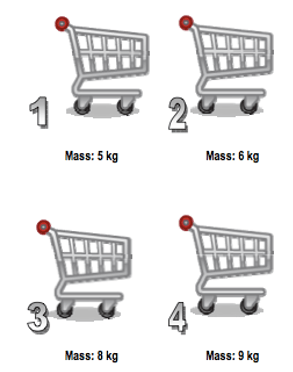
A force of 90N is applied to each cart below, which one will accelerate the fastest?
a)
Cart 1
b)
Cart 2
c)
Cart 3 
d)
Cart 4
23.
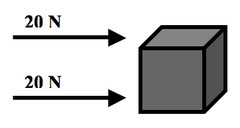
What is the net force for this situation?
a)
17 N Right
b)
17 N Left
c)
3 N Right
d)
3 N Left
24.

If the mass of the car/man/parachute is 150 kg, what is their acceleration?

a)

0.02 m/s2

b)

50 m/s2

c)

0.11 m/s2

d)

8.82 m/s2

25.
What is the net force?
a)
40 N left
b)
0 N Balalnced
c)
400 N right
d)
40 N right
26.

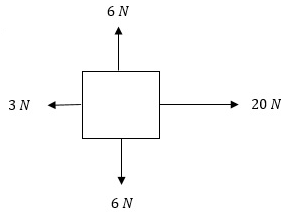
What is the NET FORCE of this diagram?

a)

17 N, right

b)

17 N, left

c)

23 N, right

d)

12 N, up